The Brain Implants market is poised for a new era of technological breakthroughs as healthcare organizations become increasingly focused on adopting neuromodulation treatments for neurological diseases. The growth in studies conducted on brain-computer interface (BCI), neurostimulators, and minimally-invasive implants is transforming the way treatments are provided to patients as well as opening up new business opportunities within the medical devices sector.
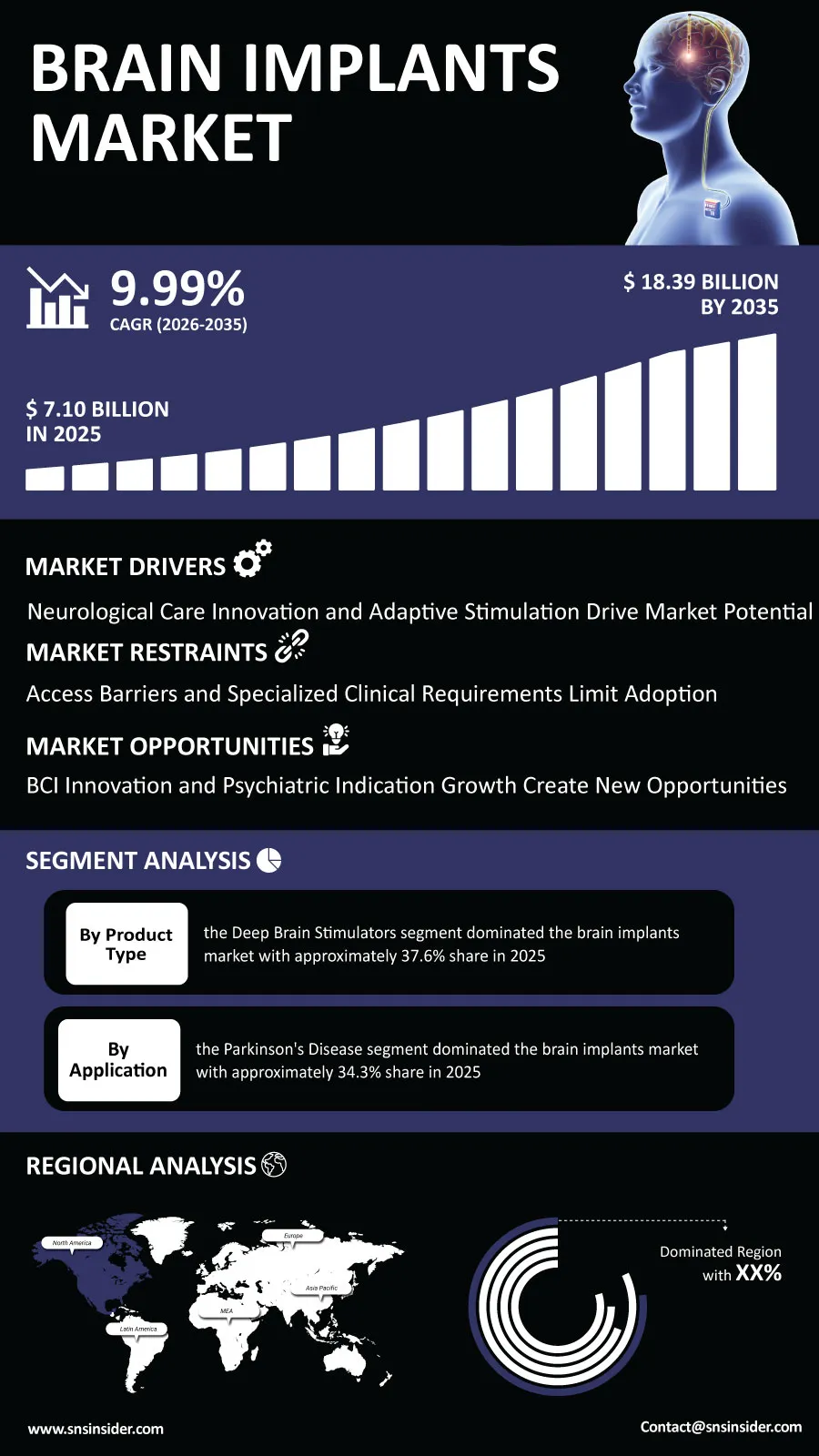
According to a recent study by SNS Insider, the global Brain Implants Market size valued at USD 7.10 billion in 2025, is anticipated to grow to USD 18.39 billion by 2035, registering a CAGR of 9.99% over the 2026–2035 forecast period. The market path follows increasing demand for implantable devices that have the ability to improve the outcome of patients in movement disorders, epilepsy, chronic neurological diseases, and neurorehabilitation.
Momentum within industry has been increased by the introduction of intelligent implant systems which feature real-time sensing capabilities, rechargeable power supplies, and wireless communication. The developments have enabled a more customized approach to treatment while minimizing the necessity for repeated surgery.
To Get Detailed Insights on the Brain Implants Market – Request a Sample Report
Next-Generation Neurotechnology Expands Clinical Possibilities
Brain implants have begun to be considered for more diverse uses apart from movement disorders. Current medical studies have extended the potential of implanted neurostimulation systems for use with cognitive disorders, psychiatric disorders, pain treatments, and brain-to-brain communication interfaces.
In addition, recent trends in the industry have emphasized the increasing interest in the development of BCI technology by firms in the sector. In January 2025, Neuralink unveiled the success of its brain computer interface implantation into a third human, boasting improved electrode capacity, higher data transfer efficiency, and increased battery life.
Product Innovation Supports Diverse Treatment Applications
Deep Brain Stimulators (DBS) was also seen to be the leading product segment in 2025, contributing to about 37.6% of global revenue. The extensive application of DBS devices in the treatment of different neurological conditions will drive their usage in various healthcare facilities.
On the other hand, Vagus Nerve Stimulators (VNS) are predicted to have the highest growth rate throughout the forecast period due to research in exploring new applications other than epilepsy.
Application wise, Parkinson's disease made up about 34.3% of market revenue in 2025 because of the extensive usage of implantable stimulation devices in the treatment of symptoms. Alzheimer's disease will emerge as the most promising application as there will be more research on its treatment through neuromodulation.
In terms of end-users, hospitals will contribute the most to market revenue while specialty neurological centers and clinics will grow the most because of the availability of neurosurgery.
Technology Enhances Treatment Precision
The current trend among manufacturers is to develop implant devices that are able to provide more customized and adaptive treatments. Platforms for closed-loop stimulation that are able to adjust treatment depending on the activity of neurons have been getting increasing interest among clinicians in need of more precise therapies.
Technologies allowing for rechargeability of implants, MRI compatibility of devices and minimally invasive surgery approaches add even more value to the market adoption of neurostimulation through improving convenience, durability of devices and eligibility.
These innovations are projected to lead to further investments in research programs to increase the use of implantable neurotechnology in treating many other neurological conditions.
North America Leads While Asia Pacific Accelerates
North America continued to be the dominant regional market in 2025 owing to well-established neuroscience infrastructure, favorable reimbursement policies, and investments in neurological research. The contribution from the United States to the North American revenues was estimated at about 87.4%. The U.S. Brain Implants Market was valued at approximately USD 3.16 billion in 2025 and forecast to increase to around USD 8.17 billion in 2035, with a CAGR of approximately 10.22%.
Asia Pacific is expected to witness the fastest growth among the regional markets till 2035 on account of growing healthcare infrastructure, rising incidence of neurological diseases, and increased usage of medical technology. China accounted for an approximate share of 44.8% of regional revenues in 2025.
In Europe, Germany contributed approximately 22.3% of regional revenue. In Latin America, Brazil contributed approximately 44.2% of the regional revenues. While Saudi Arabia accounted for approximately 31.2% of Middle East & Africa revenues.
Industry Participants Advance Innovation Through Research
The competition in the brain implants market remains stiffening since firms continue improving their research efforts and developing advanced neurostimulation systems. In 2024, Medtronic obtained FDA approval for its Percept RC rechargeable deep brain stimulation device equipped with brain sensing. Abbott, in turn, upgraded its Infinity DBS platform using BrainSense that will enable biomarker-based stimulation approach.
Leading companies operating in the global brain implants market include Medtronic plc, Abbott Laboratories, Boston Scientific Corporation, LivaNova plc, NeuroPace Inc., Nalu Medical Inc., Synchron Inc., Neuralink Corporation, BioElectronics Corporation, Renishaw plc, Aleva Neurotherapeutics SA, Saluda Medical Pty Ltd., Second Sight Medical Products Inc., Sensata Technologies, Soterix Medical Inc., Nexim Inc., Inivio AS, Battelle Memorial Institute, and Kernel Co.
An SNS Insider analyst Parry Kardani commented, "Brain implant technologies are advancing from established neuromodulation therapies toward intelligent, data-driven systems capable of supporting increasingly personalized neurological care. Continued progress in implant design, sensing capabilities, and brain-computer interface research is expected to create meaningful opportunities for healthcare providers, technology developers, and patients over the coming decade.
About the Author

Get in touch