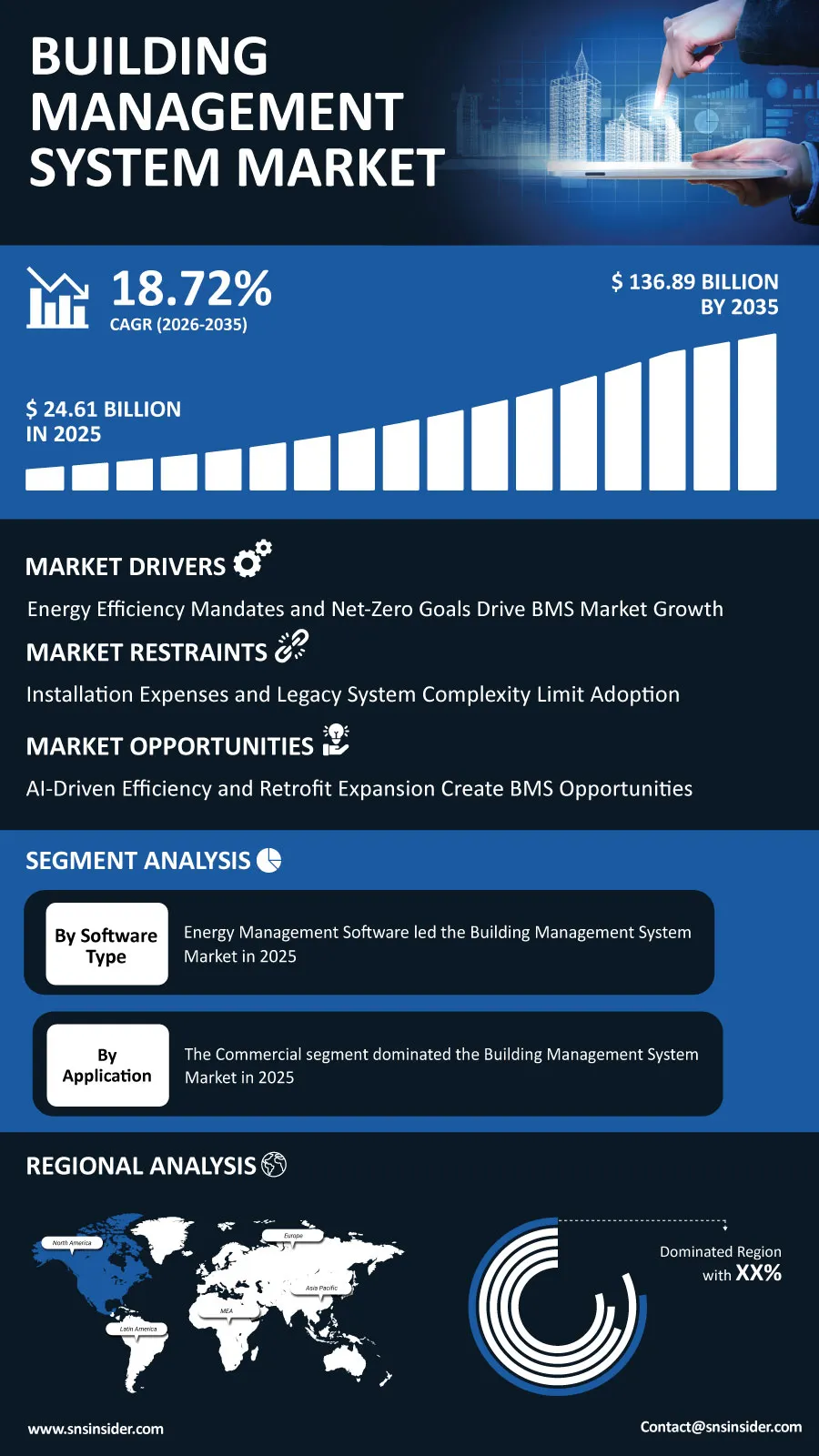
The global Building Management System Market is entering a new phase of intelligent infrastructure development as organizations modernize commercial, industrial, and residential buildings with connected technologies. “According to a recent study by SNS Insider, the global Building Management System Market size valued at USD 24.61 billion in 2025, is anticipated to grow to USD 136.89 billion by 2035, registering a CAGR of 18.72% over the 2026–2035 forecast period.”
Property owners globally are leveraging an integrated management system to enhance their business efficiency and lower energy usage and maintenance expenditure. As the digital revolution continues into the physical world from IT enterprise systems, today's buildings are intelligent ecosystems that can monitor equipment performance, optimize resource usage, and enhance the experience of the occupants using the facility through data-driven decisions.
With the increasing focus on sustainability, decarbonization, and resilience, the adoption rate of these management systems has been picking up pace in office buildings, hospitals, educational institutions, airports, manufacturing plants, and mixed-used developments. The addition of technologies, such as artificial intelligence, cloud computing, and sensors makes them essential components of smart building strategies.
To Get Detailed Insights on the Building Management System Market – Request a Sample Report
Smart Infrastructure Investments Create Significant Long-Term Growth Opportunities
The government, real estate developers, and enterprise facility managers have continued to value intelligent infrastructures that can enable sustainable operations and efficiencies in the longer term. The growing amount of investment in green buildings, renovation of buildings, and smart cities is opening up immense opportunities for the implementation of building management technology solutions around the world.
Technology advancements have enabled the facilities team to move away from reactive maintenance to predictive asset management. The constant monitoring of building assets helps in identifying anomalies and improving the lifecycle of costly building infrastructure such as HVAC system, lighting systems, elevators, fire systems, and access control systems.
The increasing number of interconnected energy assets, including renewable energy generation plants, battery energy storage systems, and electric vehicle charging infrastructure is also contributing to an increase in the use of building management technology platforms.
Key Market Insights Highlight Shifting Demand Patterns
Based on service type, Professional Services accounted for the largest share of global revenue in 2025, supported by increasing demand for consulting, system integration, deployment, and commissioning across complex building environments. Managed Services are projected to register the fastest growth through 2035 as organizations increasingly outsource monitoring, optimization, cybersecurity, and predictive maintenance functions.
By software type, Energy Management Software remained the leading segment during 2025 due to rising emphasis on reducing operational costs and improving energy efficiency across commercial properties. Security Management Software is expected to witness the highest growth rate as organizations strengthen integrated surveillance, access control, and intelligent security capabilities.
In terms of application, the Commercial segment generated the largest market share in 2025 owing to widespread implementation across office buildings, healthcare facilities, hotels, educational campuses, airports, and retail complexes. The Residential segment is anticipated to expand at the fastest pace during the forecast period as connected home technologies continue gaining mainstream adoption.
Artificial Intelligence and Connected Technologies Accelerate Industry Evolution
It is clear that artificial intelligence, machine learning and analytics have already become a crucial element of the building management business since these systems help improve the overall intelligence in the operation of modern facilities. Intelligent automation allows achieving ongoing optimization in heating, cooling, lighting, ventilation and occupancy control, as well as avoiding unnecessary energy waste.
As cloud-based systems make the management of several buildings in various regions more feasible, at the same time, virtual analysis of operational scenarios becomes possible due to digital twin technology. It allows facility managers testing scenarios in a virtual environment prior to applying them in physical infrastructures.
Cybersecurity has increasingly become a priority when it comes to investments due to large volumes of data being generated by the operation of the connected buildings. Technology companies are enhancing their security for platforms, remote monitoring, and devices that would ensure resilient building operations.
Asia Pacific Expected to Record Strong Market Expansion; North America Maintains Technology Leadership
Asia Pacific will be among the most vibrant markets over the forecast period due to rapid urbanization, increased commercial construction, creation of smart cities, and more investments in sustainable infrastructure development. Countries such as China, India, Japan, and South Korea will also accelerate the deployment of intelligent building solutions as their governments drive the trend towards energy-efficient development.
North America will continue showing robust growth due to extensive modernization of commercial buildings and use of intelligent solutions in data centers, healthcare institutions, universities, and corporate offices. Increased investments in energy efficiency projects, advanced digital infrastructure, and facility management systems are expected to bolster regional demand in the future.
Strict environmental standards and decarbonization strategies pursued by European countries are likely to continue driving modernization projects in the region. On the other hand, the Middle East and Latin American regions will continue seeing rising adoption of the technology as large commercial projects start incorporating intelligent solutions.
Industry Participants Focus on Intelligent Building Innovation
Competition within the global Building Management System Market continues to intensify due to technology firms investing heavily in cloud-based technologies, artificial intelligence, cybersecurity, digital twins, and automation technology. Firms have been launching new software features that help property owners enhance efficiency, minimize energy usage, and build sustainability performances.
Key companies operating in the global Building Management System Market include Honeywell International Inc., Johnson Controls International plc, Siemens AG, Schneider Electric SE, ABB Ltd., Robert Bosch GmbH, Emerson Electric Co., Carrier Global, Ingersoll Rand plc, Delta Controls Inc., Legrand SA, Distech Controls Inc., Trane Technologies plc, Azbil Corporation, Lutron Electronics Co. Inc., GridPoint Inc., BuildingIQ Pty. Ltd., Crestron Electronics Inc., KMC Controls Inc., and Acuity Brands Inc.
An SNS Insider analyst Sakshi Kale commented, "The convergence of artificial intelligence, cloud connectivity, and sustainability initiatives is redefining how buildings are designed and operated. Organizations investing in intelligent building ecosystems that improve operational efficiency, occupant comfort, and long-term energy performance are expected to capture significant value as digital infrastructure adoption accelerates worldwide."
About the Author

Get in touch