
Monoclonal Antibodies Market Report Scope & Overview:
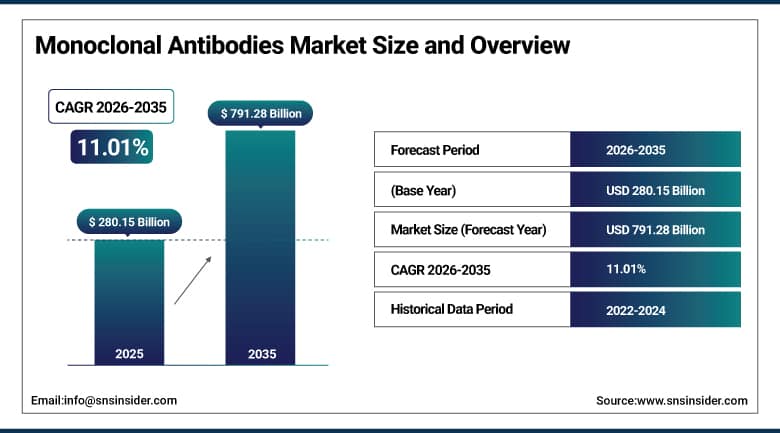
Monoclonal Antibodies Market was valued at USD 280.15 billion in 2025 and is expected to reach USD 791.28 billion by 2035, growing at a CAGR of 11.01% from 2026-2035.
The Monoclonal Antibodies Market is witnessing strong growth owing to growing use of targeted therapies in cancers, autoimmune disorders, and other chronic diseases. Monoclonal antibodies have high specificity and can specifically target disease-specific antigens, resulting in better treatment results. Increasing incidences of cancers and autoimmune disorders are expected to drive the growth in demand for antibody therapies. Moreover, developments in antibody technologies, humanized and human antibodies, antibody drug conjugates, and bispecific antibodies are likely to contribute towards the expansion of the therapeutic pipeline. Other factors that may help drive market growth include investments in R&D of biologics and approval of novel antibody therapies.
WHO/IARC estimated 20 million new cancer cases and 9.7 million cancer deaths globally in 2022, creating substantial demand for targeted oncology therapies.
To Get More Information On Monoclonal Antibodies Market - Request Free Sample Report
Monoclonal Antibodies Market Trends
-
Rising prevalence of cancer, autoimmune, and chronic diseases is driving demand for monoclonal antibodies offering targeted and effective therapeutic treatment options.
-
Increasing adoption of personalized medicine is encouraging development of monoclonal antibodies designed to target specific disease biomarkers and molecular pathways.
-
Growing use of bispecific antibodies and antibody-drug conjugates is expanding therapeutic applications and improving treatment efficacy across oncology and immunology.
-
Advancements in antibody engineering, protein design, and conjugation technologies are enhancing specificity, stability, safety, and clinical performance of monoclonal antibodies.
The U.S. Monoclonal Antibodies Market Outlook
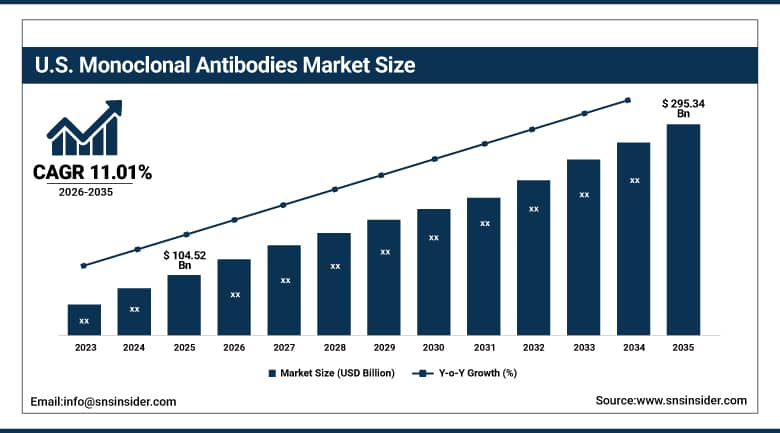
U.S. Monoclonal Antibodies Market was valued at USD 104.52 billion in 2025 and is expected to reach USD 295.34 billion by 2035, growing at a CAGR of 11.01% from 2026-2035.
The U.S. Monoclonal Antibodies Market is witnessing strong growth In light of rising incidence of cancer, autoimmune disorders, and other chronic diseases, there is increasing demand for biologics that target these ailments. Antibody drugs are highly specific in nature and are widely used for the treatment of various ailments, especially those of oncology and immunology. With advancements in areas such as antibody engineering, bispecific antibodies, drug conjugates, and personalized medicine, there has been expansion of clinical applications. Moreover, significant research and development activities, investment in development of biologics, and strong presence of clinical trial ecosystem have also contributed to growth of the market.
A large U.S. electronic-health-record study estimated that more than 15 million Americans (4.6% of the population) had at least one diagnosed autoimmune disease, supporting demand for biologic and antibody-based treatments.
Monoclonal Antibodies Market Segment Analysis
-
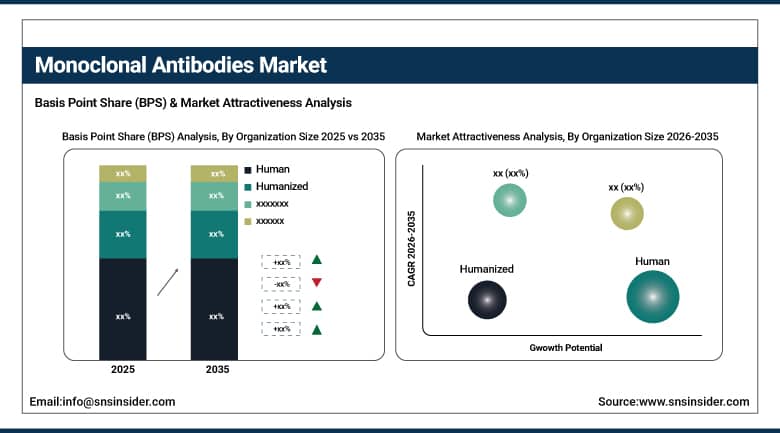
By Organization Size, Human dominates the Monoclonal Antibodies Market with 59% share in 2025; Humanized is expected to grow at the fastest CAGR of 12.07% from 2026–2035.
-
By Production, In Vitro dominates the Monoclonal Antibodies Market with 65% share in 2025; In Vitro is expected to grow at the fastest CAGR of 11.20% from 2026–2035.
-
By Application, Oncology dominates the Monoclonal Antibodies Market with 49% share in 2025; Autoimmune Diseases are expected to grow at the fastest CAGR of 12.58% from 2026–2035.
-
By End Use, Hospitals dominate the Monoclonal Antibodies Market with 60% share in 2025; Specialty Centers are expected to grow at the fastest CAGR of 12.29% from 2026–2035.
By Organization Size, Human dominates the Monoclonal Antibodies Market, while Humanized grows fastest.
Human dominated the Monoclonal Antibodies Market with the highest revenue share of about 59% in 2025, Primarily because of their favorable safety and tolerance profiles, lower immunogenicity, and efficacy, monoclonal antibodies have been used extensively in the treatment of various types of cancer, autoimmune diseases, and inflammatory conditions. The availability of well-established development and regulatory mechanisms makes monoclonal antibodies more popular among clinicians. There is growing preference for fully humanized antibodies.
Humanized is expected to grow at the fastest CAGR of 12.07% from 2026-2035, This is because of their potential to lower their immunogenicity without compromising their target specificity and efficacy. Their increasing use in cancer treatment and autoimmune diseases, coupled with progress in the field of antibody engineering, contributes to their growth in demand. The efforts being made in the pharmaceutical industry for next-generation antibody therapies add to the trend.
By Production, In Vitro dominates and grows fastest in the Monoclonal Antibodies Market.
In Vitro dominated the Monoclonal Antibodies Market with the highest revenue share of about 65% in 2025, with the aid of the controlled environment during manufacture, scalability, consistency, and better quality control. In vitro approaches are efficient in producing antibodies without much reliance on living systems and complicated manufacture procedures. There is an increasing need for therapeutic antibodies, research purposes, and efficient production that supports their market adoption.
In Vitro is expected to grow at the fastest CAGR of 11.20% from 2026-2035, motivated by the rising need for scale and control in the production of monoclonal antibodies. Advances in cell culture technology, recombinant DNA technology, and bioprocessing have improved productivity and reliability. The increase in pharmaceutical research, widening pipeline of biologics, and investments in efficient manufacturing platforms are contributing to the encouragement of in vitro manufacturing techniques.
By Application, Oncology dominates the Monoclonal Antibodies Market, while Autoimmune Diseases grows fastest.
Oncology dominated the Monoclonal Antibodies Market with the highest revenue share of about 49% in 2025, mainly because of the extensive usage of monoclonal antibodies in cancer treatment drugs. The capability of the antibody to target specific molecules related to cancer, increase specificity, and facilitate combined treatments makes them popular. The increased rate of cancer cases and development of antibody-based cancer drugs increases the demand for the market.
Autoimmune Diseases are expected to grow at the fastest CAGR of 12.58% from 2026-2035, Driven by increased prevalence of diseases such as rheumatoid arthritis, psoriasis, inflammatory bowel diseases, among others, monoclonal antibodies have been increasingly used. Monoclonal antibodies have provided targeted immunity modification as well as better therapeutic results. There has also been an increase in awareness and development of biologics.
By End Use, Hospitals dominate the Monoclonal Antibodies Market, while Specialty Centers grow fastest.
Hospitals dominated the Monoclonal Antibodies Market with the highest revenue share of about 60% in 2025, due to their state-of-the-art treatment facilities, dedicated cancer and immunology clinics, as well as trained medical staff. Hospitals have a large number of patients who require biologic drugs and infusions. Diagnostic, monitoring, and emergency treatment options available make hospitals an even more attractive environment for monoclonal antibodies administration.
Specialty Centers are expected to grow at the fastest CAGR of 12.29% from 2026-2035, This growth is being spurred by increased demand for specific and targeted biologic therapies. They offer expertise in oncology, autoimmune, and inflammatory conditions to allow personalized therapy and effective management of patients. Increasing need for outpatient therapy, specific infusion services, improved diagnostics, and inclination towards disease-specific treatment centers are other factors facilitating their growth.
Regional Analysis
|
Region |
Major Country |
Share within Region, 2025 (%) |
|---|---|---|
|
North America |
United States |
91.0% |
|
Europe |
Germany |
31.0% |
|
Asia Pacific |
China |
18.0% |
|
Middle East & Africa |
UAE |
18.0% |
|
Latin America |
Brazil |
40.0% |
North America Monoclonal Antibodies Market Insights
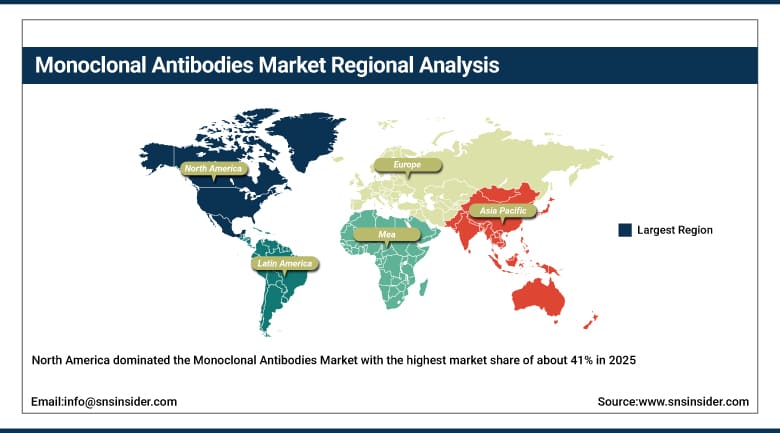
North America dominated the Monoclonal Antibodies Market with the highest market share of about 41% in 2025, Fuelled by a state-of-the-art healthcare system, robust biologics research and development activities, and extensive use of monoclonal antibodies. The presence of major drug companies, higher healthcare spending, extensive clinical trials, and the increasing burden of chronic conditions reinforce this demand and regional market leadership.
The U.S. Monoclonal Antibodies Market accounted for a market share of 91.0%, backed up by the state-of-the-art healthcare infrastructure, strong presence of the pharmaceutical and biotechnology industry, and robust investment in the research and development of biologics. The increasing use of targeted drug therapies, heavy healthcare spending, and strong clinical trial expertise are contributing to the usage of monoclonal antibodies.
Get Customized Report as Per Your Business Requirement - Enquiry Now
Europe Monoclonal Antibodies Market Insights
Europe’s monoclonal antibodies market is supported by advanced healthcare infrastructure, strong biopharmaceutical research capabilities, and widespread adoption of targeted therapies. Existing regulatory framework via the European Medicines Agency, good reimbursement structures, and the rising demand for therapies in oncology, autoimmune, and inflammatory disorders will aid market growth. The rising use of biosimilars and the ongoing investment in antibody production and precision medicines will add to market growth.
The Germany Monoclonal Antibodies Market accounted for a market share of 31.0%, Due to the presence of a powerful pharmaceutical and biotech industry, an advanced healthcare system, and R&D facilities, Germany continues to expand. The use of targeted biological medicines is driving the growth of the market, specifically the treatment of cancer and autoimmune disorders. Due to all these aspects, Germany is positioned strongly in Europe.
Asia Pacific Monoclonal Antibodies Market Insights
Asia Pacific is expected to grow at the fastest CAGR of about 12.32% from 2026–2035, Facilitated by improvements in healthcare facilities, increased prevalence of chronic disorders, and increased use of biological products. Increased pharmaceutical and biotechnology investment, increased accessibility to modern treatment procedures, government healthcare programs, increased clinical research, and increased biosimilar development in China, India, Japan, and South Korea are also boosting the market growth in the region.
The China Monoclonal Antibodies Market accounted for a market share of 18.0%, backed up by growth in biopharmaceutical production capacities, rising expenditures on health care, and the uptake of biologics. An increase in cancer cases, along with the availability of more effective treatment options, is boosting the demand for monoclonal antibodies. Government initiatives to promote innovations in biotechnology, rising clinical trials, and development of biosimilars also help.
Middle East & Africa and Latin America Monoclonal Antibodies Market Insights
The Middle East & Africa and Latin America monoclonal antibodies markets are Driven by the development of health infrastructure, growing prevalence of chronic diseases, and the availability of modern biologics drugs. Investments, growth in specialized facilities, government efforts, and partnerships with international pharma firms are increasing treatment accessibility. In Latin America, increased demand for treatments in oncology and immunology, especially in Brazil, is aiding the adoption of mAbs.
The UAE Monoclonal Antibodies Market accounted for a market share of 18.0%, These developments are being driven by better healthcare infrastructure, increased investment in medical technology, and availability of new biologic drugs. The need for specific treatment options, especially in oncology and autoimmune disorders, is helping drive adoption. Healthcare programs initiated by the government, international pharmaceutical collaboration, and modernization in the healthcare sector have played important roles in the growth of this market in the UAE.
Market Dynamics
Growth Drivers: Increasing prevalence of cancer and chronic diseases is accelerating demand for targeted monoclonal antibody therapies globally
The rising prevalence of cancer, autoimmune disorders, inflammatory diseases, and other chronic conditions is significantly driving demand for monoclonal antibody therapies. mAbs may be used to specifically attack antigens or pathways involved in a particular disease, thereby allowing the provision of a more accurate approach to treatment. Oncotherapy continues to be an important field of application, but the rise in the use of monoclonal antibodies in the treatment of autoimmune, neurologic, cardiovascular, and infectious diseases has increased the population of patients who may benefit from the drugs. In 2025, nine out of the total number of newly-approved drugs were mAbs. This will continue to drive growth in the monoclonal antibodies market.
Restraints: High development and manufacturing costs can limit accessibility and widespread adoption of monoclonal antibody therapies
High development and manufacturing costs remain a major restraint for the Monoclonal Antibodies Market. mAbs are complex biological entities that need advanced cell culture technology, bioreactors, purification steps, and analytical testing. Large-scale manufacture might involve heavy financial investment into specialized facilities and competent personnel. Biologic drug manufacturing is more complex than that of many traditional small molecules, which makes additional development and validation necessary. Expensive treatment becomes the source of problems with affordability and payment for therapy, especially in LMICs. Economic factors of pharmaceutical innovation recently identified by researchers include expensive treatment as one of the obstacles to treatment access.
Opportunities: Expansion of antibody applications across oncology autoimmune and neurological diseases creates significant opportunities for monoclonal antibody developers globally
Expanding therapeutic applications are creating substantial opportunities for monoclonal antibody developers. Further identification of targets specific to various diseases will allow the use of mAbs to progress from being used in oncological indications to autoimmune diseases, neurodegenerative diseases, heart diseases, infectious diseases, and orphan diseases. This can be seen from recent approvals involving mAbs for the treatment of Alzheimer's disease and other non-oncological indications. Opportunities may also be enhanced through target specificity, long-acting mAbs, combinations, and mAbs used for difficult to treat indications.
Recent Developments:
-
2026 : Genmab A/S advanced its antibody portfolio through continued development of bispecific and next-generation antibody candidates, including programs leveraging its DuoBody and HexaBody platforms.
-
2026 : Johnson & Johnson continued expanding its monoclonal antibody portfolio through further development and commercialization of antibody-based therapies including DARZALEX, RYBREVANT, TECVAYLI, and TALVEY, supported by its collaboration with Genmab.
-
2026 : AbbVie continued advancing its antibody pipeline, including EPKINLY (epcoritamab), a CD3xCD20 bispecific antibody developed in collaboration with Genmab for B-cell malignancies.
-
2025 : Genmab continued expanding its monoclonal and bispecific antibody development pipeline, with multiple proprietary and partnered antibody candidates progressing through clinical development and its antibody technology platforms supporting programs with global pharmaceutical companies.
Monoclonal Antibodies Market key players are:
-
F. Hoffmann-La Roche Ltd.
-
Johnson & Johnson
-
AbbVie Inc.
-
Amgen Inc.
-
Merck & Co., Inc.
-
Bristol Myers Squibb Company
-
Novartis AG
-
Pfizer Inc.
-
Eli Lilly and Company
-
AstraZeneca plc
-
GSK plc
-
Sanofi S.A.
-
Regeneron Pharmaceuticals, Inc.
-
Biogen Inc.
-
Daiichi Sankyo Company, Limited
-
Takeda Pharmaceutical Company Limited
-
UCB S.A.
-
Genmab A/S
-
Gilead Sciences, Inc.
-
Astellas Pharma Inc.
Monoclonal Antibodies Market Report Scope:
| Report Attributes | Details |
|---|---|
| Market Size in 2025 | USD 280.15 Billion |
| Market Size by 2035 | USD 791.28 Billion |
| CAGR | CAGR of 11.01% From 2026 to 2035 |
| Base Year | 2025 |
| Forecast Period | 2026-2035 |
| Historical Data | 2022-2024 |
| Report Scope & Coverage | Market Size, Segments Analysis, Competitive Landscape, Regional Analysis, DROC & SWOT Analysis, Forecast Outlook |
| Key Segments | • By Source (Murine, Chimeric, Humanized, Human) • By Production (In Vivo, In Vitro) • By Application (Oncology, Autoimmune Diseases, Infectious Diseases, Neurological Diseases, Others) • By End Use (Hospitals, Specialty Centers, Research Institutes, Others) |
| Regional Analysis/Coverage | North America (US, Canada), Europe (Germany, UK, France, Italy, Spain, Russia, Poland, Rest of Europe), Asia Pacific (China, India, Japan, South Korea, Australia, ASEAN Countries, Rest of Asia Pacific), Middle East & Africa (UAE, Saudi Arabia, Qatar, South Africa, Rest of Middle East & Africa), Latin America (Brazil, Argentina, Mexico, Colombia, Rest of Latin America). |
| Company Profiles | F. Hoffmann-La Roche Ltd., Johnson & Johnson, AbbVie Inc., Amgen Inc., Merck & Co., Inc., Bristol Myers Squibb Company, Novartis AG, Pfizer Inc., Eli Lilly and Company, AstraZeneca plc, GSK plc, Sanofi S.A., Regeneron Pharmaceuticals, Inc., Biogen Inc., Daiichi Sankyo Company, Limited, Takeda Pharmaceutical Company Limited, UCB S.A., Genmab A/S, Gilead Sciences, Inc., and Astellas Pharma Inc. |

Frequently Asked Questions
Key players in the Monoclonal Antibodies Market include F. Hoffmann-La Roche Ltd., Johnson & Johnson, AbbVie Inc., Amgen Inc., and Merck & Co., Inc., among others.
The key opportunities in the Monoclonal Antibodies Market include expansion of targeted therapies, increasing development of antibody-drug conjugates, and growing demand for personalized medicine and advanced biologic treatments.
The market is driven by increasing prevalence of chronic diseases, rising demand for targeted therapies, along with growing investments in biologics and personalized medicine.
The Human segment dominated the Monoclonal Antibodies Market, accounting for approximately 59.00% market share.
The North America region dominated the Monoclonal Antibodies Market in 2025 with a 41.00% share, driven by high firearm sales and strong defense procurement.
