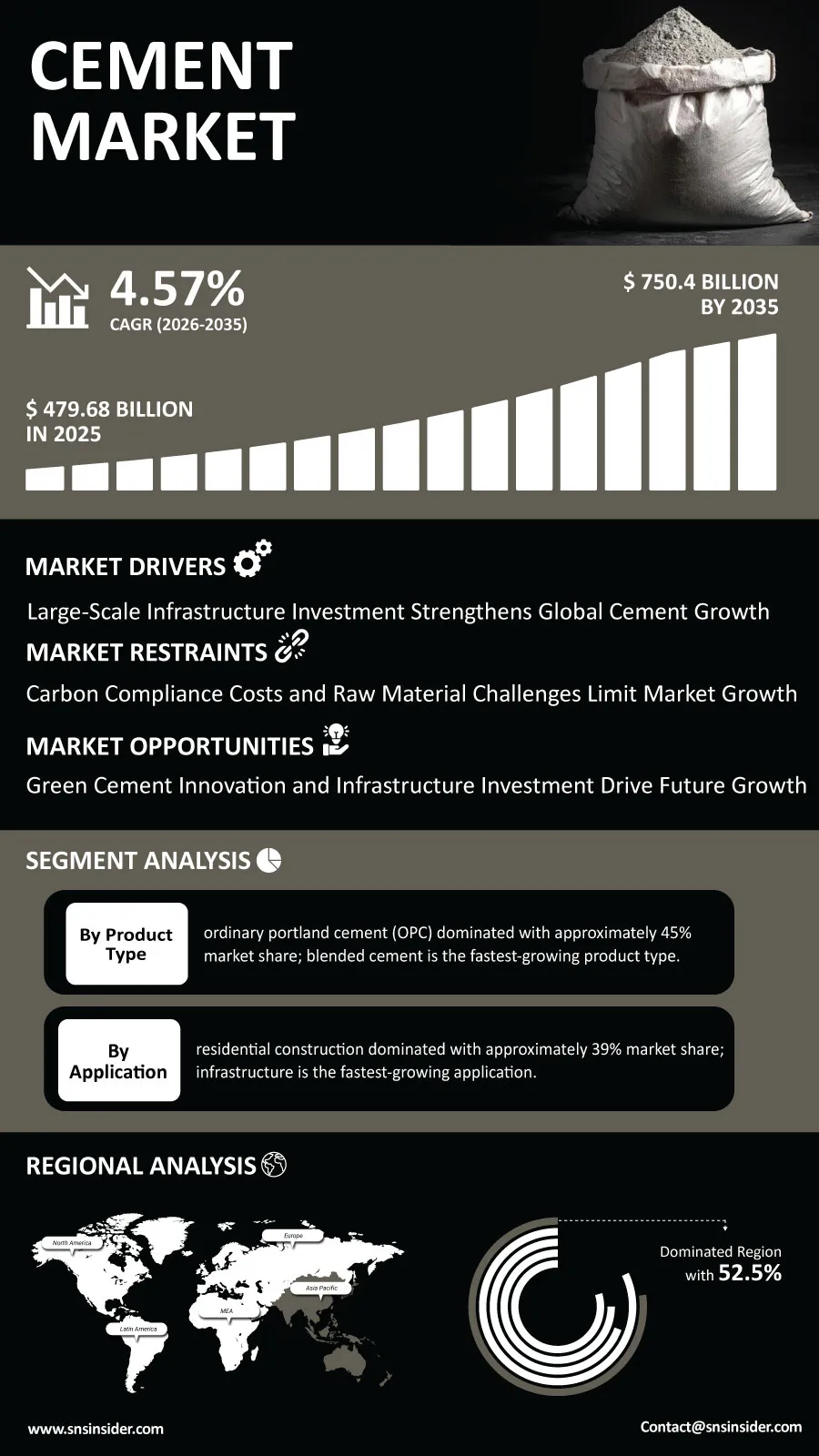
The world’s cement market is set for consistent growth in the coming years, given that governments, private sector developers, and industry investors will keep increasing their investments in transportation, construction, and energy sectors. “According to a recent study by SNS Insider, the global Cement Market size valued at USD 479.68 Billion in 2025, is anticipated to grow to USD 750.4 Billion by 2035, registering a CAGR of 4.57% over the 2026–2035 forecast period.”
Growing construction trends within the developing countries, along with modernization projects within the developed countries, have been leading to an increasing demand for cement in construction of homes, roads, railways, ports, airports, and industries. Along with this, producers of cement have been focusing on sustainability in their manufacturing processes by adopting energy-efficient techniques and alternate sources of raw material.
To Get Detailed Insights on the Cement Market – Request a Sample Report
Sustainable Construction and Infrastructure Investment Create Long-Term Growth Opportunities
Public expenditure on infrastructure continues to be one of the key growth drivers for the cement sector. Widespread investments in roads, highways, bridge systems, metro systems, renewable energy facilities & utilities, water management projects and affordable housing continue to support stable cement demand from mature and developing economies. Growing urban populations are also pushing governments to fast track residential construction projects and city development schemes.
The shift towards environmentally friendly production practices across the industry is also opening up more opportunities for innovation. More cement producers are selling blended cements that incorporate supplementary cementitious materials in order to reduce the consumption of clinker and thus the carbon emissions. The growing adoption of alternative fuels, carbon capture technologies, and digital plant automation is enabling manufacturers to achieve better operational efficiency in meeting the demands of tighter environmental regulations.
Key Market Insights Highlight Evolving Product Demand
Based on product type, Ordinary Portland Cement (OPC) captured around 45% revenue share in global market in 2025 owing to established applications in residential, commercial and industrial construction projects. During the forecast period, Blended Cement is expected to register the highest growth due to governments, contractors and developers focusing on using lower-carbon construction materials and adopting more sustainable building practices.
By application, the key for primitive analysis showed that Residential Construction accounted for nearly 39% of total market demand in 2025. In the forecast period, Infrastructure segment is estimated to be the largest and fastest-growing function since nations extend their transportation, energy, water and public utility networks that rely on high-volume concrete applications.
We also provide industry-specific market forecast and final report will generally be in the form of revenue by each segment (or end user, product types, products for custom reports) with base year that usually par no to be customary 12% among competitive players. Government Projects are expected to be the fastest-growing end-user segment, as public investment programs place higher importance on sustainable infrastructure modernization and economic development.
Advanced Manufacturing Technologies Transform Cement Production
To improve their productivity with less pollution, cement manufacturers-cement makers are being redefined by technological innovation. These include process control systems usage that are adaptive; predictive maintenance; digital platforms for monitoring processes and proactive quality management programs in to minimize operational costs and maximize production efficiency.
Investments in calcined clay technology, alternative fuel systems based on biomass and industrial waste as well as upstream carbon capture solutions at production sites are also gaining ground among manufacturers. This progress is allowing the industry to reduce emissions while still producing high-performance cement products for changing construction needs and advancing global green building standards.
Asia Pacific Continues to Lead Global Cement Demand
Asia Pacific continued to be the largest and fastest-growing regional market in 2025, aided by large-scale infrastructure investment, rapid urbanization and ongoing residential construction activity across China, India and Southeast Asia. Government will continue to invest in transportation corridors, industrial development and affordable housing programs to continue its solid per capita leadership position in global cement consumption.
The report showed that North America continues to enjoy substantial infrastructure modernization through public investment programs, while Europe embraces sustainable cement technologies under more aggressive climate policies. At the same time, Latin America, along with the Middle East and Africa are seeing higher cement demand as yields improve in part as urban populations grow, industrial fundamentals also diversify alongside infrastructure omnibuses which underpin longer-term regional growth prospects.
Industry Participants Accelerate Innovation and Low-Carbon Manufacturing
The competitive trend in the global cement industry is becoming more about sustainability, efficiency, and innovation. Some of the top producers of this commodity are making investments in cement products with low carbon footprints, alternative materials, digital manufacturing, and increasing capacity to enhance their competitiveness.
Key companies operating in the global Cement Market include Holcim Ltd., Heidelberg Materials AG, CEMEX S.A.B. de C.V., CRH plc, Buzzi S.p.A., UltraTech Cement Ltd., China National Building Material Group Corporation (CNBM), Anhui Conch Cement Company Ltd., Votorantim Cimentos, InterCement Participacoes S.A., The Siam Cement Group (SCG), Taiwan Cement Corporation, Titan Cement International S.A., Martin Marietta Materials Inc., Eagle Materials Inc., Summit Materials Inc., Shree Cement Ltd., Dalmia Bharat Ltd., ACC Ltd., and Taiheiyo Cement Corporation.
An SNS Insider analyst Himanshu Sharma commented, "The global cement industry is entering a new phase where infrastructure expansion and sustainability initiatives are advancing simultaneously. Companies investing in low-carbon cement technologies, digital manufacturing capabilities, and energy-efficient production processes will be well positioned to capitalize on rising construction demand while meeting increasingly rigorous environmental expectations throughout the coming decade."
About the Author

Get in touch