
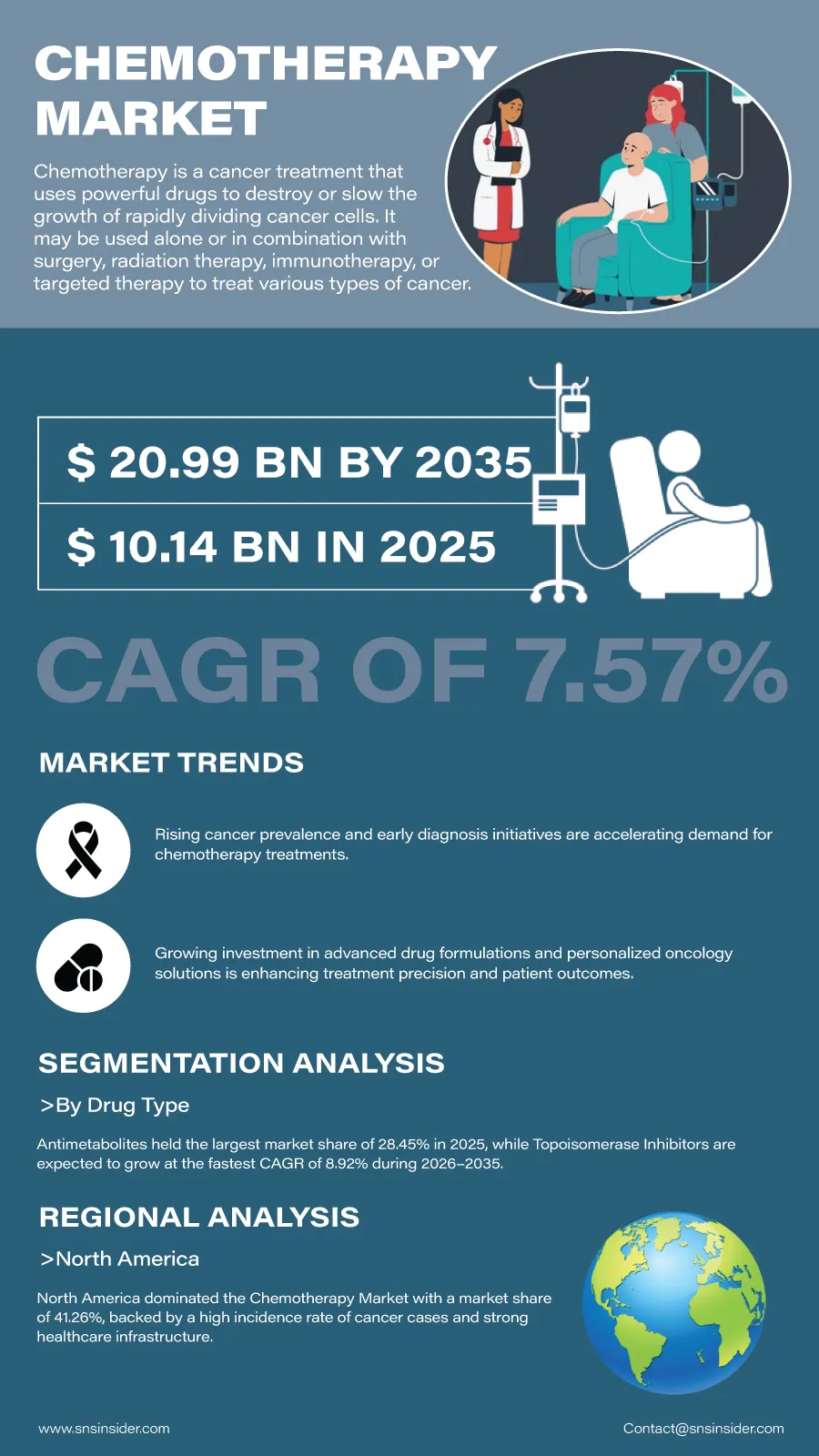
The global Chemotherapy Market is projected to witness substantial growth over the next decade as healthcare providers continue expanding access to comprehensive cancer treatment while pharmaceutical companies accelerate innovation across oncology therapeutics. “According to a recent study by SNS Insider, the global Chemotherapy Market size valued at USD 10.14 billion in 2025, is anticipated to grow to USD 20.99 billion by 2035, registering a CAGR of 7.57% over the 2026–2035 forecast period.”
The rising incidence of cancer globally, the expansion of oncological facilities, and advancements in therapeutic options have created an environment that is conducive to market growth. Many healthcare facilities globally are allocating funds towards implementing a comprehensive program for treating cancers using both traditional chemotherapy treatments and new methods involving precision medicine.
Despite developments in cancer treatment, chemotherapy still plays an important role within multi-disciplinary approaches for treating cancers using surgery, radiotherapy, immunotherapy, and target medicines. Advances made in oncology research have continued to improve treatment choices and clinical decisions.
Innovation in Oncology Care Continues to Drive Market Evolution
There are changes taking place in the oncology setting as there is an adoption of a more personalized way of providing treatment among healthcare professionals. There have been developments in the area of better pharmaceuticals and treatment plans that have been developed with the aim of ensuring the best possible results.
There have been developments in the field of supportive care, infusions, and digital oncology which are assisting doctors and other health practitioners in treatment planning and monitoring the patients effectively.
Growing collaboration among pharmaceutical companies, healthcare institutions, and research organizations continues to accelerate the development of next-generation oncology solutions that address evolving patient needs.
Key Market Findings Highlight Emerging Opportunities
In terms of drugs, the market share generated by antimetabolites was 28.45% in 2025 due to their extensive application in cancer treatment methods.
Topoisomerase inhibitors have been forecasted to demonstrate the highest growth rate throughout 2035, growing at a CAGR of 8.92%, fueled by continuous development in precision oncology and combination therapy techniques.
The largest share of intravenous chemotherapy in the market (61.37% of market revenue in 2025) reflects its wide acceptance as the best route of administration in hospitals and oncological clinics. Nevertheless, the market segment of oral chemotherapy is forecasted to grow at the fastest pace at a CAGR of 9.14%.
Regarding cancer types, lung cancer accounted for 24.18% of market revenue in 2025, emphasizing the importance of chemotherapy in the treatment of lung cancer. Blood cancer treatments are forecasted to demonstrate the fastest growth at a CAGR of 8.76% during 2035 as a result of the constant development in the field of hematologic cancers.
From the perspective of end users, hospitals and clinics dominated the market with 52.63% of market revenue in 2025. In turn, home care will experience the fastest growth at a CAGR of 9.38%.
Patient-Centered Cancer Care Expands Treatment Accessibility
The healthcare industry is witnessing the adoption of models that enhance the convenience and treatment continuum along with the overall experience of patients in the oncology cycle. The growing prevalence of ambulatory infusion centers, oncology at home treatments, and digital healthcare platforms is aiding in improving the access to cancer treatment.
Simultaneously, continued investment in the detection programs and multidisciplinary cancer care along with supportive care has improved the process of managing cancer comprehensively in both developed as well as developing healthcare markets.
Regional Markets Continue to Strengthen Growth Prospects
In North America, the share in terms of global market revenue is estimated to be 41.26%, aided by the presence of sophisticated oncology infrastructure, clinical research capabilities, reimbursement systems, and availability of advanced cancer therapies. Investments in precision oncology and cancer facilities are further solidifying the dominance of the region.
On the other hand, the Asia Pacific region is likely to emerge as the fastest growing regional market with a CAGR of 9.36% from 2025 to 2035. Healthcare advancements, increasing awareness about cancer, oncology therapy availability, and health care investments in nations, such as China and India will bring growth potential to market players.
Leading Companies Continue to Advance Oncology Innovation
The competitive environment is extremely dynamic due to the efforts of pharmaceutical firms in terms of investing in clinical research, innovation, partnerships, and commercialization strategies for the purpose of increasing the range of cancer treatments.
Firms that compete in the chemotherapy market around the world are F. Hoffmann-La Roche, Novartis, Pfizer, Merck & Co., Johnson & Johnson, Eli Lilly and Company, Sanofi, Bristol Myers Squibb, AstraZeneca, and Takeda Pharmaceutical Company.
An SNS Insider analyst Parry Kardani commented, "Advances in precision oncology, combination treatment strategies, and patient-focused care models are reshaping the future of cancer therapy. Continued innovation across chemotherapy and integrated oncology solutions is expected to create significant opportunities for healthcare providers and pharmaceutical companies over the coming decade."
About the Author

Get in touch




