
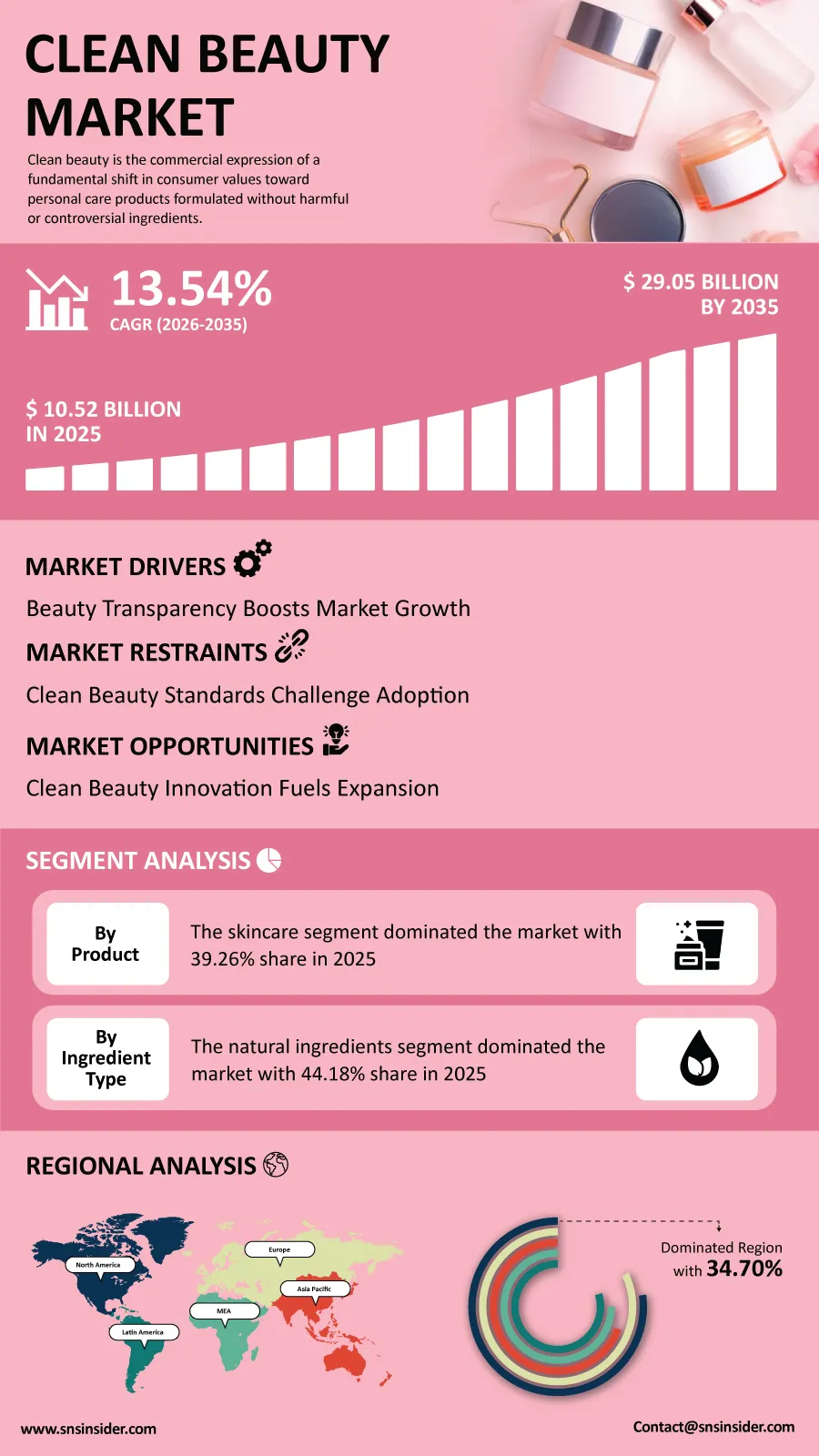
The clean beauty movement worldwide is gaining momentum, as more consumers prioritize ingredient transparency, ethical sourcing and environmentally friendly products. “According to a recent study by SNS Insider, the global Clean Beauty Market size valued at USD 10.52 Billion in 2025, is anticipated to grow to USD 29.05 Billion by 2035, registering a CAGR of 13.54% over the 2026–2035 forecast period.”
A growing choice for science-backed formulations free of controversial ingredients while being safe, sustainable and effective is driving demand for clean beauty products. Modern consumers are more educated on cosmetic labeling, thus will look for brands that aim for more transparency during production and throughout the product lifecycle.
In response to these trends, beauty manufacturers are reformulating existing portfolios, extending natural and organic ingredient offerings, and investing in cutting-edge biotechnology-based ingredients. In addition, digital retail channels, education through influencers and social commerce tools are also forcing awareness allowing upstart brands to compete with legacy multinational businesses.
To Get Detailed Insights on the Clean Beauty Market – Request a Sample Report
Sustainable Innovation Creates Long-Term Industry Opportunities
A shift towards more sustainable personal care is creating new business opportunities across beauty. To meet changing customer needs of a greener future and to improve brand loyalty, firms are also investing in refillable packaging, recyclable materials, and sustainable supply chains.
Similarly, ingredient development is being transformed at a fast pace in biotechnology. Precision fermentation and lab-made cosmetic actives have enabled manufacturers to create more consistent products while decreasing their reliance on 'unreliable, traditional' plant sourcing. These technologies provide better traceability, lower environmental footprints and increased flexibility in formulations;
Men's grooming is another space to watch. skincare, as awareness and demand from younger male consumers broaden internationally, brands are creating targeted clean beauty lines for men's grooming requirements to generate incremental revenue opportunities in premium via DTC channels but also at mass through expanding routes to market.
Key Market Insights Highlight Shifting Demand Patterns
As per product the skincare segment represented for 39.26% of worldwide market revenue in 2025, driven by expanding customer consideration towards everyday facial consideration products and ingredient aware purchasing choices. The haircare segment is expected to record fastest growth during the forecast period owing to rapidly increasing demand for sulfate-free, silicone-free and naturally formulated hair care products through 2035.
Constituent type Overview: In 2025, Natural constituents produced 44.18% of total sales due to consumer demand for plant based formulations across the board. While the organic ingredients segment is expected to be the fastest growing in terms of revenue during the forecast period, as certified organic beauty products are thriving.
By the distribution channel, specialty stores accounted for 41.84% of global revenue in 2025 as consumers continue to appreciate recommendations from experts and curated product collections. The online segment is estimated to register the highest growth over 2023-2035, attributed to growing e-commerce platforms, direct-to-consumer brands and social shopping experience.
Advanced Ingredient Technologies Strengthen Market Competitiveness
As always, innovation is at the heart of ongoing industry evolution as manufacturers launch multifunctional formulations that combine elements of skincare, wellness and cosmetic performance. The market is increasingly competitive, and brand differentiation is seen to be best achieved through research into biotechnological derived ingredients, microbiome-friendly formulations and naturally sourced active compounds.
AI is bringing quality of the product line such as its ability to screen ingredients faster, optimization of formulation, personal beauty recommendation etc. Coupled with the benefits of improved supply chain transparency and digital consumer connection, these advancements are expediting commercialization within global beauty markets.
North America Captured 34.70% Revenue Share in 2025; Asia Pacific to Register Highest CAGR by 2035
North America gained 34.70% share of global market revenue in the year 2025, with high consumer awareness and existence of established premium beauty brands along with broader acceptance of clean-label personal care products. The market leadership of the region is additionally underpinned by a strong retail network, growing adoption of cruelty-free formulations and ripening product innovation.
Asia Pacific is predicted to become the fastest-growing regional market until 2035, spurred by larger middle classes, rising disposable incomes, growing internet access and interest in ingredient transparency. China's, Korea's, Japan´s and India´s beauty consumers uptake all premium skin-care products while the mainstream nab their eco-friendly purchases.
Europe still accounts for the bulk of global demand, fueled by stringent legislation regarding cosmetics and strong organic certification regimes, as well as increasing consumer availability in some local markets. Meanwhile, Latin America and the Middle East continue to grow steadily through premium retail development, increasing beauty.
Industry Participants Focus on Product Transparency and Sustainable Growth
The competition continues to be fierce in the clean beauty spaces as manufacturers increase research into naturally derived ingredients, sustainable packaging technologies, and performance formulations. Although innovations in how a consumer interacts with the product, strategic retail partnerships and digital marketing initiatives are allowing brands to deepen consumer engagement while growing global distribution networks.
Key companies operating in the global Clean Beauty Market include L'Oréal SA, Unilever PLC, The Estée Lauder Companies Inc., Procter & Gamble Co., Shiseido Company Ltd., The Honest Company Inc., Ilia Beauty LLC, Beautycounter LLC, Beekman 1802, Credo Beauty, Drunk Elephant, Tata Harper Skincare, Versed Skin, Biossance, Tower 28 Beauty LLC, Kjaer Weis GmbH, Aether Beauty LLC, Follain Inc., Alima Pure Inc., and Cocokind LLC.
An SNS Insider analyst Himanshu Sharma commented, "Growing consumer demand for ingredient transparency, environmentally responsible formulations, and scientifically validated clean products is reshaping the global beauty industry. Companies investing in sustainable innovation, biotechnology-derived ingredients, and omnichannel retail strategies are expected to remain well positioned for long-term market expansion."
About the Author

Get in touch




