
Clinical Trial Equipment & Ancillary Solutions Market is gaining importance as drug makers handle ever more complicated research projects that take place in multiple countries, specialized treatments, and dispersed patient involvement. More people will need equipment services, temperature control logistics, ancillaries procurement, sample management, and digital monitoring services that help sponsors run research successfully.
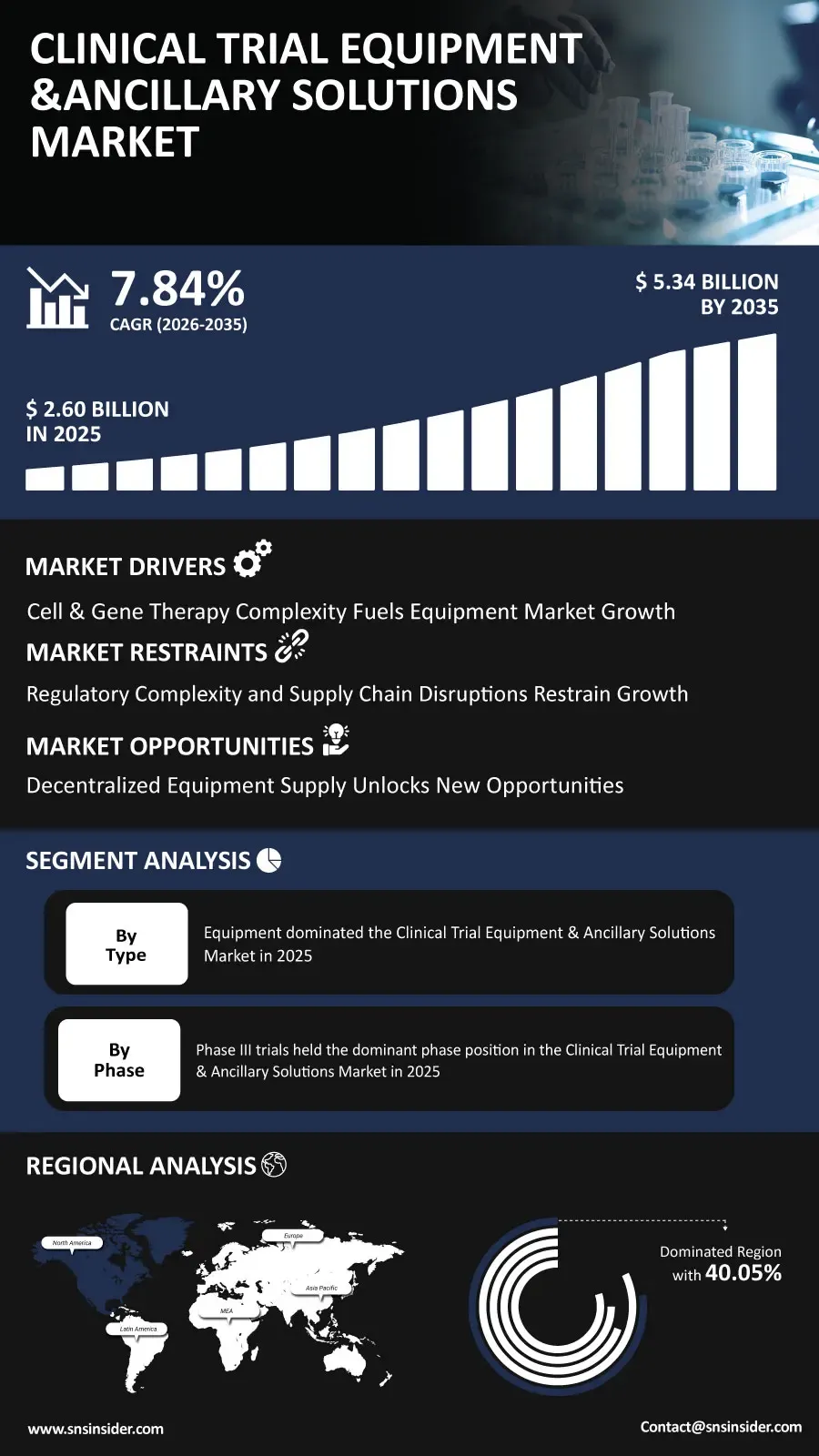
According to a recent study by SNS Insider, the global Clinical Trial Equipment & Ancillary Solutions Market size valued at USD 2.60 billion in 2025, is anticipated to grow to USD 5.34 billion by 2035, registering a CAGR of 7.84% over the 2026–2035 forecast period. The expansion reflects increasing clinical research activity alongside the growing operational requirements associated with precision medicine, biologics, cell and gene therapies, and decentralized clinical trials.
To Get Detailed Insights on the Clinical Trial Equipment & Ancillary Solutions Market – Request a Sample Report
Complex Research Programs Raise Demand for Specialized Infrastructure
Clinical research is becoming more equipment-oriented due to the need of the sponsors to assess treatments which call for specific storage conditions, specimen processing, patient monitoring and safe transportation. The complex trials may employ ultralow temperature freezers, centrifuges, infusion pumps, patient wearables, cryotanks and other equipment items defined by the protocol.
Another aspect of growing demands is related to the emergence of decentralized trials where not only equipment and supplies should be available at the investigative sites but sponsors also start requiring patient kits, home use equipment, specimen collection supplies and shipments directly to participants.
Equipment Leads While Outsourced Sourcing Gains Momentum
The equipment emerged as the dominant category in 2025, as research centers continued to need specialized equipment for testing samples, storing samples, diagnostics, administering treatments, and monitoring patients. The growing sophistication in clinical processes is prompting sponsors to seek providers who can procure, calibrate, manage, trace, and reclaim the equipment at different research sites.
Sourcing will be registering the fastest growth till 2035. There is growing interest among pharmaceutical firms and CROs in consolidating their sourcing operations with specialized providers. The use of one provider makes it easier for vendors to manage equipment, supplies, and other material needs during the study.
Phase III Holds the Largest Position as Early Research Accelerates
The highest proportion was achieved by Phase III trials in 2025 due to the fact that large pivotal trials normally include many sites, patients, and logistical challenges. In some cases, equipment will have to be dispatched to many different sites in order to carry out a late-phase multinational trial.
In contrast, Phase I trials are expected to increase at the fastest pace. The growth in early phase testing of new technologies, including cell-based therapies, gene therapy, precision drugs, and novel biologics increases the demand for specialized equipment from the early phase trials.
North America Maintains Leadership
North America captured 40.05% of the total revenue share in 2025 due to the presence of advanced clinical research facilities and the significant number of pharmaceutical and biotechnology companies. Around 90% of the North American revenue was contributed by the U.S.
The U.S. Clinical Trial Equipment & Ancillary Solutions Market size was estimated at USD 0.89 billion in 2025 and further expected to reach USD 1.76 billion by 2035 at a CAGR of 7.84%.
Asia Pacific region is seen as the fastest growing market due to an increasing research activity of pharmaceutical sponsors in China, India, and several other Asian countries. China held around 38% share of regional revenue. In Europe, UK held a share of 27%. In the Middle East and Africa region, Israel held 42% of the revenue share.
Digital Platforms and Advanced Therapies Reshape the Industry
Technology is now being used as an increasingly significant differentiator within the world of clinical supplies. Tracking through RFID and IoT technologies can give visibility into where equipment is located and its condition, while technology platforms can link information about inventory, calibrations, shipping information, and temperature.
There is also an increasing need for highly specific logistics because of advanced therapies. These types of therapy require specific cryogenic storage facilities and chain-of-custody documentation, thereby driving the need for a supplier that can provide dedicated cold chain capabilities.
Sustainability is another emerging consideration as pharmaceutical sponsors seek recyclable packaging, consolidated transportation, and more efficient cold-chain systems throughout clinical development programs.
Industry Participants Expand Global Capabilities
Recent industry activity reflects the market's shift toward specialized and technology-enabled services. Marken (UPS Healthcare) expanded its capabilities for cryogenic cell therapy logistics in 2026, while Almac Group strengthened its Asia Pacific clinical supply infrastructure with a Singapore facility in 2025. Thermo Fisher Scientific also advanced digital clinical supply management capabilities in 2025, highlighting the industry's movement toward centralized visibility and data-driven operations.
Key companies operating in the global Clinical Trial Equipment & Ancillary Solutions Market include Almac Group Ltd., Marken Ltd. (UPS Healthcare), World Courier Inc. (AmerisourceBergen), Fisher Clinical Services (Thermo Fisher Scientific), Myonex Inc. (Catalent), Yourway Transport Inc., Biocair Ltd., Woodley Equipment Company Ltd., Imperial CRS Inc., Emsere SAS, Quipment SAS, MNX Global Logistics, Parexel International Corporation, IQVIA Holdings Inc., Ancillare LP, IRM (International Resource Management), ClinSupplies Ltd., Eurofins CDMO, Catalent Inc. (Clinical Supply Services), and PCI Pharma Services.
An SNS Insider analyst Parry Kardani commented, “The clinical research supply chain is becoming increasingly specialized as advanced therapies and decentralized study models introduce new equipment, monitoring, and logistics requirements. Providers combining global infrastructure with digital visibility and specialized handling capabilities are positioned to benefit from the industry's continued evolution.
About the Author

Get in touch




