The Infusion Pump Market is experiencing a new era of innovation as healthcare organizations all around the world are stepping up their investments in the Internet-of-Things medical devices that can help with increasing drug administration accuracy and better patient outcomes. The growing trend of treatment at home, and the healthcare digitization trend, makes healthcare providers use smart infusion devices.
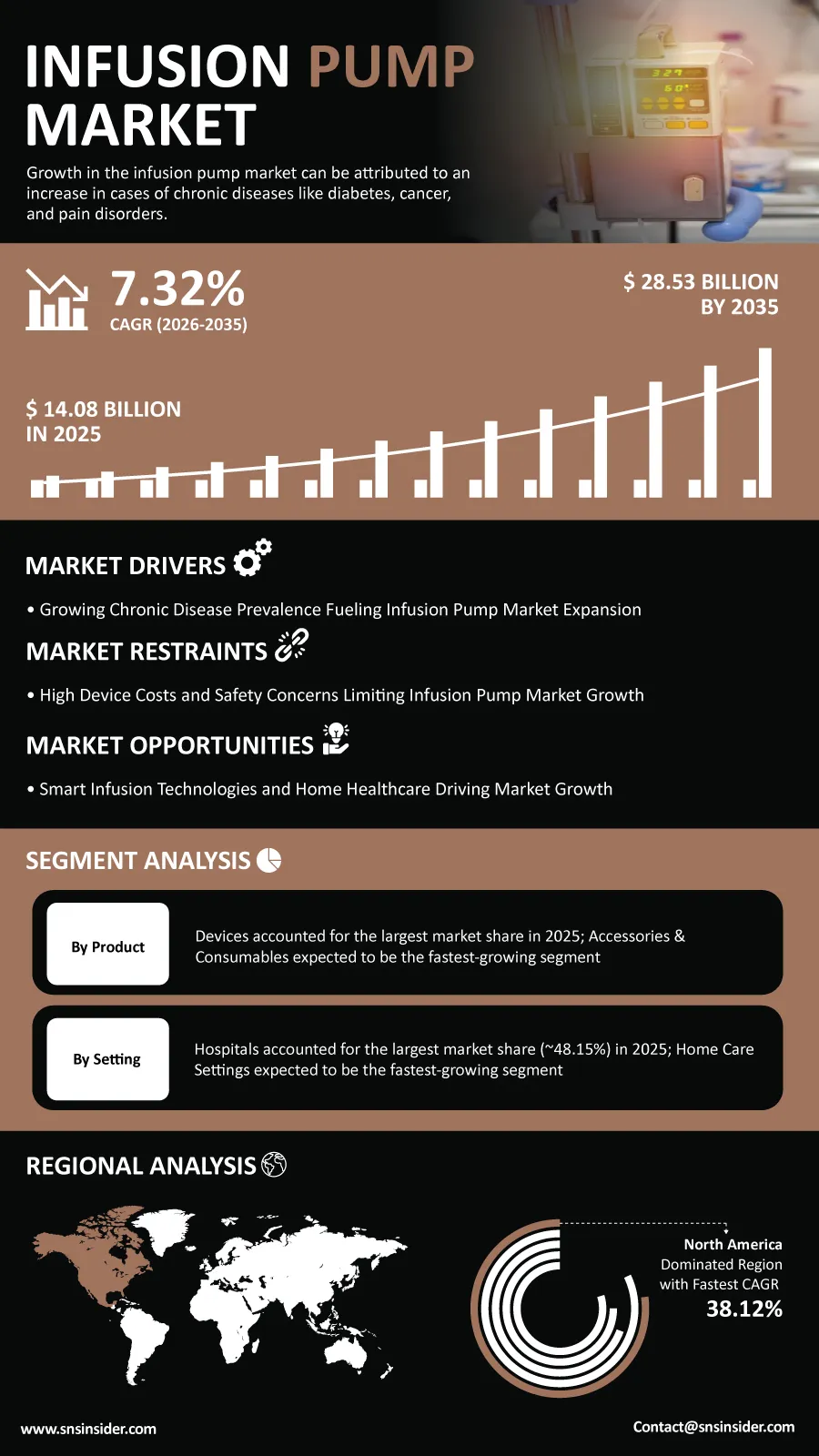
According to a recent study by SNS Insider, the global Infusion Pump Market size valued at USD 14.08 billion in 2025, is anticipated to grow to USD 28.53 billion by 2035, registering a CAGR of 7.32% over the 2026–2035 forecast period. Increasing prevalence of chronic diseases, expanding healthcare infrastructure, and continuous innovation in smart infusion systems are expected to sustain market growth throughout the next decade.
There is an ever-increasing emphasis being placed by healthcare providers on the delivery of medications with precision, minimizing errors and streamlining processes. This has led to the development of new infusion systems that are equipped with built-in safety features, connectivity, and remote monitoring capabilities enabled through software technology. The trend toward ambulatory and home-based healthcare delivery has spurred increased demand for portable infusion systems.
To Get Detailed Insights on the Infusion Pump Market – Request a Sample Report
Smart Medical Technologies Transform Infusion Therapy
The infusion therapy landscape is also continuously being influenced by digital healthcare technology as hospitals connect their infusion pumps to their electronic health record systems and monitoring systems. The use of artificial intelligence, predictive analytics, and automation is ensuring precise dosing as well as early detection of any possible delivery problems.
Apart from hospitals, portable and wearable devices are making it possible for people to get long-term treatments outside hospital environments. This trend helps health professionals looking for cost-efficient ways of treating diseases as well as providing better comfort for patients.
Market Segments Highlight Expanding Clinical Opportunities
Based on product, devices generated the largest market share in 2025 due to widespread deployment across hospitals, specialty clinics, and ambulatory care facilities. Meanwhile, accessories and consumables are projected to become the fastest-growing segment as recurring replacement requirements continue generating long-term revenue opportunities for manufacturers.
By healthcare setting, hospitals accounted for approximately 48.15% of market revenue during 2025, supported by extensive use in intensive care, oncology, surgical procedures, and critical care environments. Home care settings are expected to record the highest growth, expanding at a CAGR of 7.89% through 2035 as healthcare delivery increasingly shifts beyond traditional hospital environments.
By application, diabetes represented the leading market segment during 2025, reflecting continued adoption of insulin infusion technologies and connected diabetes management solutions. Chemotherapy/Oncology and Pain Management are forecast to experience strong future growth as demand rises for precise medication delivery in complex therapeutic applications.
Innovation and Digital Connectivity Strengthen Market Competition
Medical technologies firms are making substantial investments in intelligent infusion technologies that will enable greater treatment precision while at the same time simplifying operations. Connectivity, dose error reduction technologies, cloud monitoring, and connectivity to hospital information systems have become important product differentiation factors.
Wearable and ambulatory infusion technology is being introduced by manufacturers to enable patients to take their medications away from hospitals. With a view toward minimizing the costs involved in keeping patients hospitalized, the use of connected infusion technology is expected to rise steadily.
Regional Markets Continue Expanding Through Healthcare Modernization
North America continues to be the largest regional market in 2025, capturing around 38.12% share of total global revenues. Reimbursement policies, good healthcare facilities, and usage of connected devices continue making the region a leader. Within North America, the USA is contributing to about 74% of regional revenue. The USA Infusion Pump Market size is estimated to grow from USD 4.52 billion in 2025 to USD 7.95 billion by 2035, at a CAGR of 7.30%.
The fastest regional growth will be seen in Asia Pacific as investments in healthcare continue growing in China, India, Japan, and South Korea. China accounts for around 40% of regional revenues due to expanding hospital infrastructure and adopting advanced medical devices.
In Europe, Germany contributes to about 28% of regional revenue due to the investments made in digital healthcare and medical devices. In Latin America, Brazil contributes to about 44% of regional revenue, whereas UAE contributes to about 30% of Middle East & Africa revenue.
Leading Companies Accelerate Smart Healthcare Innovation
Competition across the infusion pump market continues to intensify as manufacturers expand connected product portfolios, strengthen digital capabilities, and introduce next-generation infusion technologies. Recent industry developments include Smiths Medical receiving FDA clearance during Q2 2025 for its CADD-Solis VIP Ambulatory Infusion Pump, supporting outpatient pain management and chemotherapy services. Earlier, in April 2024, Baxter International Inc. secured FDA 510(k) clearance for its Novum IQ Large Volume Infusion Pump integrated with Dose IQ Safety Software, reinforcing the industry's focus on intelligent medication delivery systems.
Major companies operating in the global infusion pump market include BD (Becton, Dickinson and Company), Baxter International Inc., Medtronic plc, Fresenius Kabi AG, ICU Medical, Inc., Smiths Medical, Terumo Corporation, Moog Inc., Nipro Corporation, Zyno Medical, B. Braun Melsungen AG, Insulet Corporation, Tandem Diabetes Care, Johnson & Johnson (Ethicon), Roper Technologies (Roper Medical), Micrel Medical Devices SA, Mindray Medical International, Shenzhen Biocare Medical Instrument Co., Woo Young Medical Co., Ltd., and AMPall Co., Ltd.
An SNS Insider analyst Parry Kardani commented, "The future of infusion therapy will be defined by intelligent connectivity, automation, and patient-centric care models. Companies that successfully combine smart software capabilities with reliable drug delivery technologies will be well positioned to capitalize on the expanding demand for precision healthcare across hospitals and home care environments.
About the Author

Get in touch