
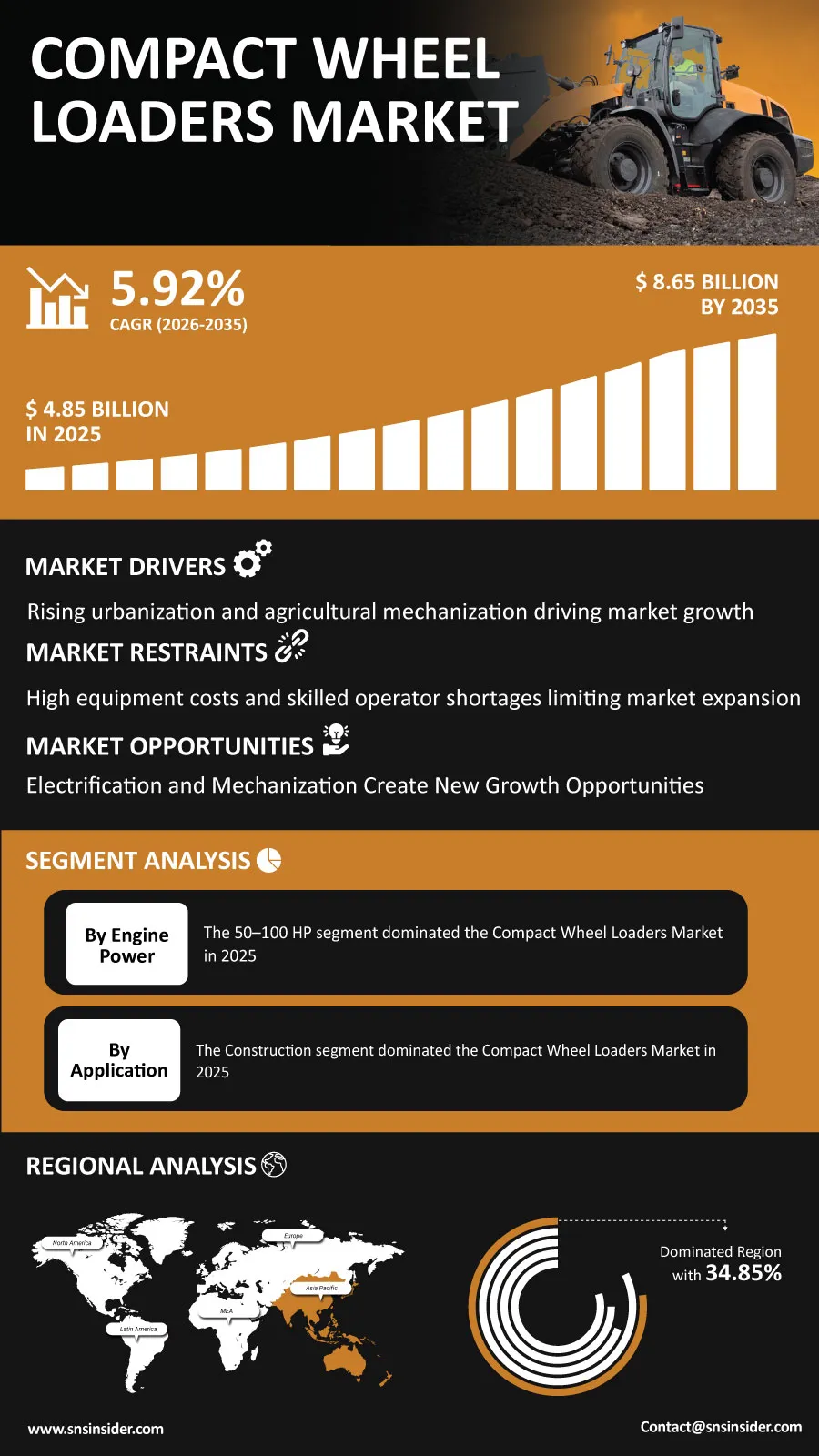
The global Compact Wheel Loaders Market is set for significant expansion as urbanization and agricultural mechanization continue to reshape versatile equipment demand worldwide. “According to a recent study by SNS Insider, the global Compact Wheel Loaders Market size valued at USD 4.85 billion in 2025, is anticipated to grow to USD 8.65 billion by 2035, registering a CAGR of 5.92% over the 2026–2035 forecast period.”
The field of compact construction and agricultural equipment technology has seen some massive transformations, owing to which many manufacturers that focus on increasing the efficiency and versatility of their equipment can capitalize on this trend. This requires the design of more maneuverable and electrically powered loaders that would enable the contractors as well as the farmers to be able to operate more efficiently in such an environment. This refers to instances in which compact wheel loaders are being used for the purpose of urban construction, agricultural handling, landscaping, and municipal maintenance. The manufacturers are always striving to make their machines more efficient than ever before to cater to different operator requirements.
To Get Detailed Insights on the Compact Wheel Loaders Market – Request a Sample Report
Electrification and Telematics Create New Demand
The Compact Wheel Loaders Market has progressed from basic machinery designed for loading to becoming increasingly connected and electrified equipment. As a result, due to the rising investments in telematics, electrification, and operator assistance systems by all manufacturers regardless of size, there is an increased need for flexible compact wheel loaders.
A new generation of compact wheel loaders has the potential to become more productive, environmentally-friendly and to provide remote fleet management abilities that will save money on unscheduled downtimes. This offers an opportunity to be more productive when dealing with increasingly demanding job sites and farms.
Manufacturers of machines, rentals, and finance companies are increasingly collaborating due to the growing demand for future solutions that will make compact machinery accessible, efficient, and environmentally-friendly.
Key Market Findings Highlight High-Growth Segments
By operating weight, the 6,000–10,000 Kg segment dominated the Compact Wheel Loaders Market in 2025, accounting for 49.61% of total market revenue. The same segment is projected to remain the fastest-growing category, expanding at a 6.52% CAGR through 2035 due to its balance of lifting capacity, maneuverability, and versatility across construction, agriculture, landscaping, and industrial applications.
By engine power, the 50–100 HP segment accounted for the largest market share of 59.45% in 2025 and is also expected to register the fastest growth with a 6.58% CAGR, supported by strong demand for compact machines offering an ideal combination of performance, fuel efficiency, and operating flexibility.
By application, the Construction segment held the highest revenue share of 53.58% in 2025 owing to growing infrastructure development and urban construction projects worldwide. Meanwhile, Agriculture is anticipated to be the fastest-growing application segment with a 6.87% CAGR, driven by rising farm mechanization and increasing adoption of multifunctional equipment.
Among end users, Construction Companies dominated the market with a 47.60% revenue share in 2025, while Agricultural Enterprises are projected to witness the fastest growth at a 6.76% CAGR, supported by increasing investments in commercial farming and labor-saving equipment.
Connectivity, Sustainability, and Rental Adoption Shape Industry Trends
The end-user demands for compact wheel loaders that come with connected technologies, which enable improved visibility of the fleet, lower maintenance expenses, and higher equipment utilization, are growing. Connected technologies such as telematics, predictive maintenance, assistance for operators, and diagnostics become standard options on the platforms of new machines. On the other hand, electric and hybrid product lines keep developing in response to tougher environmental legislation as well as better performance. The increased presence of rental fleets and special financing plans make modern compact wheel loaders available for construction companies and farmers.
Asia Pacific Leads the Global Market While North America Records the Fastest Growth
The Asia Pacific region had the largest share of the Compact Wheel Loaders Market in the world in 2025 owing to the rapid pace of urbanization, huge developments in infrastructure, mechanization of the agriculture sector, and significant levels of construction activities taking place in countries like China, India, Japan, and Southeast Asia. On the other hand, North America is projected to grow at the fastest rate in the coming years due to infrastructure modernization, rising demand for fuel-efficient/electric compact machinery, and construction & agriculture investments.
Leading Companies Drive Innovation and Competition
The global Compact Wheel Loaders Market remains highly competitive as manufacturers continue investing in electrification, digital technologies, fuel-efficient equipment, and advanced attachment capabilities. Major companies operating in the market include Caterpillar, AB Volvo, Komatsu Ltd., Doosan Bobcat, Wacker Neuson SE, Deere & Company, HD Construction Equipment, CNH Industrial N.V., LiuGong Machinery Co., Ltd., XCMG Global, SANY Heavy Industry Co., Ltd., Hitachi Construction Machinery Co., Ltd., JCB (J.C. Bamford Excavators Ltd.), Avant Tecno Oy, Kubota Corporation, Liebherr-International Deutschland GmbH, Schäffer Maschinenfabrik GmbH, Shandong Lingong Construction Machinery Co., Ltd. (SDLG), Yanmar Holdings Co., Ltd., and Mecalac.
An SNS Insider analyst Santosh Bhul commented, "The rapid electrification and digital connectivity of compact equipment is creating unprecedented demand across construction, agriculture, and municipal applications. Manufacturers that successfully combine maneuverability, efficiency, and connected fleet management capabilities will be best positioned to capitalize on emerging opportunities across urban construction, farm mechanization, and rental market segments."
About the Author

Get in touch




