
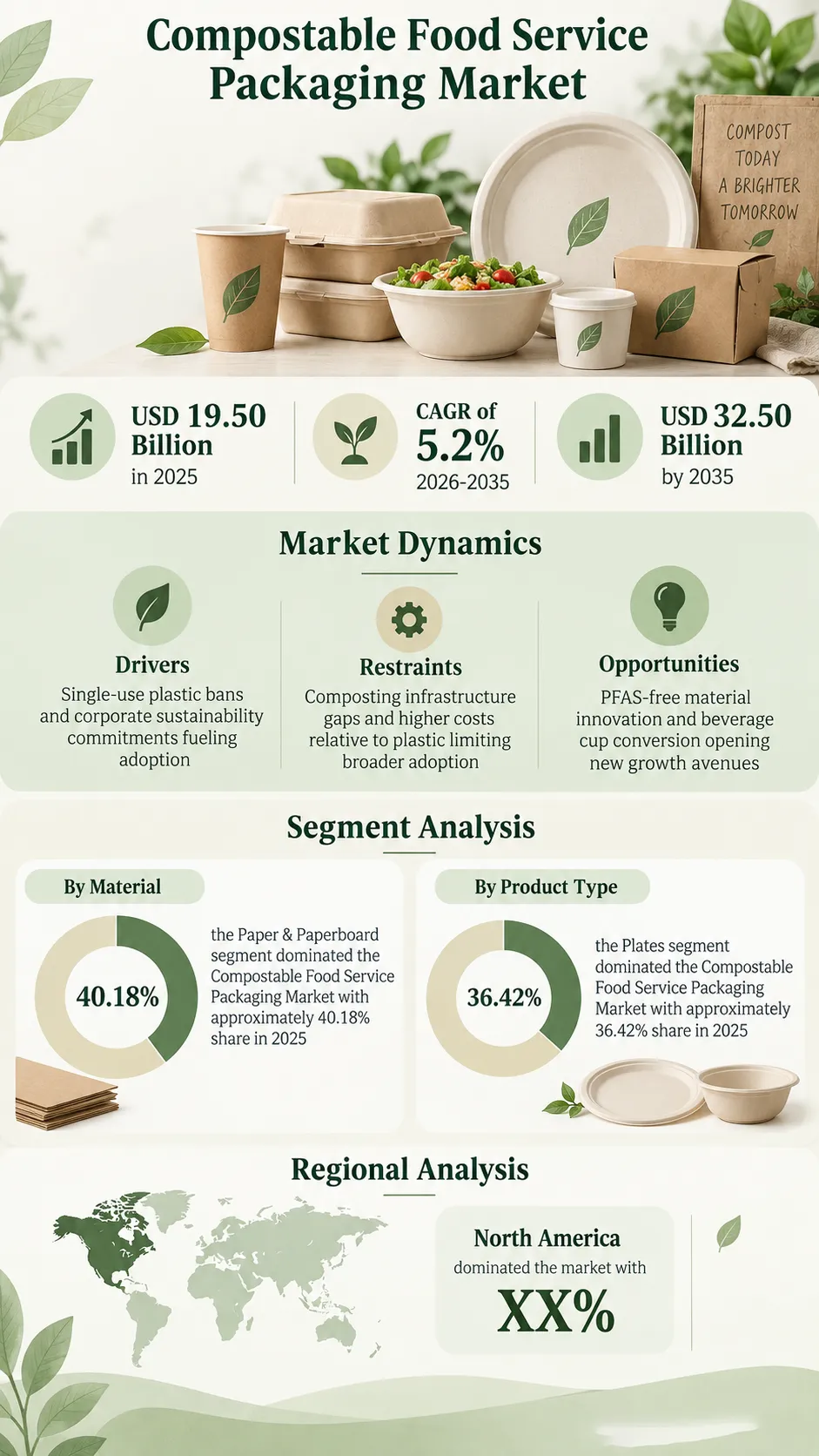
The global Compostable Food Service Packaging Market continues its steady climb as restaurants and delivery platforms lean further into regulation-ready, PFAS-free disposable packaging. “According to a recent study by SNS Insider, the global Compostable Food Service Packaging Market size valued at USD 19.50 billion in 2025, is anticipated to grow to USD 32.50 billion by 2035, registering a CAGR of 5.2% over the 2026-2035 forecast period.”
There have been steady changes within material and barrier coating technology over time, due to which many manufacturers aiming at improved compostability and food safety compliance can take advantage of this trend. This includes the need for more PFAS-free, performance-matched compostable materials that give buyers confidence in both regulatory compliance and product performance, across a wide range of applications from quick-service plates to beverage cups. This applies in situations where compostable food service packaging is used across quick-service, food delivery, and institutional applications.
Manufacturers are constantly working to improve material performance and regulatory compliance in order to meet various needs of restaurants and food delivery platforms worldwide.
To Get Detailed Insights on the Compostable Food Service Packaging Market – Request a Sample Report
Regulatory Compliance and Corporate Sustainability Ecosystems Create New Demand
The compostable food service packaging market has evolved from basic paper plate offerings into a broader mix of bagasse, seaweed-based, and PFAS-free barrier-coated products. The growing investment in fluorine-free material development, natural fiber sourcing, and multi-application development has required the development of more efficient and reliable production systems.
New material and coating approaches can improve compostability, reduce regulatory risk, and expand the range of applications compostable packaging can serve. This gives manufacturers the possibility to be more effective when reaching foodservice and delivery buyers and strengthening claims around sustainability and food safety.
Packaging manufacturers, restaurant chains, and food delivery platforms are increasingly cooperating due to the growing interest in developing future solutions for regulation-ready, high-performance compostable packaging.
Key Market Findings Highlight High-Growth Segments
The paper & paperboard segment dominated all categories in the compostable food service packaging market share with a market revenue share of approximately 40.18% in 2025 due to its low cost and long-established use across the foodservice industry.
The fastest growing category is expected to be the bagasse & seaweed segment, which will grow at a CAGR of approximately 8.4% through 2035. This will be possible owing to rising preference for natural, renewable materials with strong grease and moisture resistance.
By end-use, quick service restaurants held the largest share of total market revenue at approximately 44.23% in 2025 due to high transaction volume and regulatory scrutiny of single-use packaging waste. The food delivery & takeout segment will see the fastest growth in revenue generation at a CAGR of approximately 9.2%.
Regional trends show North America leading with approximately 31.0% revenue share in 2025, while Asia Pacific is expected to register a fast growth trajectory driven by rapid urbanization and expanding food delivery services across the region.
Material Innovation, Regulatory Compliance, and Application Diversification Gain Importance
In this regard, manufacturers have been looking at compostable packaging products that would perform better under real food-contact conditions, comply more fully with expanding PFAS regulation, and serve more diverse foodservice applications.
Innovation in PFAS-free barrier coatings, natural fiber sourcing, and multi-application development has been making it possible for companies to come up with products that can meet increasingly demanding regulatory and brand-owner expectations. In addition to that, increasing emphasis on beverage cup conversion is also making it possible for companies to find solutions that address one of the largest remaining plastic-lined packaging categories.
Such trends are likely to become even more prominent in the future.
North America Leads Amid Expanding State-Level Plastic Bans
North America represented approximately 31.0% share of global market revenue in 2025 and was the largest regional market, owing to an expanding patchwork of state and municipal single-use plastic bans alongside strong corporate sustainability commitments from major restaurant and quick-service chains. In addition, Asia Pacific is expected to register a fast growth trajectory during the forecast period, propelled by rapid urbanization and expanding food delivery services across the region's fast-growing economies.
On the other hand, Europe represented a meaningful share of global market revenue in 2025, aided by the EU Single-Use Plastics Directive and comprehensive industrial composting infrastructure across the region.
Leading Companies Drive Innovation and Competition
The environment continues to stay very dynamic since players continue innovating on material and barrier coating technology as well as forming partnerships in order to enhance their position in the industry.
Some of the major companies that operate in the global compostable food service packaging market are Sonoco Products Company, Pactiv Evergreen Inc., Genpak, LLC, Huhtamaki Oyj, Vegware Ltd., BioPak Pty Ltd., Eco-Products, Inc., World Centric, Footprint International LLC, and Stora Enso Oyj.
An SNS Insider Analyst Himanshu Sharma commented, “The steady shift toward PFAS-free, regulation-ready compostable packaging is creating consistent demand across quick-service, delivery, and institutional foodservice channels. Manufacturers that successfully combine fluorine-free material innovation, natural fiber sourcing, beverage cup conversion capability, and reliable foodservice partnerships will be best positioned to capitalize on emerging opportunities across quick-service, food delivery, and institutional applications.”
About the Author

Get in touch




