
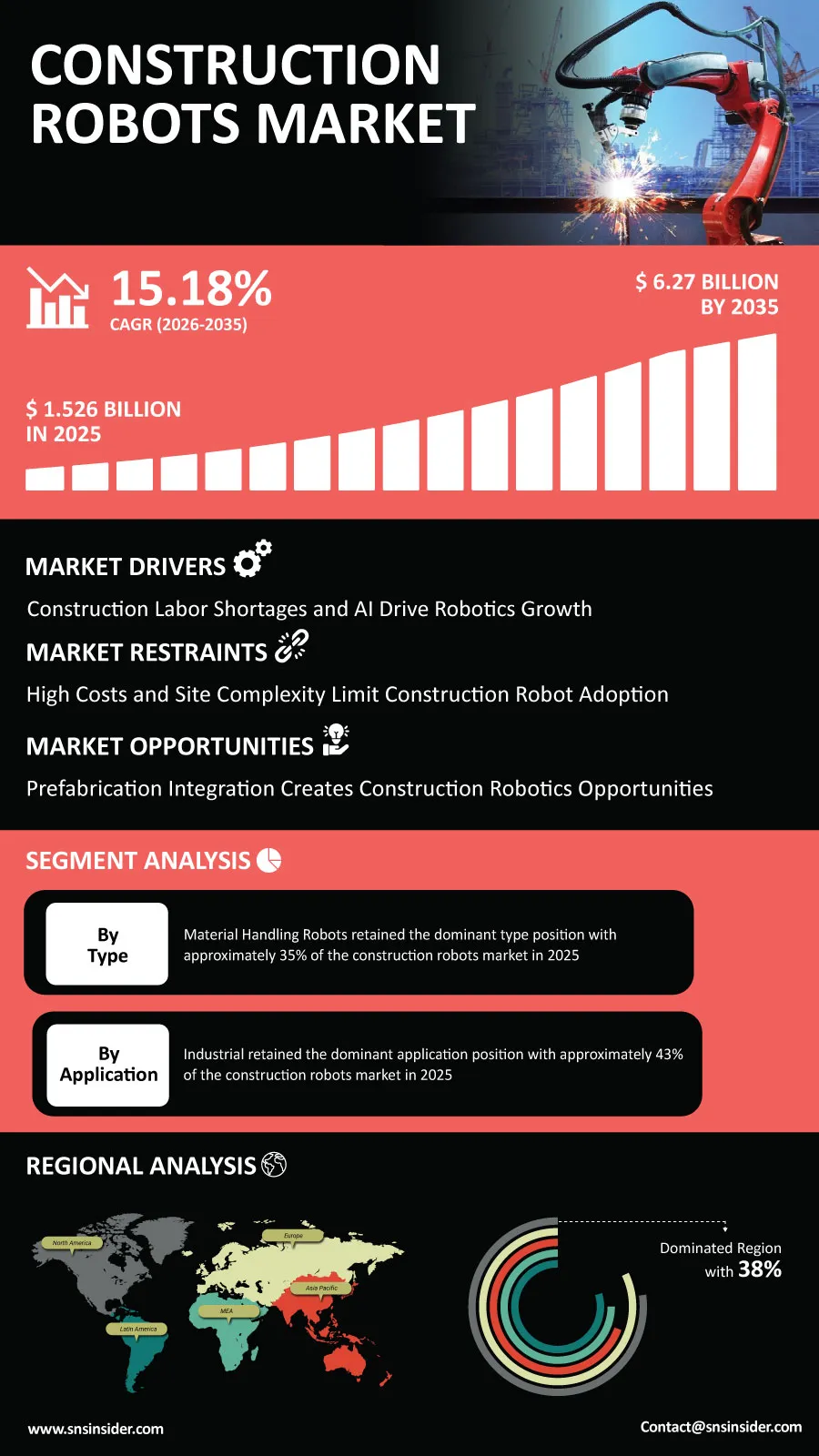
The global Construction Robots Market is witnessing rapid change and growth in automation as a key strategy for increasing efficiency, safety, and project delivery. “According to a recent study by SNS Insider, the global Construction Robots Market size valued at USD 1.526 billion in 2025, is anticipated to grow to USD 6.27 billion by 2035, registering a CAGR of 15.18% over the 2026–2035 forecast period.”
Construction firms globally have resorted to the use of robotics technology to counter labor shortages, increased operating costs, and growing need for precise construction techniques. Through automation of materials handling, robotic demolition, robotic surveying, and site monitoring systems, robotics technology has revolutionized the way commercial, industrial, and residential constructions are done.
Through artificial intelligence, enhanced sensors, machine vision, and digital construction platforms, robotics technology is gaining the ability to undertake even more complex tasks in a consistent manner. With continued government spending on infrastructure development such as transport and energy, there will be a high demand for robotic construction technology in both developed and developing countries.
To Get Detailed Insights on the Construction Robots Market – Request a Sample Report
Automation and Digital Construction Investments Unlock Long-Term Opportunities
As the deployment of digital construction technologies becomes more widespread, the robotics and software sectors can capitalize on the emerging opportunities.
Construction companies have already started deploying automated systems in order to streamline their operations, raise the bar regarding quality standards, and increase the safety of employees during the project execution process.
Further development of the construction industry is associated with the growth of modular and prefab facilities which ensure highly standardized production environment and allow leveraging automation in terms of productivity. On top of that, digital project management software helps to facilitate communication between robotic systems and other construction-related programs.
Technological breakthroughs in autonomous navigation, real-time data analysis, and control of equipment from a distance have made it possible to extend the usage of construction robots.
Key Market Insights Highlight Evolving Construction Technology Adoption
By type, the Material Handling Robots captured around 35% of the market revenue in 2025 on account of its extensive use in the transportation and positioning of construction materials. The Demolition Robots are set to witness fastest growth through 2035 with an estimated CAGR of 26.53% due to growing focus on the safety of workers and efficient demolition of structures.
By autonomy, the Semi-autonomous robots captured nearly 58% of the total market revenue in 2025 on account of the continued use of such robots which offer automated operation with the presence of operators for supervision purposes. The Fully Autonomous Robots are set to witness fastest growth with an estimated CAGR of 18.24%.
By application, the Industrial application segment contributed approximately 43% of the market revenue in 2025 due to extensive use of robots in manufacturing plants, warehouses, power plants, and infrastructure development. The Residential application segment is projected to register the fastest growth through 2035 due to automation of housing construction.
Intelligent Robotics Accelerate the Future of Modern Construction
Construction robotics is also continuously advancing from the use of machines to intelligent robots that are able to make decisions based on the data available to them. The combination of AI computer vision, Lidar, drone technologies, and BIM has improved the precision of the construction process without wasting much material and causing rework.
Robotics are also becoming collaborative robots that can assist human beings in completing their tasks by automating repetitive and physically difficult tasks while they are monitoring and ensuring the quality of the work and carrying out specialist construction tasks.
As a result of the increase in the digital transformation in the construction industry, robots are expected to become an important part of next generation project delivery approaches.
North America Accounted for 38% Market Share in 2025; Asia Pacific Forecast to Expand at the Fastest CAGR by 2035
The North America region holds around 38% share of market revenue in 2025 owing to high adoption of construction technology, infrastructure development, and labor shortage. The United States is a dominant country in the region on account of high deployment of robots in industrial, commercial, and infrastructure projects.
The Asia Pacific is expected to be a key growth region over 2035 owing to high urbanization, infrastructure development, and government digital construction initiatives in countries such as China, India, Japan, South Korea, and South East Asia. High investments made in research & development of robots and smart construction programs will increase the long-term growth prospects in the region.
Europe is expected to remain an innovative region on account of advanced engineering skills and workplace safety regulations in the region along with increased investments in construction technologies. At the same time, the Latin America and the Middle East & Africa are gradually expanding the adoption due to large-scale infrastructure projects.
Industry Participants Expand AI-Driven Robotics and Automation Solutions
As manufacturers make advancements with the use of artificial intelligence, mobility, construction digital software, and intelligent machine controls, the competition in the construction robots industry is getting tougher by the day. There has been increased collaboration in research and development of robotics products that can increase efficiency and safety in construction projects.
Key companies operating in the global Construction Robots Market include Brokk AB, Komatsu Ltd., Built Robotics Inc., Dusty Robotics Inc., Trimble Inc., Boston Dynamics Inc., Fanuc Corporation, KUKA AG, Yaskawa Electric Corporation, Shimizu Corporation, Kajima Corporation, Fastbrick Robotics (FBR Ltd.), Construction Robotics LLC, Husqvarna Group, Hilti Group, Ekso Bionics Holdings Inc., Advanced Construction Robotics Inc., Scaled Robotics SL, Cazza Technologies Inc., and Caterpillar Inc.
An SNS Insider analyst Santosh Bhul commented, “The growing convergence of robotics, artificial intelligence, and digital construction technologies is fundamentally reshaping project execution worldwide. Organizations investing in autonomous equipment, intelligent automation platforms, and connected construction ecosystems are expected to achieve meaningful improvements in productivity, safety, and operational efficiency as the global construction industry continues its digital transformation.”
About the Author

Get in touch




