
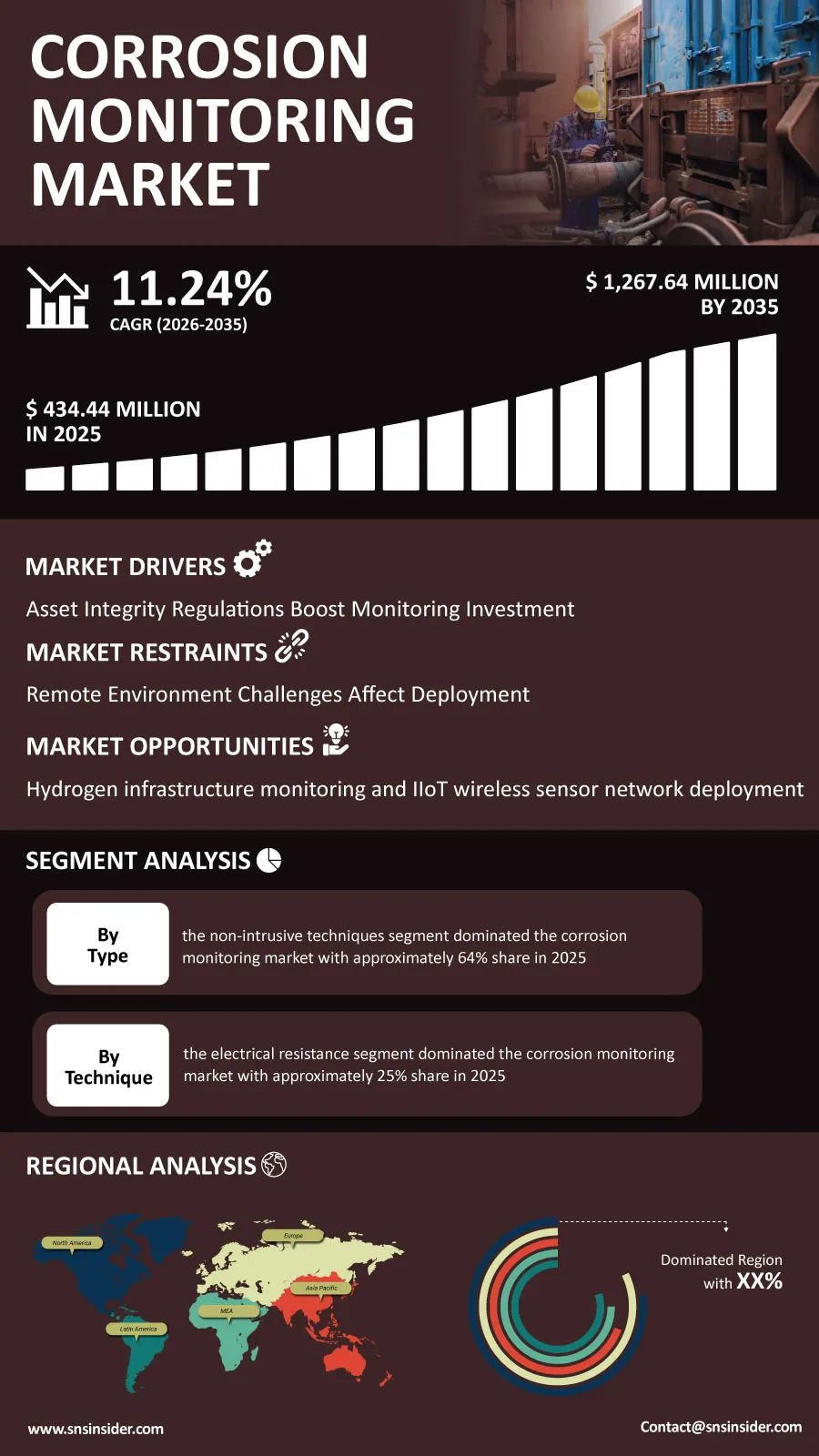
The Corrosion Monitoring Market is growing in the global sphere as industries focus on predictive maintenance, infrastructure reliability, and operational safety.“According to a recent study by SNS Insider, the global Corrosion Monitoring Market size valued at USD 434.44 Million in 2025, is anticipated to grow to USD 1,267.64 Million by 2035, registering a CAGR of 11.24% over the 2026–2035 forecast period.”
Industry players have increased their spending on technology that enables them to identify material deterioration before any failure occurs, thus keeping the cost of maintenance low and preventing operational interruptions. Monitoring continuously has become necessary for industries that use pipelines, pressure vessels, storage tanks, and structural assets in harsh environments. With organizations upgrading their aging facilities and adhering to strict safety standards, corrosion monitoring technologies have become an important aspect of asset management in the long run.
There is further increase in market opportunities due to the integration of technology with the industrial automation process. With the use of advanced sensing technologies that can relay continuous condition data, companies can take maintenance decisions and increase the life of equipment.
To Get Detailed Insights on the Corrosion Monitoring Market – Request a Sample Report
Digital Asset Management Creates New Opportunities for Industrial Monitoring
Worldwide, industries have started shifting their focus from reactive maintenance to predictive maintenance, thus driving the long-term need for corrosion monitoring systems. The operators are adopting a more connected monitoring system that assesses equipment condition rather than performing periodic inspection tasks.
The fast development of industrial internet of things technology is allowing maintenance personnel to monitor their critical assets from a distance in large-scale industrial premises and pipelines. With the help of artificial intelligence and analytics, the monitoring of corrosion enables better planning of maintenance operations and ensures safer work conditions.
The investments into hydrogen infrastructure and offshore energy projects as well as advanced industrial facilities will present new business opportunities for the monitoring systems functioning in difficult conditions.
Key Market Insights Reflect Expanding Technology Adoption
Based on type, Non-Intrusive Techniques were responsible for about 64% of the global market revenue in 2025, thanks to the capabilities of the techniques to check assets without disturbing the production process. The market share of Intrusive Techniques is estimated to grow at the fastest rate from 2025 to 2035 because of installation of advanced monitoring technologies in newly established industrial units.
Electrical Resistance was worth 25% of the market revenue in 2025 because of the wide applicability of the technique in various industries. Ultrasonic Thickness Measurement is estimated to record the fastest growth rate as more industries adopt wall thickness measurement solutions.
The Electro-Chemical Probes had almost 42% of the total market revenue in 2025, while the Electrical Probes are expected to record the highest growth rate.
End User-wise, Oil & Gas was responsible for 32% of the total global revenue in 2025 because of the extensive pipeline monitoring needs in the sector. Chemical & Petrochemical end users are expected to be the fastest-growing end user segment up to 2035.
Advanced Monitoring Technologies Accelerate Industrial Transformation
Corrosion monitoring through technological innovation remains ever-changing because it combines intelligent sensors with cloud technology and predictive maintenance. Industrial organizations are beginning to adopt wireless corrosion monitoring systems, which are easy to install and provide constant operational visibility for large plants.
The application of artificial intelligence is providing accurate information about corrosion patterns and the remaining lifespan of machinery based on past performance records. Furthermore, the incorporation of digital twin technologies will enable operators to conduct simulations, scheduling, and planning of their assets.
As digitalization increases around the world, corrosion monitoring is becoming part of enterprise asset management approaches rather than just an isolated inspection process.
North America Accounted for the Largest Market Share in 2025; Asia Pacific Forecast to Expand at the Fastest CAGR by 2035
North America is estimated to dominate among regional markets during 2025 due to substantial spending on pipeline integrity, modernization of energy infrastructure, and utilization of innovative inspection techniques. Robust regulatory environment, use of predictive maintenance and availability of major technological players further contribute to strengthening demand in the region.
Asia-Pacific is forecasted to exhibit the highest rate of growth till 2035 with the intensification of industrial activity in China, India, and Southeast Asian countries. Growth of capacity in refining, chemical production, power generation, and development of energy transportation network stimulate greater deployment of advanced corrosion monitoring systems in the region.
Europe also represents technologically mature market thanks to stringent safety standards and modernization of energy and manufacturing facilities in the region. In addition, the Middle East, Africa, and Latin America are actively investing in corrosion management to support their growing oil & gas, petrochemicals, and mining industries.
Industry Participants Expand Intelligent Monitoring Capabilities
Competition in the corrosion monitoring industry continues to be active as suppliers of technology enhance their offerings by utilizing wireless sensors, artificial intelligence, cloud computing, and asset management systems. Firms continue to focus on research and development of solutions for accurate, easy-to-deploy, and scalable monitoring that can deal with more sophisticated industrial settings.
Key companies operating in the global Corrosion Monitoring Market include Emerson Electric Co. (Roxar), Honeywell International Inc., Baker Hughes Company, SGS SA, Intertek Group plc, MISTRAS Group Inc., Cosasco (Rohrback Cosasco Systems), Rysco Corrosion Services Inc., Applus+ Services SA, TÜV Rheinland Group, Corr Instruments LLC, Matergenics Inc., BAC Corrosion Control Ltd., RS Corrosion Services Inc., Intero Integrity Services, Clamp On AS, 3X Engineering, Korosi Specindo, Metal Samples Company (Alabama Specialty Products), and Pepperl+Fuchs SE.
An SNS Insider analyst Santosh Bhul commented, “Industries are increasingly recognizing that continuous asset monitoring delivers both operational and financial advantages. Organizations investing in intelligent corrosion monitoring, predictive analytics, and connected inspection technologies will be well positioned to enhance infrastructure reliability while supporting long-term industrial sustainability and regulatory compliance.”
About the Author

Get in touch




