
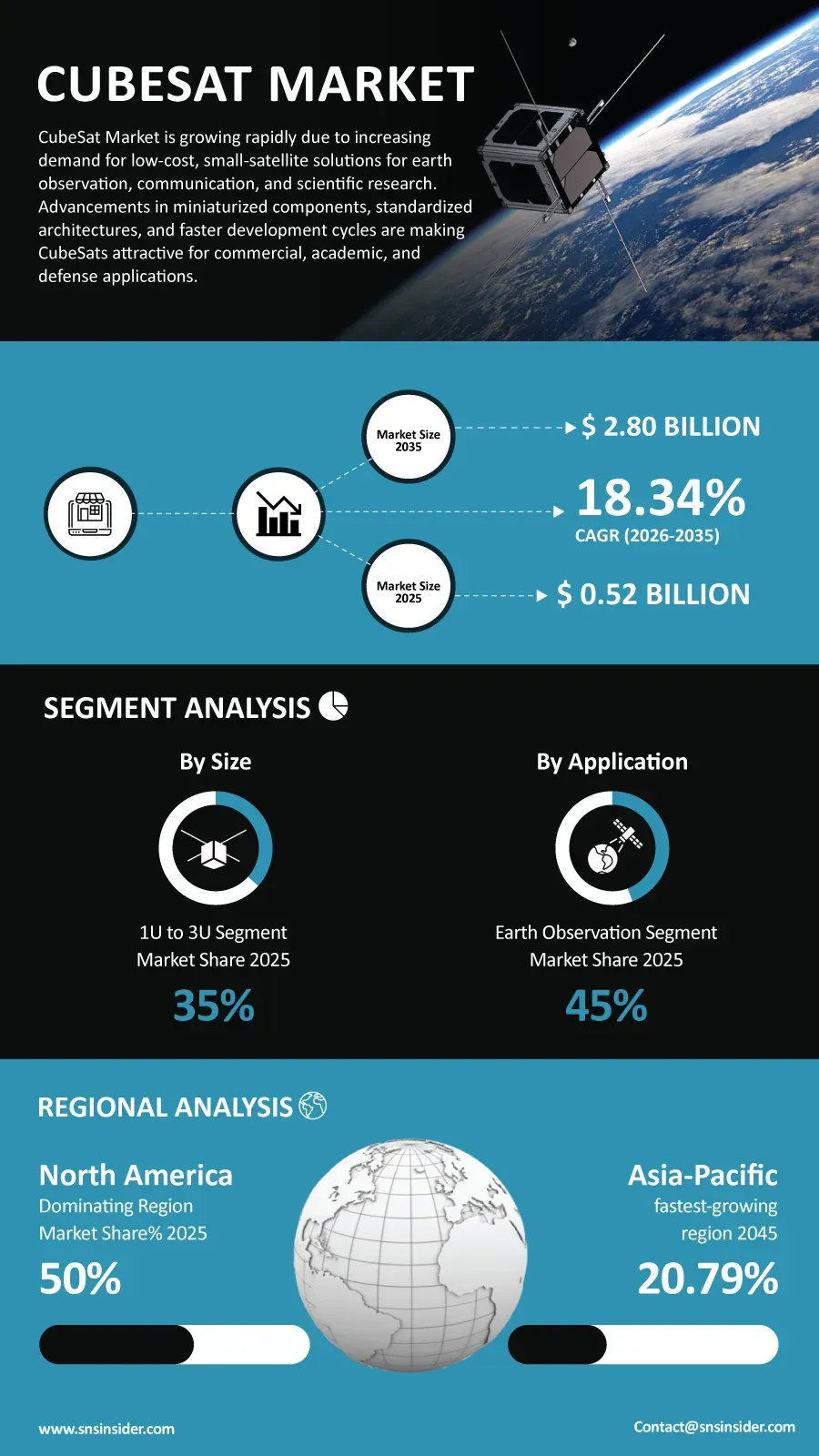
The global CubeSat Market is all set to exhibit unprecedented growth over the next 10 years as governments, commercial space companies, research institutes and defense organizations are incorporating compact satellites for economic deployment of space based capabilities. According to a recent study by SNS Insider, the global CubeSat Market size valued at USD 0.52 billion in 2025, is anticipated to grow to USD 2.80 billion by 2035, registering a CAGR of 18.34% over the 2026–2035 forecast period.
The small satellite industry is changing in response to increasing demand for inexpensive satellite missions, ever-accelerating advancements in technology and improvements in access to launch services. CubeSats have developed into a competent platform for Earth observation, communications, scientific research and technological demonstration that can allow organizations to provide more sophistical space missions at lower capital expenditure than traditional satellites.
The ongoing miniaturization of satellite systems and equipment enables onboard propulsion, power subsystems, and CubeSat structural standards which are furthing boosting the market. With the increase of both private and public sector investment into space activities, CubeSats are rapidly becoming a key component of the increasingly global space economy.
To Get Detailed Insights on the CubeSat Market – Request a Sample Report
Expanding Space Programs Create Significant Market Opportunities
Governments and private space companies are quickly increasing satellite constellations to enhance communication networks, environment monitoring, national security and science exploration. These miniature satellites offer a flexible, relatively low-cost platform for placing numerous satellites into orbit while simultaneously accelerating the development schedule and mitigating mission risk.
The emergence of demand for near real-time Earth observation and change detection data is also opening up fresh commercial opportunities in various sectors including agriculture, disaster management, climate monitoring, urban planning and natural resource management. CubeSat platforms have also been used by universities and research institutions for technology validation, educational missions and scientific experimentations which is further expanding the market opportunity.
At the same time, new advancements in rideshare launch services, reusable LV and satellite deployment technologies are opening up the globe to higher levels of activity from startups and up-start space companies.
Key Market Insights Highlight Shifting Demand Patterns
The 1U to 3U CubeSat segment, by size, is expected to hold about 35% of the total global revenue share in 2025 backed by its high application range across educational, government and commercial missions. Due to larger payloads, better communication systems and more complex mission capabilities, the 6U to 12U segment is predicted to be the fastest growing segment until 2035.
Earth observation based on application in 2025 is projected to contribute more than 45% of the market revenue as need for low-cost satellite images is increasing continuously inspiring numerous applicationsincluding agriculture, climate monitoring, piracy prevention, disaster response and defense operations. As satellite constellations help to deliver connectivity, IoT networks and broadband services across the globe, communication applications are expected to grow at the fastest rate.
Payloads are expected to generate 28% of market revenue by subsystem in 2025, as they are critical for both mission performance and data collection. Advanced pointing accuracy and satellite stabilization are critical requirements for many of the higher-value missions performed by satellites, making the Attitude Determination and Control System (ADCS) segment to register highest growth during forecasted period.
By end use, Government & Defense is anticipated to account for 50% of global market revenue by 2025 supported by increasing investments in surveillance, reconnaissance, scientific research and national security applications. Through 2035, the commercial segment will be the fastest growing as private companies extend CubeSat deployments within imaging, communications, logistics and IoT services.
Satellite Innovation Continues to Transform Space Accessibility
CubeSat Technology Evolution CubeSats are rapidly changing the economics of-space we can deploy these missions at low-cost and with organizations of much smaller scale than before, especially at-train different spacecraft in an accessible way. Miniaturized sensors, onboard computing, propulsion technologies, artificial intelligence and autonomous operations are broadening mission capabilities while shrinking satellite footprints.
Manufacturers have also invested heavily in modular satellite architectures to enable easier integration, lower production costs, and faster deployment timelines. These innovations are allowing constellations to be deployed more rapidly while accommodating ever more sophisticated commercial, scientific, and defense missions.
Regional Markets Demonstrate Strong Growth Momentum
North America is estimated to represent 50% of the global market revenue in 2025 due to the presence of a well-established aerospace ecosystem, significant government investment, high commercial space activity and leading satellite manufacturing and launch providers. This trend of continuous innovation spanning Earth observation, communications and Defense applications reinforces the region's market leadership.
Asia pacific is anticipated to be the fastest growing regional market, with 20.79% CAGR from 2034 to 2023. Growing government investments in national space programs, increasing private sector participation, expansion of satellite communication infrastructure, and growing research initiatives are catalyzing the deployment of CubeSats over the region.
Growing demand for affordable small satellite platforms is likely to grow continuously across the world as various countries are focusing on domestic space capabilities and satellite-based services during the forecast period.
Industry Participants Focus on Advanced Small Satellite Solutions
The competitive landscape continues to be rapidly evolving, as manufacturers and satellite operators alike invest in next-generation CubeSat platforms with higher levels of imaging capabilities, more advanced propulsion options, integrated artificial intelligence for data processing, and communication technologies. Collaborations, growth of constellation and continuous product innovations are attributed to play a crucial role in enhancing the competitive position across nations.
Key companies operating in the global CubeSat Market include Planet Labs PBC, Spire Global Inc., AAC Clyde Space, GomSpace A/S, Blue Canyon Technologies (BCT), Raytheon Technologies, Terran Orbital Corporation (Tyvak Nano-Satellite Systems), NanoAvionics (Kongsberg NanoAvionics), EnduroSat, Lockheed Martin Corporation, Northrop Grumman Corporation, Aerospace Corporation, SpaceX, Rocket Lab USA Inc., D-Orbit S.p.A, ISISPACE (Innovative Solutions In Space), Surrey Satellite Technology Ltd (SSTL), Millennium Space Systems (Boeing), L3Harris Technologies Inc., ExoLaunch GmbH, and York Space Systems.
An SNS Insider analyst Sushant Kadam commented, “CubeSats are redefining access to space by enabling affordable, rapid, and highly scalable satellite missions across commercial, scientific, and government sectors. Continued advancements in miniaturization, launch services, and constellation technologies will position CubeSats as one of the most influential platforms driving the future growth of the global space industry.”
About the Author

Get in touch




