
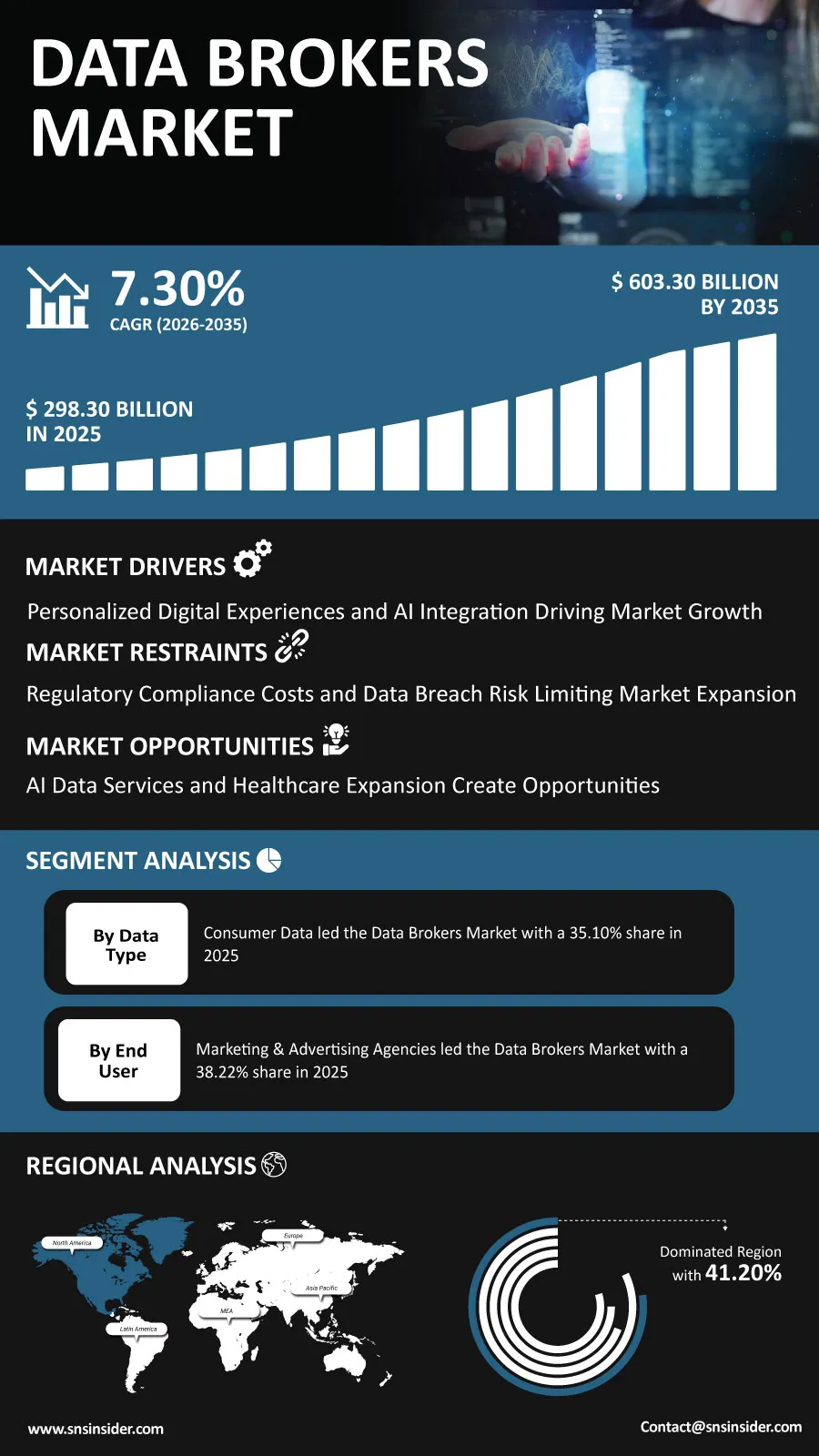
The global Data Brokers Market is set for significant expansion as enterprises worldwide continue relying on third-party data aggregation for marketing, risk management, and business intelligence. "According to a recent study by SNS Insider, the global Data Brokers Market size valued at USD 298.30 billion in 2025, is anticipated to grow to USD 603.30 billion by 2035, registering a CAGR of 7.30% over the 2026-2035 forecast period."
There have been tremendous changes within data brokerage technology over time due to which many companies who aim at improving data quality and insight generation can take advantage of this trend. This includes the need for more accurate, AI-enriched datasets that will provide businesses with the ability to make better-informed decisions. This applies in situations where data broker services are used for marketing and advertising, risk assessment, fraud detection, and identity verification.
Companies are constantly working hard to ensure that their data offerings perform better than before in order to meet various needs of enterprise customers.
To Get Detailed Insights on the Data Brokers Market – Request a Sample Report
AI-Driven Data Monetization Ecosystems Create New Demand
The data brokers market has evolved from basic data aggregation to more advanced AI-enriched and predictive analytics use cases. The growing investment in machine learning-driven data quality management, identity resolution platforms, and healthcare data infrastructure for a variety of industry verticals has required the development of more efficient and reliable data services.
New designs of data broker platforms can increase accuracy, reduce fraud risk, and allow for more precise targeting and decision-making. This gives businesses the possibility to be more effective when reaching customers and doing better risk management.
Data brokers, advertising holding companies, and technology providers are increasingly cooperating thanks to the growing interest in developing future solutions for data monetization.
Key Market Findings Highlight High-Growth Segments
The consumer data segment dominated all categories in the data brokers market share with a market revenue share of 35.10% in 2025 due to its wide application in segmentation, targeting, and predictive analytics.
The fastest growing category is expected to be health data which will grow at a CAGR of 13.80% through 2035. This will be possible owing to the increasing need for digitized medical records and value-based care analytics.
By data category, structured data held the largest share of total market revenue of 61.40% in 2025 due to its ease of integration into enterprise analytics systems. The unstructured data segment will see the fastest growth in revenue generation at a CAGR of 12.60%.
Based on end user, marketing and advertising agencies generated a share of 38.22% of market revenue in 2025 thanks to third-party data's central role in campaign optimization. On the other hand, healthcare and life sciences will be the segment recording the fastest revenue growth at a CAGR of 14.34%.
Distributive trends are changing as well. Subscription pricing accounted for a 58.60% revenue share in 2025. But pay-per-use models will turn out to be the fastest-growing pricing structure through 2035, on the back of flexible data marketplace platforms, smaller organization adoption, and increased demand from specialized use cases.
Accuracy, Compliance, and Personalization Gain Importance
In this regard, businesses have been looking at data solutions that would make their decision-making more accurate and require less manual analysis and be more compliant.
Innovation in AI-driven analytics, identity resolution, and data quality management has been making it possible for companies to come up with products that can operate effectively across demanding regulatory conditions. In addition to that, increasing emphasis on privacy compliance and data breach prevention is also making it possible for companies to find solutions that optimize data broker performance.
Such trends are likely to become even more prominent in the future.
North America Emerges as the Largest Market with 41.20% Revenue Share Amid Rising AI Integration
The North America region represented 41.20% share of global market revenue in 2025 and was the largest regional market, owing to advanced data ecosystems, robust digital infrastructure, and the presence of major data brokerage firms. In addition, Asia Pacific is expected to be the fastest-growing market during the forecast period, propelled by rapid smartphone adoption, surging e-commerce transactions, and applications across the region's fast-growing digital economies.
On the other hand, Europe represented a meaningful share of global market revenue in 2025, aided by the stringent GDPR regulatory framework and a favorable environment for compliance-driven data infrastructure innovation.
Leading Companies Drive Innovation and Competition
The environment continues to stay very dynamic since players continue innovating on products and technologies as well as forming partnerships in order to enhance their position in the industry.
Some of the major companies that operate in the global data brokers market are Acxiom LLC, Experian PLC, Equifax Inc., Dun & Bradstreet Holdings Inc., Oracle Corporation, LiveRamp Holdings Inc., Nielsen Holdings plc, Epsilon Data Management LLC, TransUnion LLC, and CoreLogic Inc.
An SNS Insider Analyst Sakshi Kale commented, "The rapid commercialization of AI-driven data monetization technology is creating unprecedented demand for high-performance data broker platforms. Companies that successfully combine data accuracy, regulatory compliance, AI-enabled analytics, and advanced engineering capabilities will be best positioned to capitalize on emerging opportunities across marketing, risk management, and healthcare data applications."
About the Author

Get in touch




