
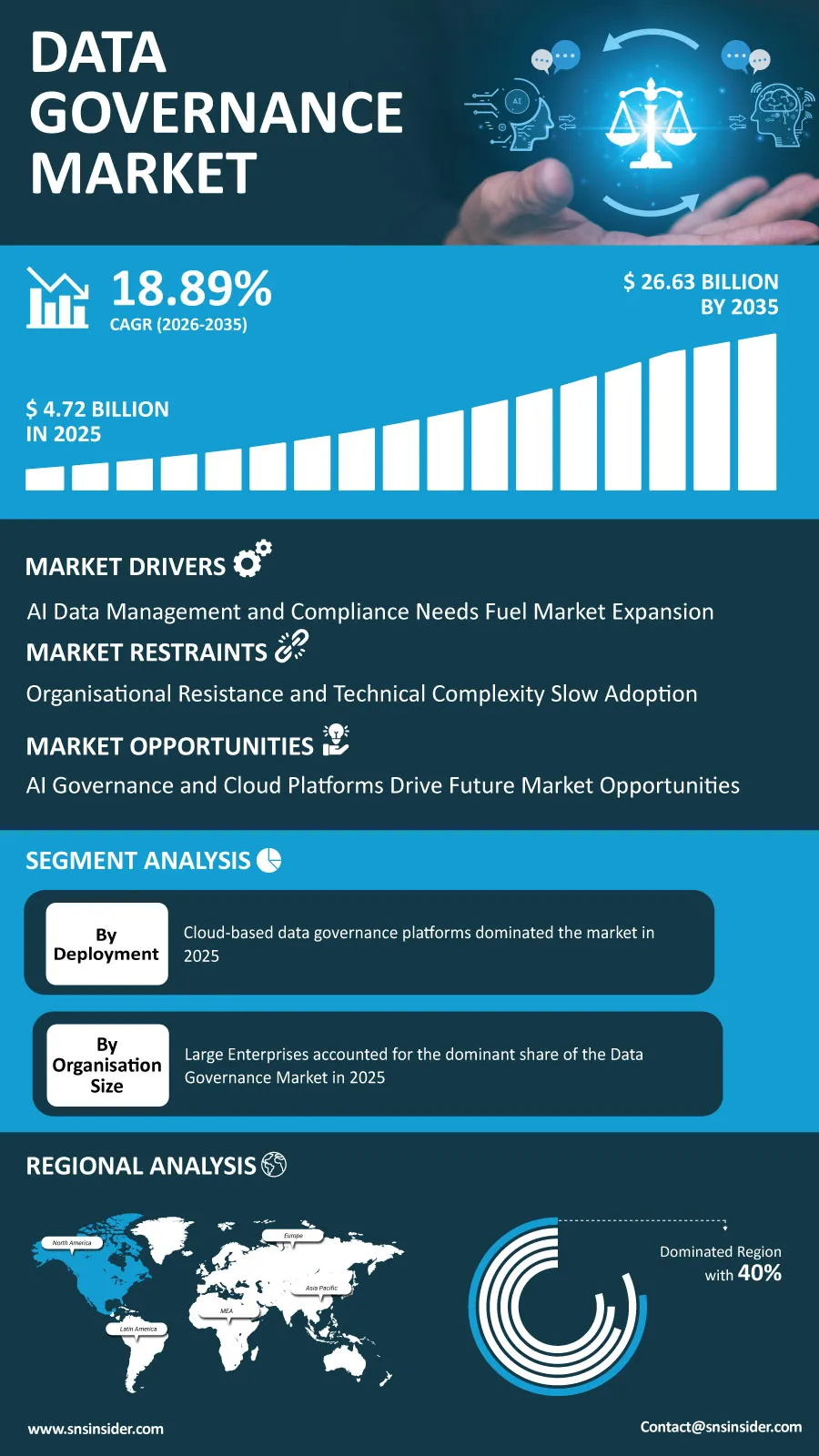
The global market for Data Governance is about to witness a new phase of growth due to the increased focus by organizations to create trusted and secure data environments. “According to a recent study by SNS Insider, the Data Governance Market size valued at USD 4.72 billion in 2025, is anticipated to grow to USD 26.63 billion by 2035, registering a CAGR of 18.89% over the 2026–2035 forecast period.”
Companies have realized that data has become an important corporate asset that needs to be managed throughout its lifecycle. With companies migrating to the cloud at an accelerated rate and pursuing digital transformation and artificial intelligence, it is increasingly necessary to have governance frameworks in place to ensure consistency and transparency of data. Companies are making investments in technology solutions that manage metadata, enforce policies, and provide trusted data sets.
The exponential rise in the amounts of enterprise information is also impacting the needs for governance. The amount of information being produced from cloud applications, Internet of Things, customers’ platforms, and business operations is increasing like never before, thus the need for governance platforms that will handle multi-cloud environments efficiently while still being compliant and minimizing risks.
To Get Detailed Insights on the Data Governance Market – Request a Sample Report
AI Adoption and Regulatory Modernization Strengthen Long-Term Market Opportunities
The increasing usage of artificial intelligence by enterprises is presenting several new possibilities for data governance providers since companies require dependable data bases to be built for training machine learning algorithms and carrying out more advanced analysis. AI solutions rely on high-quality data that is traceable and well-documented, and hence there is a need for governance solutions.
Stricter privacy and digital governance laws are being adopted by governments around the world, which necessitate companies to gain greater insight into how their data is being gathered, processed, and distributed. Such regulatory changes are prompting companies to adopt an enterprise-wide governance strategy that will help in better audit preparedness and also ensure proper utilization of data.
Cloud-based governance platforms are additionally promoting the use of cloud through the deployment of scalable models, automated metadata discovery, and centralization of policies. All these are making it easier for organizations to deal with their expanding digital ecosystems without complicating the administrative aspect of things.
Key Market Insights Highlight Shifting Enterprise Priorities
By component, solutions held the largest share of global revenue in 2025 as organizations continued to invest in comprehensive governance platforms that cover metadata management, policy administration, data cataloging, and quality monitoring. Driven by these trends,the fastest growth through 2035 will be in services: consulting,implementation and managed governance skills to deliver those of the data.
Cloud-based has great share in the market 2025 by deployment and it is expected to fast grow in segment during forecasted period. With their versatility, scalability and capability to seamlessly integrate with modern enterprise platforms they continue to fuel growing adoption across organisations large and small.
This is dominated by large enterprises, which earned 95% of income from the market owing to extensive compliance obligations and intricate data infrastructures. Small and medium-sized enterprises (SMEs) are set to see the greatest growth, as cloud-delivered governance solutions turn cheaper and easier to deploy.
By industry vertical, BFSI continued to be the number one market segment in 2025 due to regulatory compliance and large data management requirements. Healthcare is forecasted to be the fastest growing sector to 2035, with digital health initiatives, electronic medical records and AI-supported clinical applications creating a rising demand for governance frameworks.
Intelligent Automation Reshapes Modern Data Governance Platforms
With the rises of artificial intelligence, automation and active metadata capabilities for data governance platforms, technology providers are speeding up efforts integrating these into their enterprise-level services. Modern solutions automatically crawl for data discovery, classification and lineage mapping, quality assessment, and compliance monitoring to limit manual administrative efforts that would result in improved operational performance.
This is also driving organizations to adopt federated governance models where business units own domain-specific information yet operate under robust enterprise-wide governance. By decentralizing governance, this approach accelerates innovation, aligns collaboration, and allows businesses to scale with their digital footprint.
Amid these trends, enterprises are adopting emerging technologies at a rapid pace and investing heavily in analytics, cloud computing and AI and become reliant on it for their operations prompting governance platforms to reinvent themselves from being compliance tools into strategic business solutions that not only improves data accessibility and solidifies cyber security but also helps them realize long-term digital transformation objectives.
North America Held the Largest Share of the Data Governance Market in 2025; Asia Pacific Projected to Register the Fastest CAGR Through 2035
North America was the largest regional market during 2025, supported by digital infrastructure advancements combined with widespread cloud adoption and regulatory oversight surrounding enterprise data management. The US still champions regional growth as enterprises spend large on governance technologies backing AI, cybersecurity, financial services, healthcare and public sector modernization.
The Asia Pacific regional is expected to witness the highest CAGR during the forecast period. With rapid digitalization in China, India, Japan, and Southeast Asia; as well as the expansion of cloud infrastructure compounds the challenge in these countries to satisfy evolving data privacy regulations and push enterprises towards data governance-driven approaches that help securely scale data management.
Europe is also a big growth opportunity, as organizations looking to comply with changing privacy regulations and new AI governance frameworks strengthen their governance practices. At the same time, Latin America and Middle East & Africa are seeing increasing uptake due to governments enhancing digital transformation programs and businesses modernizing data management functionalities.
Industry Participants Expand AI-Powered Governance Capabilities
The competition in the international Data Governance Market is growing stronger as IT vendors focus on building AI-driven automation solutions, cloud native technologies, metadata intelligence, and enterprise governance platforms. The vendors are developing new product portfolios to assist companies in becoming more compliant, improving data quality, and deploying trusted AI.
Key companies operating in the global Data Governance Market include IBM Corporation, Oracle Corporation, Informatica Inc., Collibra Inc., Alation Inc., Microsoft Corporation, SAP SE, SAS Institute Inc., Talend (Qlik), Erwin (Quest Software), Data Ladder, Ataccama Corporation, Profisee Group, Precisely, Varonis Systems Inc., Reltio Inc., Stibo Systems, TIBCO Software Inc., MicroStrategy Incorporated, and Denodo Technologies.
An SNS Insider analyst Sakshi Kale commented, "As organizations increasingly depend on AI, cloud computing, and data-driven decision-making, governance has become a strategic business priority rather than a compliance exercise. Vendors delivering intelligent automation, scalable governance architectures, and trusted data management capabilities are expected to capitalize on the market's strong long-term growth trajectory."
About the Author

Get in touch




