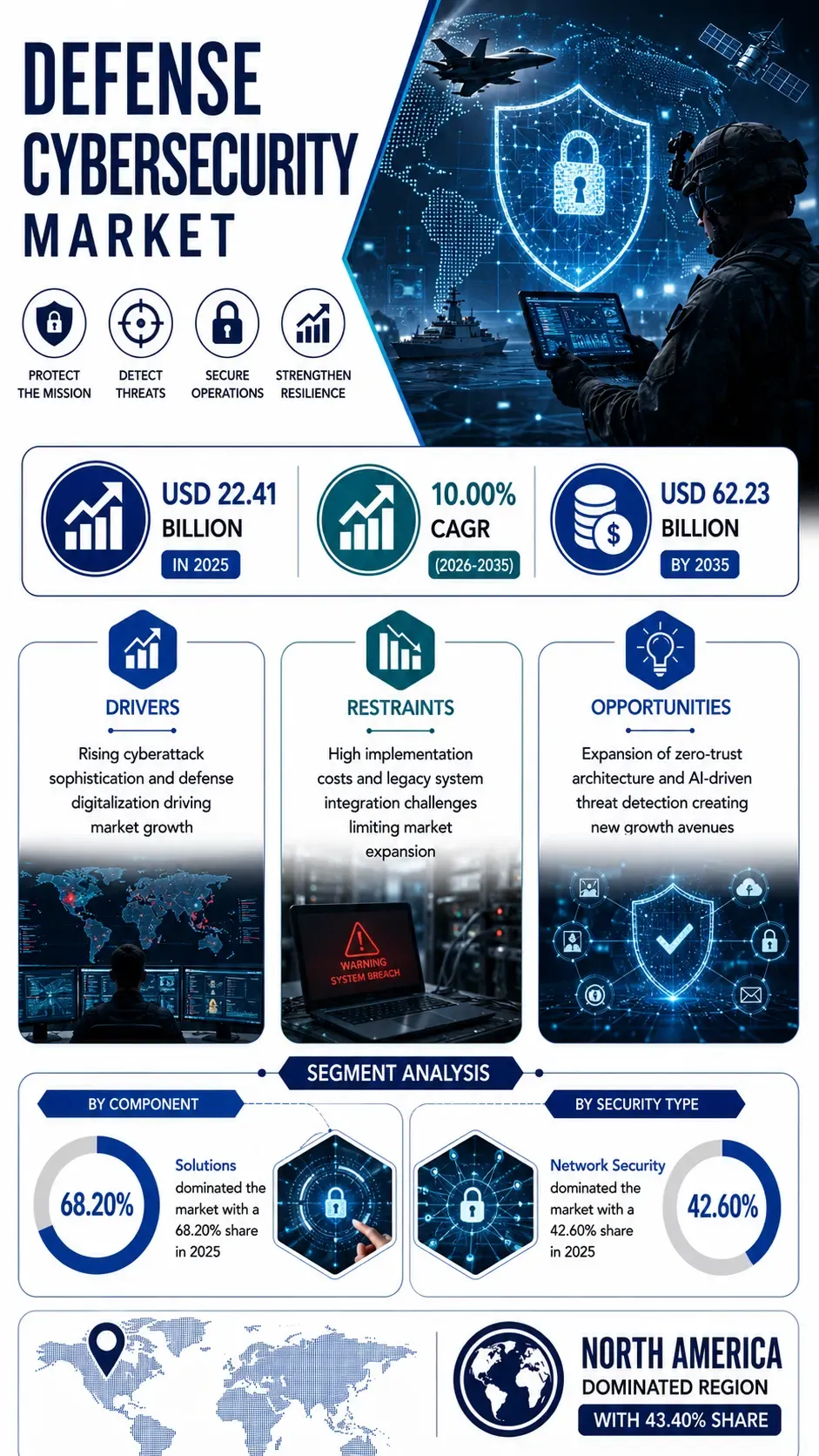
The global Defense Cybersecurity Market is set for significant expansion as cyberattack sophistication and zero-trust architecture adoption continue to reshape military network protection worldwide. “According to a recent study by SNS Insider, the global Defense Cybersecurity Market size valued at USD 22.41 billion in 2025, is anticipated to grow to USD 62.23 billion by 2035, registering a CAGR of 10.00% over the 2026–2035 forecast period.”
There have been tremendous changes within military network security technology over time, due to which many defense organizations who aim at improving cyber resilience can take advantage of this trend. This includes the need for more sophisticated, zero-trust-aligned security architectures that will provide military organizations with the ability to protect increasingly interconnected command, control, and intelligence systems. This applies in situations where defense cybersecurity supports armed forces, defense contractors, and government agencies. Defense organizations are constantly working hard to ensure that their cyber defense capabilities perform better than before in order to meet various national security and operational continuity requirements.
To Get Detailed Insights on This Market – Request a Sample Report
Zero-Trust Architecture Creates New Demand
The defense cybersecurity market has evolved from perimeter-based network protection to increasingly sophisticated, continuous-verification security architectures. The growing investment in zero-trust frameworks, AI-driven threat detection, and cloud security across defense organizations of all sizes has required the development of more resilient and adaptive cyber defense platforms.
New security architectures can increase threat detection speed, improve identity and access control, and allow for expansion into increasingly complex cloud, C4ISR, and connected weapons system environments. This gives defense organizations the possibility to protect mission-critical infrastructure while maintaining operational continuity amid escalating cyber threat sophistication.
Defense contractors, cybersecurity technology providers, and government agencies are increasingly cooperating thanks to the growing interest in developing future solutions for resilient, zero-trust-aligned military cyber defense.
Key Market Findings Highlight High-Growth Segments
The solutions segment dominated all categories in the defense cybersecurity market share with a market revenue share of 68.20% in 2025 due to increasing deployment of network security, endpoint protection, and encryption platforms. The fastest growing category is expected to be services which will grow at a CAGR of 12.73% through 2035, owing to rising demand for integration, consulting, and managed security services.
By security type, network security held the largest share of total market revenue at 42.60% in 2025 due to its foundational role protecting military communication infrastructure. Identity and access management will see the fastest growth in revenue generation at a CAGR of 11.49%, driven by growing zero-trust approach adoption.
Based on deployment mode, on-premises systems generated a share of 54.60% of market revenue in 2025 thanks to classified network security and data sovereignty requirements. On the other hand, cloud deployment will be the segment recording the fastest revenue growth at a CAGR of 12.90%, supported by wider secure cloud adoption across defense organizations.
Distributive end-user trends are changing as well. Armed forces accounted for a 58.00% revenue share in 2025 owing to their heavy reliance on secure networks and mission-critical data protection. But defense contractors will turn out to be the fastest-growing end-user category through 2035, on the back of growing recognition of the defense industrial base as a critical attack vector.
Resilience, Automation, and Zero-Trust Adoption Gain Importance
In this regard, defense organizations have been looking at cybersecurity solutions that would deliver more resilient threat detection while requiring less manual intervention and offering stronger identity verification capability.
Innovation in zero-trust architecture, AI-driven automated threat detection, and cloud security management has been making it possible for companies to come up with platforms that can operate effectively across increasingly complex military network environments. In addition to that, increasing emphasis on defense industrial base protection is also making it possible for cybersecurity providers to find solutions that address evolving national security requirements. Such trends are likely to become even more prominent in the future.
North America Emerges as the Largest Market with 43.40% Regional Revenue Share Amid Rising Defense Technology Investment
The North America region represented the largest share of regional market revenue in 2025 at 43.40%, owing to prominent players including Booz Allen Hamilton, Cisco Systems, and Raytheon making extensive investments in advanced cybersecurity solutions. On the other hand, Asia Pacific is expanding at a fast CAGR of 11.4% as Japan, South Korea, and India enhance cyber doctrine and invest in sovereign clouds, positioning the region as the fastest-growing defense cybersecurity market through 2035.
Leading Companies Drive Innovation and Competition
The environment continues to stay very dynamic since players continue innovating on zero-trust architecture and AI-driven threat detection as well as forming partnerships in order to enhance their position in the industry. Some of the major companies that operate in the global defense cybersecurity market are Lockheed Martin, Northrop Grumman, RTX Corporation, BAE Systems, Thales Group, General Dynamics, Booz Allen Hamilton, Leidos, CACI International, and SAIC.
An SNS Insider analyst Santosh Bhul commented, "The escalating sophistication of nation-state cyber threats is creating unprecedented demand for zero-trust-aligned, AI-enhanced defense cybersecurity capability. Providers that successfully combine automated threat detection, cloud security expertise, and defense industrial base protection will be best positioned to capitalize on emerging opportunities across armed forces, contractor, and government agency applications."
About the Author

Get in touch