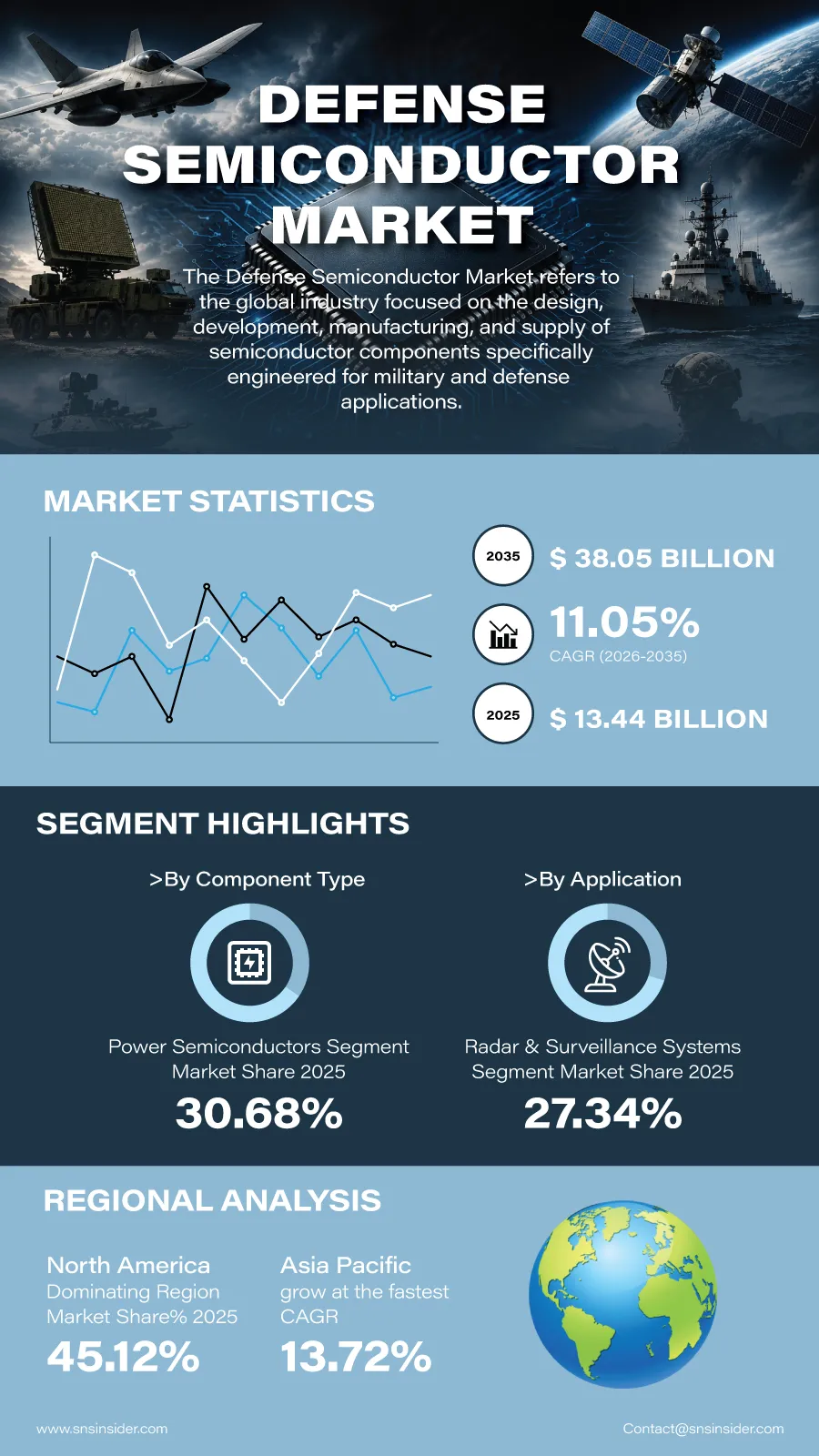
The global Defense Semiconductor Market is poised for significant expansion over the coming decade as governments strengthen military capabilities through next-generation electronics, autonomous systems, and advanced battlefield technologies. According to a recent study by SNS Insider, the global Defense Semiconductor Market size valued at USD 13.44 billion in 2025, is anticipated to grow to USD 38.05 billion by 2035, registering a CAGR of 11.05% over the 2026–2035 forecast period.
Rising geopolitical instability, the quick pace at which technology is advancing in defense, and the rising digitization of defense systems, the need for semiconductors that are tailored to meet the unique needs of the defense industry is steadily growing. Modern defense systems depend on efficient chips to control everything from radars to communication systems.
To Get Detailed Insights on the Defense Semiconductor Market – Request a Free Sample Report
Constant improvements in reliable semiconductors production, innovative packaging solutions, radiation-tolerant electronics, and secure processing architectures will only improve the prospects of the industry. As defense organizations focus on resilience of the supply chain and local production capabilities, semiconductor providers become strategic allies in national security programs.
Military Modernization Continues to Generate New Growth Opportunities
Various defense entities are quickly adopting electronics-rich platforms globally to enhance awareness and decision-making capabilities during operations on land, air, maritime, space, and cyberspace battlefields. The development has created steady growth potential for semiconductors that offer high performance but are reliable in harsh operating environments.
The increasing use of autonomous systems, unmanned platforms, artificial intelligence, and edge computing has opened up new opportunities for semiconductor suppliers of high-end processors, power devices, radio frequency devices, and embedded solutions. Growing spending on satellite constellations, missile defense systems, and electronic warfare solutions will also drive growth in the market going forward.
Moreover, various governmental programs promoting semiconductor production within their borders have created growth potential for defense suppliers to increase regional manufacturing and improve their supply chains.
Key Market Insights Highlight Shifting Demand Patterns
By component type, power semiconductors dominated with a 30.68% of global market revenue in 2025 due to their essential role in radar systems, electronic warfare platforms, power conversion, and advanced military electronics. Power semiconductors are also projected to register the fastest growth through 2035 with a CAGR of 12.80% as adoption accelerates across electrified defense platforms and high-energy military applications.
Based on application, radar and surveillance systems led with 27.34% of market revenue in 2025 as armed forces continue upgrading air defense networks with active electronically scanned array technologies. Electronic warfare is forecast to emerge as the fastest-growing application segment, expanding at a CAGR of 13.10% as military organizations strengthen electromagnetic spectrum capabilities.
By platform, aerospace applications, including aircraft, unmanned aerial vehicles, and satellites, represented a 32.45% of market revenue in 2025 because of their extensive semiconductor requirements for avionics, communications, and mission systems. Cybersecurity and intelligence platforms are expected to record the fastest growth through 2035, driven by increasing deployment of secure hardware architectures and advanced encryption technologies.
In terms of technology, digital semiconductors are expected to dominate market revenue in 2025 as defense platforms become increasingly software-defined and data-driven. RF and power semiconductors are projected to witness the strongest growth over the forecast period owing to expanding deployment of next-generation radar, communications, and electronic warfare systems.
An Infographic Representation of the Global Defense Semiconductor Market
Secure Electronics and AI Integration Transform Defense Capabilities
Today’s military platforms have become more dependent on semiconductors that help them achieve artificial intelligence and real-time analysis. Defense departments invest a significant amount in the development of processors offering increased processing power with cybersecurity, reliability, and immunity from electronic attacks.
Gallium nitride and silicon carbide materials, radiation hardening, secure hardware, and low-power processors are currently developed to fulfill new needs for their applications. It is expected that the emergence of these developments will increase demand in both modernization programs and novel platforms.
Regional Markets Demonstrate Strong Strategic Investment
It is anticipated that North America will contribute 45.12% to the world market revenue share in 2025 due to large-scale defense expenditures, highly sophisticated semiconductor fabrication processes, and numerous procurement activities in military electronics. This will be further strengthened with continued investments in foundry programs and advanced defense systems.
The Asia Pacific region is expected to exhibit the highest growth rate with a CAGR of 13.72% from 2022 to 2035. The increase in defense budget, rapid militarization, development of electronic manufacturing industries, and growing investments in sophisticated radars and missiles have driven regional demands.
As governments continue strengthening national security priorities while expanding domestic semiconductor ecosystems, demand for specialized defense-grade electronics is expected to rise steadily across both developed and emerging markets.
Industry Participants Focus on Trusted Manufacturing and Advanced Technologies
The competitive landscape remains highly dynamic owing to the continued investments by semiconductor manufacturers in analog, RF, secure processing, power electronics, and heterogeneous integration technologies. Collaborations between semiconductor companies and defense contractors and government organizations are still key in the development of future defense initiatives.
Key companies operating in the global Defense Semiconductor Market include Intel Corporation, Texas Instruments, Analog Devices, AMD (Xilinx), Microchip Technology, Infineon Technologies, NXP Semiconductors, STMicroelectronics, Qualcomm, Broadcom, Renesas Electronics, Maxim Integrated, ON Semiconductor, Lattice Semiconductor, Vishay Intertechnology, Raytheon Technologies, Lockheed Martin, BAE Systems, Northrop Grumman, and Boeing.
An SNS Insider analyst Santosh Bhul commented, “Growing investments in defense modernization, secure semiconductor manufacturing, and electronics-intensive military platforms are reshaping the global defense technology landscape. Companies that deliver trusted, high-performance, and resilient semiconductor solutions will be well positioned to capitalize on expanding procurement opportunities throughout the forecast period.”
About the Author

Get in touch