
Electric Toothbrush Market Report Scope & Overview:
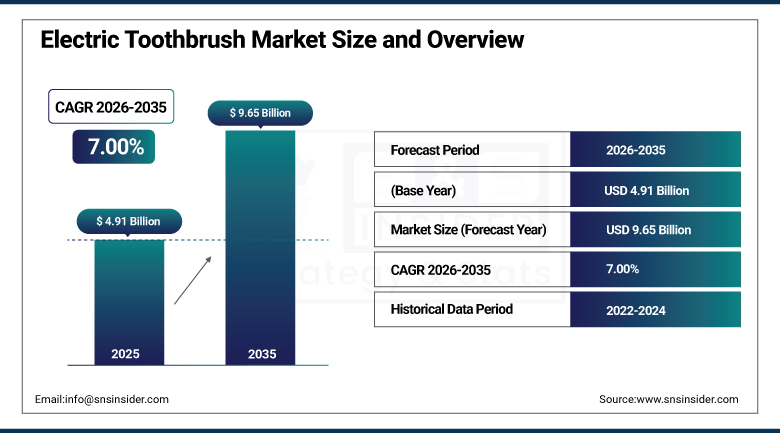
The Electric Toothbrush Market size was valued at USD 4.91 Billion in 2025 and is expected to reach USD 9.65 Billion by 2035, growing at a CAGR of 7.00% from 2026 to 2035.
Electric Toothbrush Market has been experiencing a growing trend owing to increasing disposable income and rising global awareness regarding oral hygiene practices. The continued support from dentists due to the clinical evidence that powered brushing can eliminate a significant amount of plaque compared to manual brushing is continuously fueling market growth, in addition to favorable regulatory classification in many key regions that helps shorten the innovation cycle. Declining price barriers are also contributing to the adoption rate of electric toothbrushes in many areas where connected electric toothbrushes are available at less than fifty dollars.
Royal Philips unveiled the new Philips Sonicare 6000 and Sonicare 6400 electric toothbrushes in September 2025, available exclusively at Walmart, featuring Next-Generation Sonicare technology designed to make the switch from manual brushing feel natural from day one while removing considerably more plaque than a manual toothbrush, even in hard-to-reach areas.
To Get more information On Electric Toothbrush Market - Request Free Sample Report
Electric Toothbrush Market Trends
-
Clinical acceptance that powered brushing removes considerably more plaque than manual methods continues reinforcing dentist recommendations.
-
Falling price thresholds are bringing connected electric toothbrush models below fifty dollars in several regions.
-
Sustainability regulation is pushing manufacturers toward rechargeable, modular, and recyclable product architectures.
-
Pharmacies are bundling electric toothbrushes with dental insurance enrollment to offset premium price differences.
-
Smart-device integration including app connectivity and real-time brushing feedback continues expanding across premium product tiers.
U.S. Electric Toothbrush Market Size Outlook
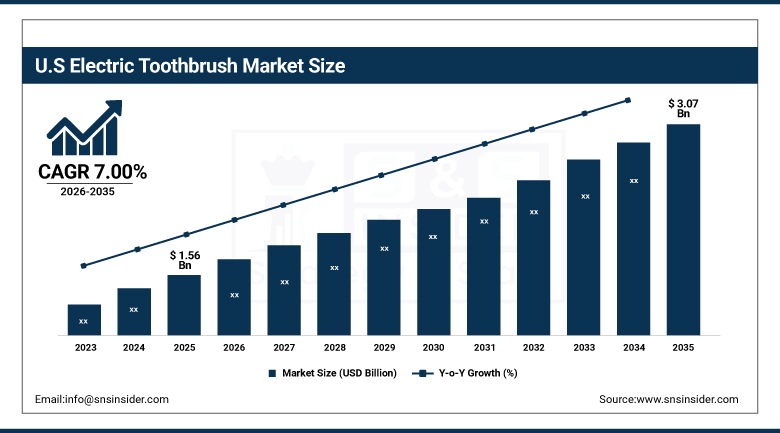
The U.S Electric Toothbrush Market was valued at USD 1.56 Billion in 2025 and is expected to reach USD 3.07 Billion by 2035, growing at a CAGR of 7.00% from 2026 to 2035.
The U.S. remained a dominant market in North American electric toothbrush sales due to high household penetration rates, solid online sales channels, and ongoing premiumization through connected products. The increase in prices showed that customers were ready to pay for advanced functionalities such as connectivity and instant feedback from the product. The country remained one of the top commercial markets for this technology in 2025.
Waterpik, based in Fort Collins, Colorado, received an NBC Select Wellness Award for its electric toothbrush in early 2025 with testers noting visibly cleaner teeth when using the product twice a day. The company has been focused on precision and innovation in dental products and is known not only for water flossers but also for its electric toothbrushes.
Electric Toothbrush Market Segment Analysis
-
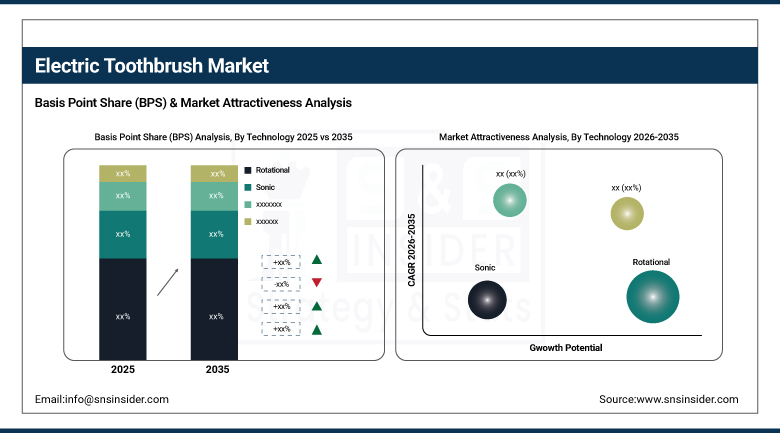
By Technology, the Rotational segment held approximately 58.10% share in 2025, while the Sonic segment is the fastest growing.
-
By End Use, the Adults segment held approximately 80.40% share in 2025, while the Kids segment is the fastest growing.
-
By Distribution Channel, the Supermarkets segment held approximately 43.68% share in 2025, while the Online Retail segment is the fastest growing, with a CAGR of approximately 9.56%.
-
By Price Tier, the Standard segment held the larger share in 2025, while the Premium segment is the fastest growing.
By Technology, Rotational led the market, Sonic grew fastest
Rotational was the leading segment in the technology type in 2025, accounting for an estimated share of 58.10% in terms of revenue, based on its proven mechanical simplicity and relatively cheaper production costs than the sonic counterparts. This combination of being affordable and having an approval from dentists has kept rotational technology as the go-to technology among the mainstream population when purchasing electric toothbrushes.
Sonic is expected to witness the fastest CAGR throughout the forecast period, based on clinical proof regarding the ability of sonic technology fluid dynamics to remove plaque not only where the bristle touches but even in hard to reach areas in between the teeth and gum line, which is impossible for rotational technology to achieve.
By End Use, Adults led the market, Kids grew fastest
The Adults segment held the largest end-use share in 2025, at approximately 80.40%, reflecting the broad base of adult consumers who represent the primary purchasing decision-makers for household oral care products. That purchasing power concentration keeps the adult end-use category firmly at the center of overall electric toothbrush demand across nearly every major market.
The Kids segment is projected to grow at the fastest CAGR during the forecast period, driven by growing pediatric dental health awareness campaigns and dental professional efforts to build proper oral hygiene habits from an early age. Rising parental willingness to invest in child-specific electric toothbrush models featuring app-based gamification and timers continues pushing this end-use segment's growth rate ahead of the broader end-use segmentation.
By Distribution Channel, Supermarkets led the market, Online Retail grew fastest
The Supermarkets Distribution Channel had the largest market share in 2025 of around 43.68%. This was due to the convenience of comparison between products before purchasing, and the guidance that comes with this distribution channel. The convenience and practicality associated with supermarkets and hypermarkets make it the dominant distribution channel among electric toothbrushes sold worldwide.
Online Retail Distribution Channel will be the fastest-growing segment with a compound annual growth rate of 9.56%. Online retail makes provision for customer comparisons, reviews, and also replacement of heads via subscriptions, which physical stores cannot provide. Online Retail will experience growth at a faster rate than the rest of the segments in distribution channel segmentation due to the regulation of prices and returns policy.
By Price Tier, Standard led the market, Premium grew fastest
The Standard segment held the larger price tier share in 2025, anchored by budget-conscious consumers and first-time electric toothbrush adopters who prioritize basic, reliable brushing functionality over advanced smart features. That broad affordability continues keeping standard-tier models the entry point of choice across the majority of first-time buyers transitioning from manual toothbrushes.
The Premium segment is projected to grow at the fastest CAGR during the forecast period, driven by rising average retail prices reflecting the shift toward smart-connected models featuring app connectivity, pressure sensors, and real-time brushing feedback. Growing consumer willingness to invest in premium personal care devices continues pushing this price tier's growth rate ahead of the broader price tier segmentation across established markets in particular.
Regional Analysis
|
Region |
Major Country |
Share within Region, 2025 (%) |
|---|---|---|
|
Europe |
Germany |
27.90% |
|
North America |
United States |
88.20% |
|
Asia Pacific |
China |
35.40% |
|
Middle East & Africa |
UAE |
26.20% |
|
Latin America |
Brazil |
37.70% |
Europe Electric Toothbrush Market Insights
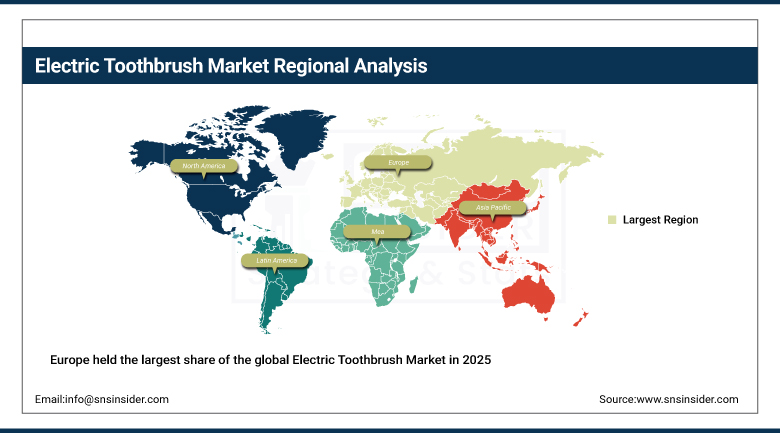
Europe held the largest share of the global Electric Toothbrush Market in 2025, at approximately 36.89%, supported by high emphasis on maintenance of good oral health, comparatively higher disposable income, and availability of advanced product variants across the region. Continued regulatory emphasis on sustainability, most notably battery regulation encouraging rechargeable and modular product architectures, kept Europe firmly ahead of every other region in this market throughout the year.
Germany accounted for roughly 27.90% of regional revenue, supported by strong dental health awareness and high disposable income among consumers. France, the United Kingdom, and Italy contributed significant additional regional demand through their own established oral care markets, reinforcing Europe's position as the clear global leader in electric toothbrush adoption.
Get Customized Report as per Your Business Requirement - Enquiry Now
North America Electric Toothbrush Market Insights
North America occupied a considerable market share within the global Electric Toothbrush Market in 2025 due to the presence of high household penetration up to forty-two to forty-five percent and high use of the e-commerce distribution channel. The subscription model and premiumization were the drivers of regional demand for the rest of the year.
The United States accounted for about 88.20% of regional revenues, owing to the presence of top oral care brands and higher expenditure on electric toothbrushes per capita. Canada accounted for the remaining portion of regional revenues, which grew continuously thanks to universal dental insurance coverage that stimulates referrals from dentists, thus making North America one of the most commercially attractive regions in 2025.
Asia Pacific Electric Toothbrush Market Insights
Asia Pacific was the fastest-growing region in the global Electric Toothbrush Market, with a CAGR near 8.74% through the forecast period, driven by rising disposable income and growing oral hygiene awareness across the region's largest and most populous economies. India in particular is projected to grow at a CAGR exceeding eleven percent over the forecast period, reflecting rapid consumer adoption of electric toothbrushes as a premium personal care category.
China accounted for roughly 35.40% of regional revenue, supported by rising middle-class disposable income and growing domestic electric toothbrush manufacturing capacity. Japan and South Korea contributed significant additional regional demand through their own advanced consumer electronics and personal care markets, reinforcing Asia Pacific's position as the clear growth leader in this market.
MEA & Latin America Electric Toothbrush Market Insights
The Middle East and Africa region recorded steady growth in electric toothbrush adoption in 2025, driven by rising disposable income and growing dental health awareness across the Gulf states in particular. The UAE accounted for roughly 26.20% of regional revenue, supported by rising consumer demand for premium personal care products.
Latin America expanded at a comparable pace, led by Brazil at roughly 37.70% of regional revenue, where growing middle-class disposable income continued to support category growth. Mexico and Argentina followed a similar trajectory as regional consumer electronics and personal care adoption expanded further through the remainder of the forecast period.
Growth Drivers: Clinical validation and rising oral hygiene awareness
Increasing disposable income and growing awareness regarding oral hygiene continue to be the central force behind electric toothbrush market growth, reinforced by clinical evidence that powered brushing removes considerably more plaque than manual methods. Dental awareness campaigns conducted by professional dental associations continue increasing consumer education regarding proper oral hygiene, particularly among children, reinforcing structural demand growth across the broader market.
Supportive regulatory categorization in major markets continues shortening innovation cycles and speeding new product approval, while falling price thresholds bring connected electric toothbrush models below fifty dollars in several regions. Technological advancements including app connectivity, pressure sensors, and real-time brushing feedback continue fueling market growth as consumers increasingly view electric toothbrushes as a genuine health technology investment rather than a simple hygiene commodity.
Restraints: Price sensitivity and replacement head costs
The high initial cost of electric toothbrush compared to that of a manual brush has remained a limitation to the uptake of the technology by consumers due to financial constraints especially in developing countries where disposable income is low. The cost associated with replacement heads, which can build up substantially over time, adds to the cost of ownership compared to manual toothbrushes.
The issues related to battery life and recharging facilities have remained a real challenge to the adoption of the electric toothbrush especially in areas where power availability is inconsistent. It becomes harder for electric toothbrushes to penetrate into such developing countries due to such challenges.
Opportunities: Premiumization and smart-connected feature expansion
Growing consumer willingness to invest in premium personal care devices presents substantial opportunity for manufacturers positioned to deliver smart-connected models featuring app-based coaching, pressure sensors, and personalized brushing programs. Manufacturers capable of differentiating through genuine clinical performance improvements stand to capture a growing share of demand as consumers increasingly research features before purchasing.
Expanding pharmacy bundling with dental insurance enrollment presents a further significant growth avenue, as this distribution strategy helps offset premium price differences and widens access to advanced electric toothbrush technology. Manufacturers and retailers capable of navigating insurance and loyalty program partnerships stand to capture meaningful new revenue streams as this channel continues maturing through 2035.
Recent Developments:
-
2026: Philips Sonicare introduced its refreshed brand platform Feel the Care alongside new toothbrush models spanning the 5000 through 7300 Series in March, marking the first major drivetrain upgrade to its Sonicare technology in more than a decade.
-
2026: Philips Sonicare launched the Next-Generation DiamondClean Series 9900 Prestige, the brand's first electric toothbrush powered by on-device artificial intelligence and real-time spatially aware brushing guidance.
-
2025: Colgate-Palmolive continued expanding its electric toothbrush lineup with designs prioritizing affordability and ease of use, targeting families and first-time electric brush adopters seeking a fuss-free brushing experience.
Electric Toothbrush Companies are:
-
Koninklijke Philips N.V.
-
Water Pik, Inc.
-
Church & Dwight Co., Inc.
-
Dr. Fresh, Inc.
-
Panasonic Holdings Corporation
-
Conair LLC
-
Foreo AB
-
Burst Oral Care Inc.
-
Quip NYC Inc.
-
Xiaomi Corporation
-
GSK plc
-
Spotlight Oral Care Ltd.
-
Suri Ltd.
-
Goby, Inc.
-
Bitvae
-
Fairywill
-
Oclean
-
MySmile
Electric Toothbrush Market Report Scope:
| Report Attributes | Details |
|---|---|
| Market Size in 2025 | USD 4.91 Billion |
| Market Size by 2035 | USD 9.65 Billion |
| CAGR | CAGR of 7.00% From 2026 to 2035 |
| Base Year | 2025 |
| Forecast Period | 2026-2035 |
| Historical Data | 2022-2024 |
| Report Scope & Coverage | Market Size, Segments Analysis, Competitive Landscape, Regional Analysis, DROC & SWOT Analysis, Forecast Outlook |
| Key Segments | • by Technology (Rotational, Sonic) • by End Use (Adults, Kids) • by Distribution Channel (Supermarkets, Online Retail, Pharmacies) • by Price Tier (Standard, Premium) |
| Regional Analysis/Coverage | North America (US, Canada, Mexico), Europe (Eastern Europe [Poland, Romania, Hungary, Turkey, Rest of Eastern Europe] Western Europe] Germany, France, UK, Italy, Spain, Netherlands, Switzerland, Austria, Rest of Western Europe]), Asia Pacific (China, India, Japan, South Korea, Vietnam, Singapore, Australia, Rest of Asia Pacific), Middle East & Africa (Middle East [UAE, Egypt, Saudi Arabia, Qatar, Rest of Middle East], Africa [Nigeria, South Africa, Rest of Africa], Latin America (Brazil, Argentina, Colombia, Rest of Latin America) |
| Company Profiles | Colgate-Palmolive Company, Koninklijke Philips N.V., Water Pik, Inc., Church & Dwight Co., Inc., Dr. Fresh, Inc., The Procter & Gamble Company, Panasonic Holdings Corporation, Conair LLC, Foreo AB, Burst Oral Care Inc., Quip NYC Inc., Xiaomi Corporation, GSK plc, Spotlight Oral Care Ltd., Suri Ltd., Goby, Inc., Bitvae, Fairywill, Oclean, MySmile |

Frequently Asked Questions
The Electric Toothbrush Market is expected to grow at a CAGR of 7.00% from 2026 to 2035.
The Electric Toothbrush Market was valued at USD 4.91 Billion in 2025.
Increasing disposable income combined with growing awareness regarding oral hygiene and clinical validation of powered brushing is the major growth factor.
The Rotational segment held approximately 58.10% share in 2025.
Europe held the largest share of the Electric Toothbrush Market in 2025, at approximately 36.89%, while Asia Pacific was the fastest-growing region.
