
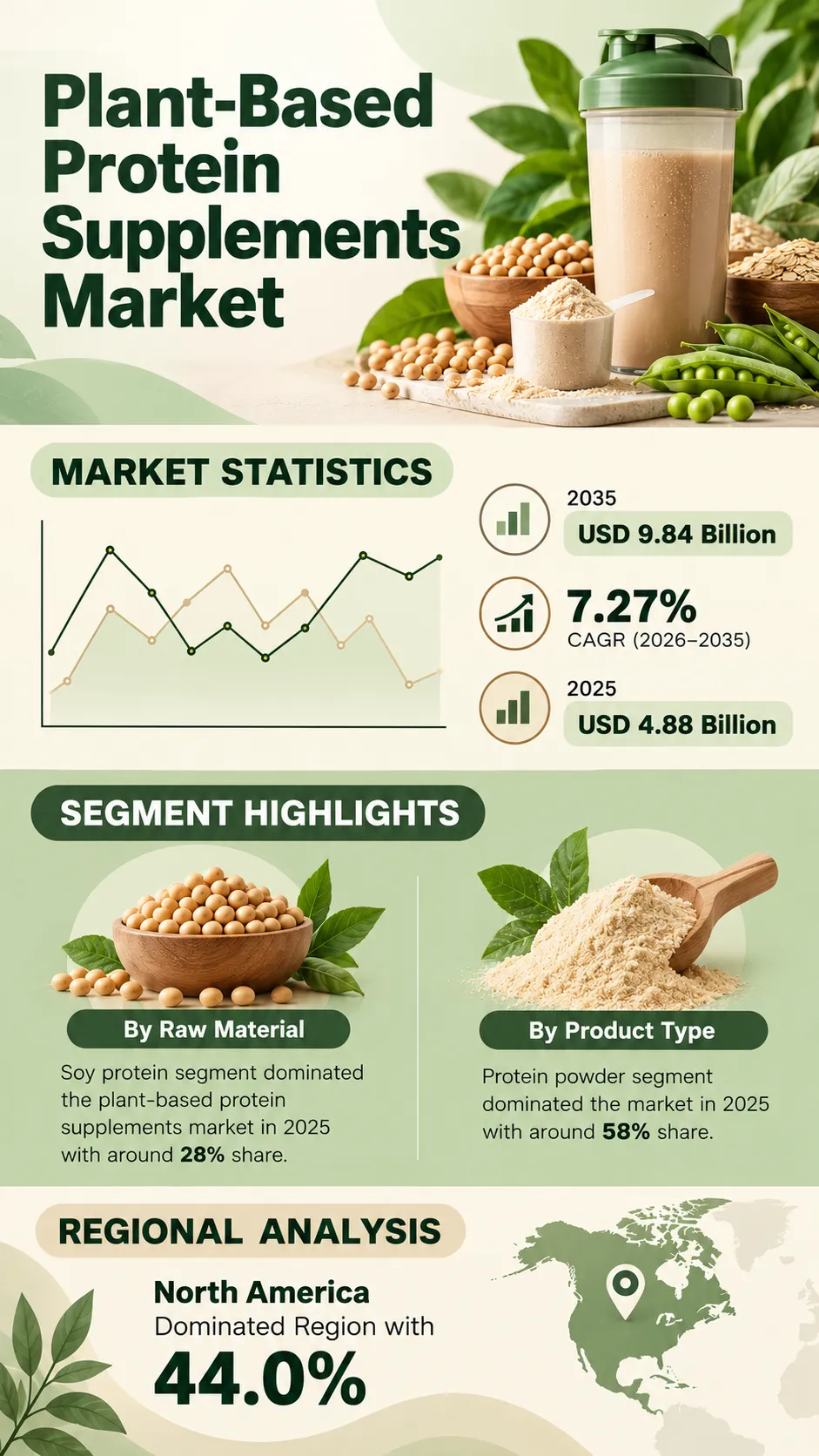
The global Plant-Based Protein Supplements Market is set for steady expansion as health-conscious and environmentally aware consumers worldwide continue embracing dairy-free protein alternatives. “According to a recent study by SNS Insider, the global Plant-Based Protein Supplements Market size valued at USD 4.88 billion in 2025, is anticipated to grow to USD 9.84 billion by 2035, registering a CAGR of 7.27% over the 2026-2035 forecast period.”
There have been notable changes within plant-based protein formulation and positioning over time, due to which many brands aiming at improving taste, texture, and quality verification can take advantage of this trend. This includes the need for more palatable, purpose-built products that will provide consumers with the ability to meet nutritional needs without dairy or animal-based ingredients. This applies in situations where plant-based protein supplements are used for sports nutrition, general wellness, and weight management purposes.
Brands are constantly working to ensure that their plant-based protein products perform better than before in order to meet various needs of health-conscious and environmentally aware consumers.
To Get Detailed Insights on the Plant-Based Protein Supplements Market – Request a Sample Report
Multi-Source Protein Ecosystems Create New Demand
The plant-based protein supplements market has evolved from basic single-source soy formulations to more advanced multi-source blends and ready-to-drink use cases. The growing investment in taste improvement, quality verification, and sustainable sourcing for a variety of applications has required the development of more efficient and reliable formulation systems.
New approaches to plant-based protein formulation can increase palatability, improve consumer trust through rigorous quality verification, and allow for broader application versatility across sports nutrition and general wellness sectors. This gives brands the possibility to be more effective when reaching health-conscious consumers and doing better product differentiation.
Supplement brands, ingredient suppliers, and agricultural producers are increasingly cooperating thanks to the growing interest in developing future solutions for sustainable protein nutrition.
Key Market Findings Highlight High-Growth Segments
The soy protein category has been dominant in the Plant-Based Protein Supplements Market, contributing a revenue share of 28% in 2025, as it is well accepted by consumers and offers a complete amino acid profile.
The pea protein category has been forecasted to experience the highest rate of growth because of increasing consumer inclination toward soy-free, allergen-friendly protein sources.
On the basis of application, sports nutrition & fitness was the biggest revenue contributor in 2025, accounting for 46%, because of widespread athlete and fitness enthusiast adoption. General wellness & weight management is anticipated to show the highest growth as more mainstream consumers adopt plant-based protein for broader health reasons.
By distribution channel, retail stores accounted for 64% of market revenue in 2025, owing to consumer preference for established grocery and specialty retail channels. On the other hand, the online channel is expected to grow at the highest rate driven by the growth of direct-to-consumer supplement brands and greater accessibility.
Quality, Taste, and Innovation Gain Importance
In this regard, brands have been looking at formulations that would make their products safer, better tasting, and more nutritionally complete.
Innovation in multi-source protein blending, quality verification, and taste improvement has been making it possible for companies to come up with products that can meet increasingly demanding consumer expectations. In addition to that, increasing emphasis on rigorous safety testing and ready-to-drink format expansion is also making it possible for companies to find solutions that optimize consumer trust.
Such trends are likely to become even more prominent in the future.
North America Emerges as the Largest Market Amid Rising Vegan and Flexitarian Adoption
The North America region represented the largest share of global market revenue in 2025, owing to the region’s strong consumer demand for dairy-free protein alternatives and presence of well-established plant-based protein brands. In addition, Asia Pacific is expected to be the fastest-growing market during the forecast period, propelled by expanding e-commerce accessibility and rising health consciousness across the region’s large population base.
On the other hand, Europe represented a significant share of global market revenue in 2025, aided by strong consumer demand for sustainable and dairy-free nutrition products.
Leading Companies Drive Innovation and Competition
The environment continues to stay dynamic since players continue innovating on formulations and quality verification processes as well as forming partnerships in order to enhance their position in the industry.
Some of the major companies that operate in the global plant-based protein supplements market are Garden of Life LLC, Vega (Danone S.A.), Orgain, Inc., Ancient Nutrition, Sunwarrior, LLC, NOW Health Group, Inc., Nutiva, Inc., Naked Nutrition.
An SNS Insider Analyst Parry Kardani commented, “The rapid evolution of quality-verified, multi-source plant-based protein technology is creating unprecedented demand for high-quality dairy-free nutrition products. Brands that successfully combine taste innovation, rigorous safety verification, sustainable sourcing, and advanced formulation capabilities will be best positioned to capitalize on emerging opportunities across sports nutrition, general wellness, and weight management applications.
About the Author

Get in touch




