
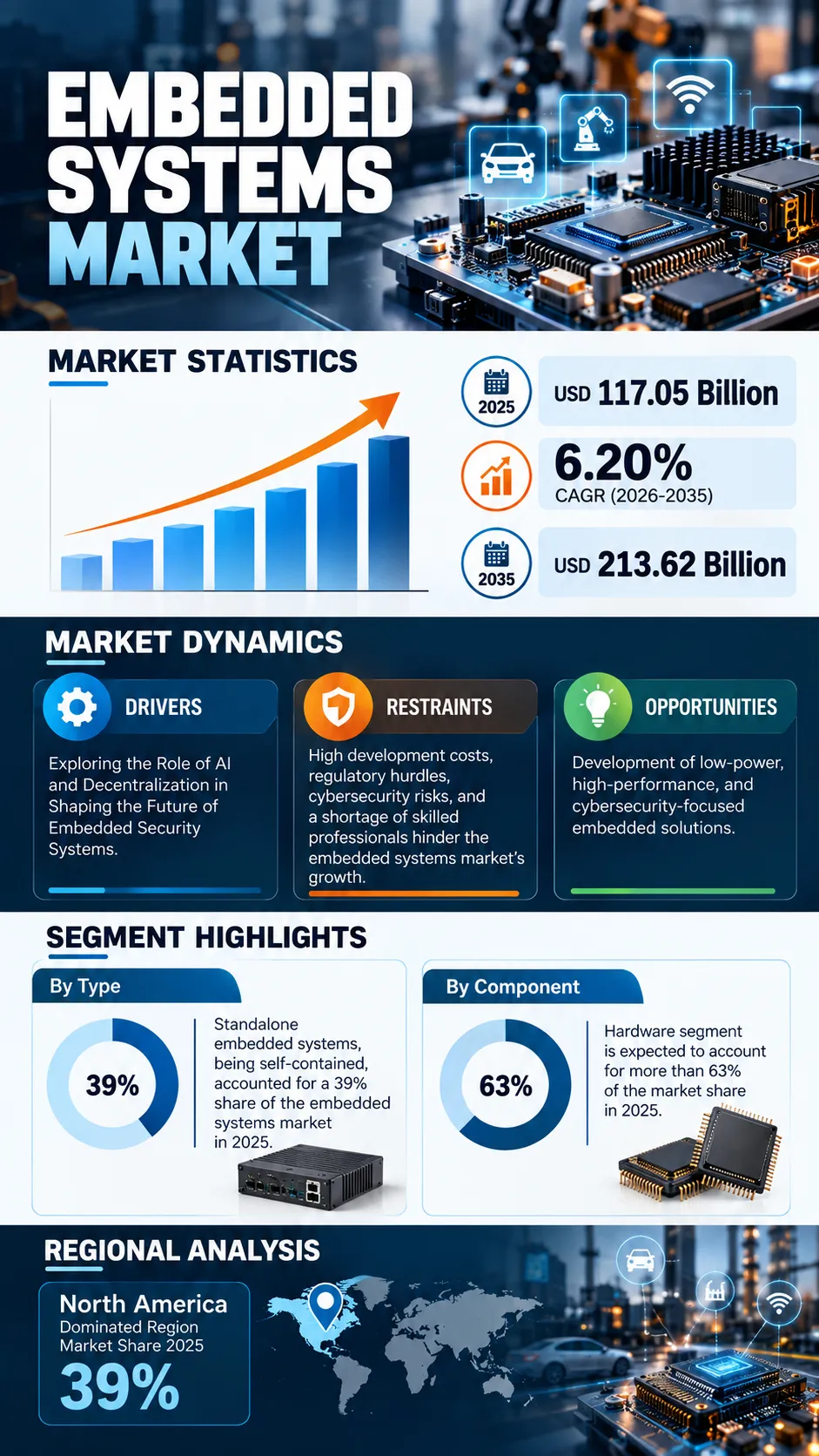
Embedded Systems Market is poised for consistent growth as companies within various industries like automotive, industrial, consumer electronics, health care, and connected devices become more dependent on intelligent computing architectures. “According to a recent study by SNS Insider, the global Embedded Systems Market size valued at USD 117.05 billion in 2025, is anticipated to grow to USD 213.62 billion by 2035, registering a CAGR of 6.20% over the 2026–2035 forecast period.”
Due to the fast growth of technologies related to connectivity, there is an emerging need for small-size but efficient computing systems designed to handle specialized operations. Car electronics, smart home appliances, production equipment, healthcare devices, and communication tools require higher computing power and create a steady demand for embedded hardware and software.
Furthermore, with the development of artificial intelligence and Internet of Things technologies, the use of embedded systems is becoming more relevant because of the benefits that can be achieved by the proximity of information processing.
To Get Detailed Insights on the Embedded Systems Market – Request a Sample Report
Connected Technologies Create New Growth Opportunities
The development of interconnected devices increases the reach of the embedded processing, controller, sensor, and communication components market. In the context of enterprise adoption of automation and digital equipment, embedded technology is gaining significance because of its capability of monitoring, controlling, and decision-making in real time.
The automotive industry also represents another promising growth opportunity. The technology used by electric cars, self-driving automobiles, and driver-assistance solutions should be quite advanced since it must manage power, sensing, safety, communication, and control of the automobile.
Meanwhile, industrial enterprises have been developing embedded technologies as a way to upgrade their manufacturing infrastructure. Manufacturing systems are becoming more dependent on real-time computing capabilities.
Key Market Insights Highlight Shifting Demand Patterns
By type, standalone embedded systems held around 39% of the global market revenues in 2025. They are characterized by their special design and reliability, hence making them applicable for uses that require special functions in automotive, medical, industrial, and consumer electronics settings.
Based on component, hardware was expected to account for more than 63% of the market share revenue by 2025. Microcontrollers, processors, sensors, and other semiconductor parts continue to be important for embedded systems as companies seek greater processing power, compactness, and energy savings.
In addition, the further development of Internet of Things-connected products is leading to greater demand for embedded hardware that can be used to ensure wireless connectivity and perform other tasks related to the processing of information locally. It is equally important to stress that software abilities are becoming much more relevant.
AI and Edge Computing Reshape Embedded System Development
The incorporation of artificial intelligence into embedded systems is bringing about opportunities in terms of self-governance and analysis in real time. With intelligent embedded systems, information processing can be done on the spot, making it possible to make faster decisions in areas, such as vehicle safety, robot manufacturing, medical diagnostics, and intelligent infrastructure.
The area of cybersecurity, on the other hand, is becoming equally important as devices grow more and more connected. Device manufacturers are installing security processors and other measures to protect devices against attacks.
North America Captures 39% Embedded System Market Revenue as Asia Pacific Expands Rapidly
The North America market is expected to continue to dominate with about 39% share of worldwide revenues in 2025 due to heavy investment in artificial intelligence, Internet of Things, industrial automation, automotive electronics, aerospace, and semiconductor technologies. In addition, there is a well-developed research and development environment that contributes to innovation in embedded systems.
The Asia Pacific region will register the highest growth rate during the forecast period. Manufacturing capacity expansion, smart city projects, automotive manufacturing, robotics, and electronics in China, India, Japan, and South Korea create considerable demand for embedded solutions.
Moreover, Europe continues to show its steady growth through investment in industry 4.0, connected cars, industrial automation, edge computing, and secure digital technology. Latin America and the Middle East & Africa are growing their adoption of embedded systems slowly but steadily.
Industry Participants Focus on Advanced Embedded Platforms
The competitive environment is still very much driven by technology, with semiconductor firms and computing businesses working on processors, microcontrollers, sensors, cybersecurity technologies, and even artificial intelligence. Companies are working on better performance, lower energy needs, cybersecurity, and increasingly complicated architectures in both automotive and industrial sectors.
Key companies operating in the global Embedded Systems Market include Renesas Electronics, STMicroelectronics, Infineon Technologies, Texas Instruments, Qualcomm, NXP Semiconductors, Microchip Technology, Analog Devices, Intel Corporation, Advanced Micro Devices, Broadcom, Cisco Systems, Samsung Electronics, IBM, Micron Technology, Qualcomm Technologies International, ON Semiconductor, MediaTek, and NVIDIA Corporation.
An SNS Insider analyst Sushant Kadam commented, “The growing convergence of AI, IoT, edge computing, and intelligent automation is expanding the role of embedded systems across major industries. Demand for secure, energy-efficient, and high-performance computing architectures is expected to remain a central factor shaping product development and investment opportunities through 2035.”About the Author

Get in touch




