
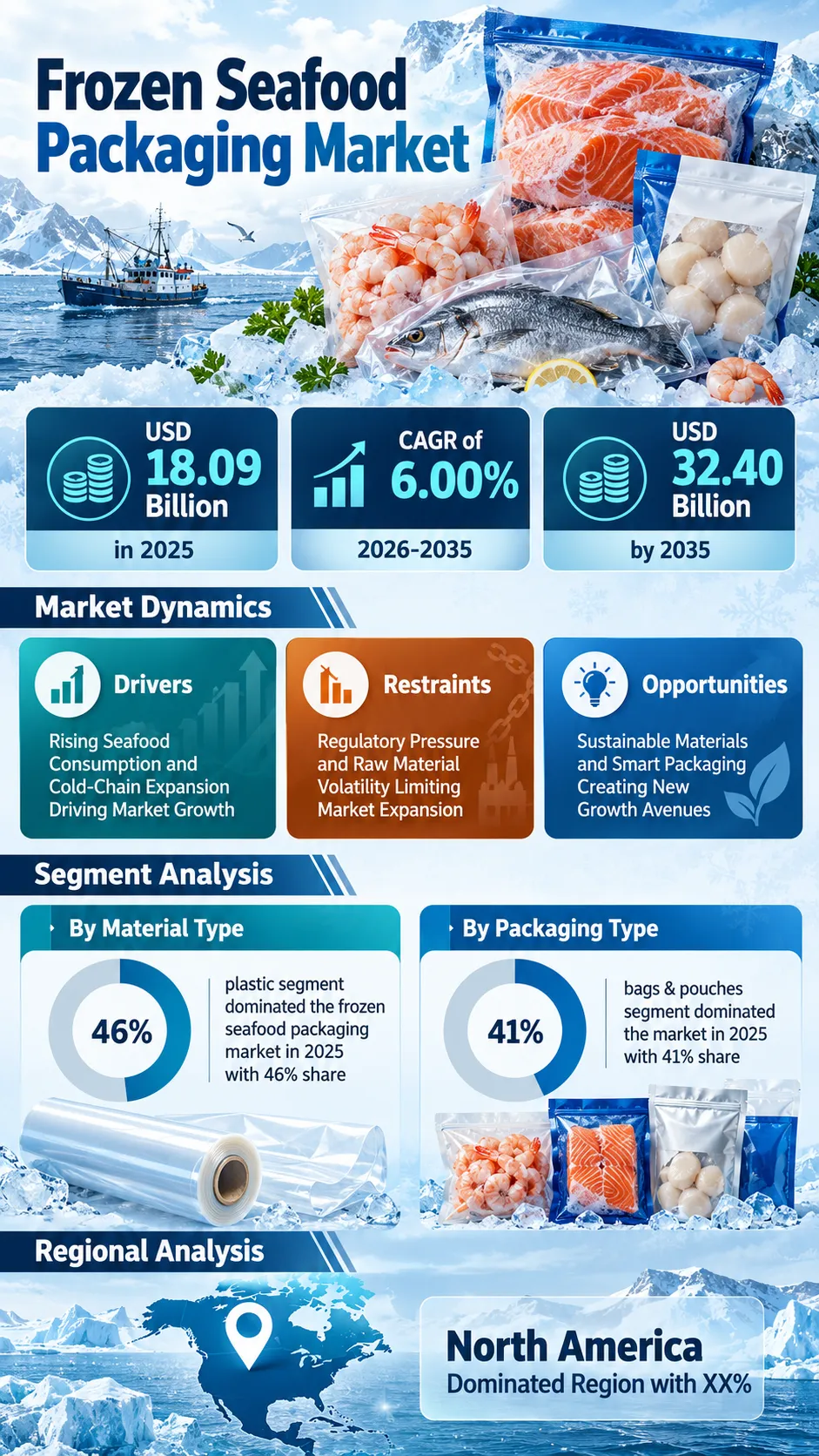
The global Frozen Seafood Packaging Market is set for steady expansion as rising seafood consumption and expanding cold-chain infrastructure continue to reshape packaging demand worldwide. “According to a recent study by SNS Insider, the global Frozen Seafood Packaging Market size valued at USD 18.09 billion in 2025, is anticipated to grow to USD 32.40 billion by 2035, registering a CAGR of 6.00% over the 2026-2035 forecast period.”
There have been notable changes within frozen seafood packaging formulation and positioning over time, due to which many manufacturers aiming at improving barrier performance and sustainability can take advantage of this trend. This includes the need for more recyclable, freezer-grade, and traceable packaging solutions that will provide processors with the ability to meet retailer and consumer expectations across retail, foodservice, and export categories. This applies in situations where frozen seafood packaging is used for retail display, bulk export, and direct-to-consumer delivery purposes.
Manufacturers are constantly working to ensure that their frozen seafood packaging products perform better than before in order to meet various needs of sustainability-focused and quality-conscious seafood processors.
To Get Detailed Insights on the Frozen Seafood Packaging Market – Request a Sample Report
Sustainable Barrier Solutions Create New Demand
The frozen seafood packaging market has evolved from basic multilayer plastic films to more advanced recyclable and fiber-based barrier formats. With the increasing use of mono-material films, freezer grade coated paperboard, and freshness-indicating technology, there has been an increasing need for the use of more efficient packaging solutions.
A new method of packaging frozen seafood products will not only help in improving shelf life and sustainability of the product but will also help in providing more versatility to the product. The manufacturers will be in a position to effectively market the products to sustainability-driven processors.
Packaging manufacturers, seafood processors, and material science companies are increasingly cooperating thanks to the growing interest in developing future solutions for recyclable, high-barrier frozen seafood packaging.
Key Market Findings Highlight High-Growth Segments
The plastic category has been dominant in the Frozen Seafood Packaging Market, contributing a revenue share of 46% in 2025, as it offers strong moisture barrier performance and cost-effective compatibility with vacuum sealing processes.
The paper & paperboard category has been forecasted to experience the highest rate of growth because of increasing regulatory pressure toward recyclable, curbside-collectible packaging formats.
On the basis of application, fish was the biggest revenue contributor in 2025, accounting for 39%, because of high global consumption volumes and established cold-chain distribution networks. Shrimp & crustaceans is anticipated to show the highest growth as global shrimp aquaculture output continues to expand.
By distribution channel, supermarkets & hypermarkets accounted for 54% of market revenue in 2025, owing to consumer preference for established retail chains with reliable cold-chain handling. On the other hand, the online retail channel is expected to grow at the highest rate driven by expanding grocery delivery and subscription-based seafood box services.
Barrier Performance, Recyclability, and Traceability Gain Importance
In this regard, manufacturers have been looking at formulations that would make their products more protective, more recyclable, and more convenient for cold-chain handling.
Innovation in barrier film technology, freezer-grade coatings, and traceable sourcing has been making it possible for companies to come up with products that can meet increasingly demanding retailer and regulatory expectations. In addition to that, increasing emphasis on smart packaging and sustainability positioning is also making it possible for companies to find solutions that optimize processor and consumer trust.
Such trends are likely to become even more prominent in the future.
North America Emerges as the Largest Market Amid Rising Cold-Chain Investment
The North America region represented the largest share of global market revenue in 2025, owing to the region's high per-capita seafood consumption and well-established cold-chain logistics infrastructure. In addition, Asia Pacific is expected to be the fastest-growing market during the forecast period, propelled by expanding seafood processing and export capacity across the region's large population base.
On the other hand, Europe represented a significant share of global market revenue in 2025, aided by strong seafood consumption traditions and well-established regulatory frameworks governing food-contact packaging.
Leading Companies Drive Innovation and Competition
The environment continues to stay dynamic since players continue innovating on barrier film formulations and recyclable materials as well as forming partnerships in order to enhance their position in the industry.
Some of the major companies that operate in the global frozen seafood packaging market are Amcor plc, Sealed Air Corporation, Crown Holdings Inc., Sonoco Products Company, Mondi Group, DS Smith plc, Huhtamaki Oyj, Constantia Flexibles Group GmbH.
An SNS Insider Analyst commented, “The rapid evolution of recyclable, high-barrier frozen seafood packaging technology is creating unprecedented demand for sustainable, freezer-grade protective solutions. Manufacturers that successfully combine barrier performance, recyclability, traceability capabilities, and advanced film formulation technology will be best positioned to capitalize on emerging opportunities across retail, foodservice, and export applications.”
About the Author

Get in touch




