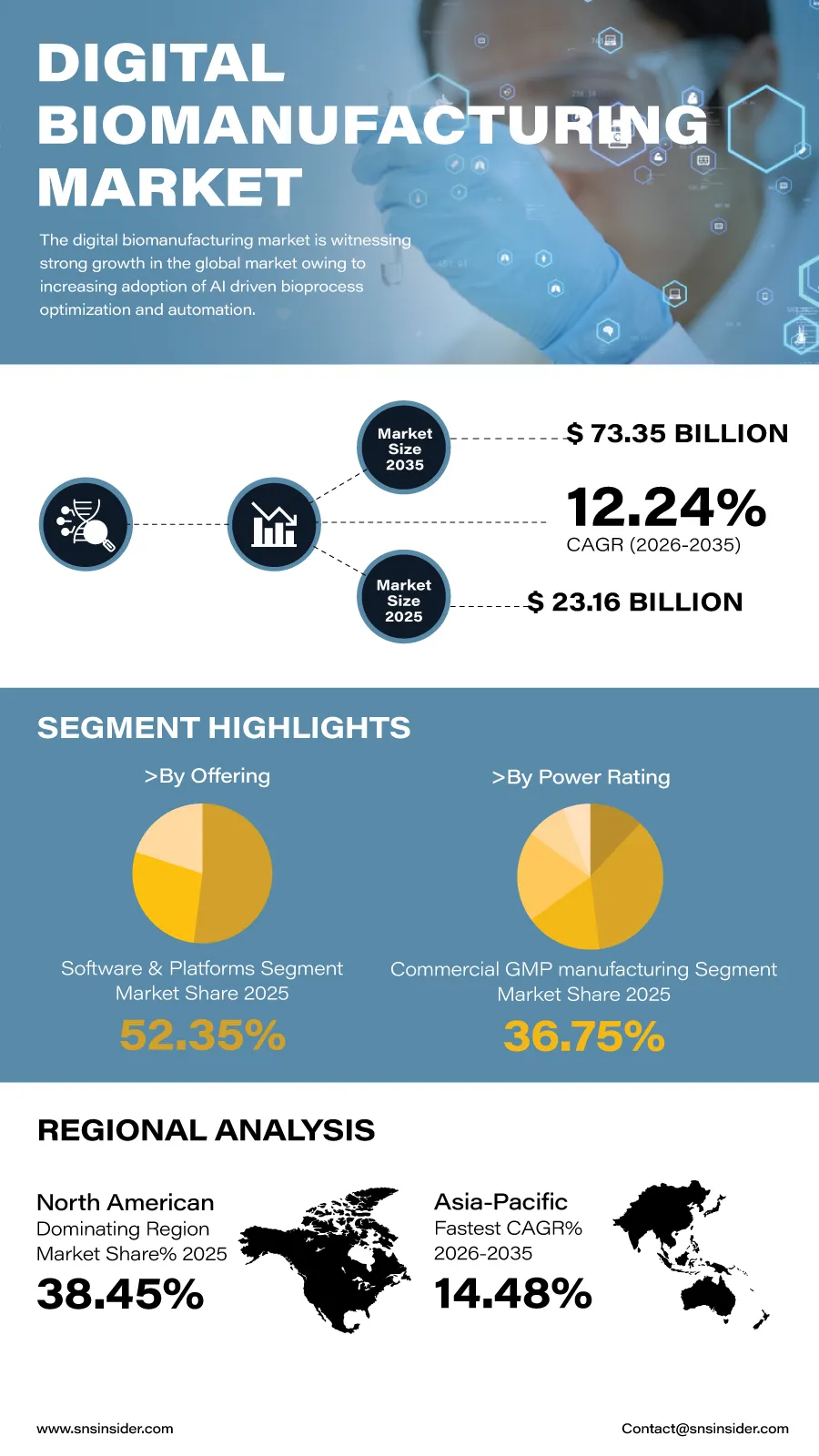
The global Digital Biomanufacturing Market is anticipated to grow at a very high level in the upcoming decade owing to rising investment by pharmaceutical and biotech companies towards advanced manufacturing technologies that facilitate improved efficiency, productivity and effectiveness of the production process. “According to a recent study by SNS Insider, the global Digital Biomanufacturing Market size valued at USD 23.16 billion in 2025, is anticipated to grow to USD 73.35 billion by 2035, registering a CAGR of 12.24% over the 2026–2035 forecast period.”
Digitization is evolving by adopting advanced manufacturing processes, which utilizes digitally connected manufacturing operations for the production for biologicals, vaccines, cell and gene therapies and many other advanced therapeutics.
The trends of digitization are evolving day by day in the industrial sector which often leads to an increasing focus on production technologies that can support decision-making, optimizing production performance, etc.
To Get Detailed Insights on the Digital Biomanufacturing Market – Request a Free Sample Report
Intelligent Manufacturing Technologies Drive Industry Transformation
Digital still drives innovations across modern biomanufacturing with advanced analytics, cloud computing, automation, artificial intelligence and connected manufacturing processes. These innovations are allowing companies to optimize their processes for production time and resource efficiency over the entire manufacturing process.
More smart manufacturing plants will be enhanced by pharmaceutical companies for resilient manufacturing and massive production of the next generation biologics, as well as tailored medicines. Besides, companies are also trying to connect digitally all the processes like research and development, quality management and commercial manufacturing.
The evolution of a greater data-driven manufacturing approach would certainly be one of the crucial pillars to just how our industry will develop in future.
Key Market Findings Highlight Emerging Opportunities
Due to the large-scale adoption of digital manufacturing solutions for operational management and production optimization, software and platforms accounted for 52.35% of global market revenues in 2025.
Moreover, based on growth rate from 2026-2035, services segment is projected to be the fastest-growing segment during the same period demonstrating a CAGR of 16.03% through this time due to high demand for implementation, validation and integration as well as digital transformation consulting in pharmaceutical manufacturing facilities.
In terms of technology, manufacturing execution systems and electronic batch records accounted for 30.80% towards the market revenue in 2025 and consistently enabled production control and compliance improvements, which further supported the implementation of digitization across industries. However, the Artificial Intelligence, Machine learning, advanced Analytics Technologies are forecasted to be the fastest-growing technology with a CAGR of 19.28% from 2026-2035.
Regarding application fields, commercial GMP manufacturing execution held 36.75% share in terms of revenue in 2025 and the fastest growing applications projected are technology transfer and facility digitalization, at a CAGR of 16.38%, due to increasing investments in scalable manufacturing infrastructure.
Conversely, pharmaceutical and biotechnology companies accounted for 58.90% share of market revenues in the year 2025; contract manufacturing organizations (CMO), and contract development and manufacturing organizations (CDMO) will record the fastest growth with a CAGR of 16.18%.
An Infographic Representation of the Global Digital Biomanufacturing Market
Digital Innovation Supports Next-Generation Biopharmaceutical Manufacturing
With all the complexities of biologics manufacturing, many companies have adopted intelligent manufacturing systems that assist with creating processes that are uniform and thereby lower risk. Digital manufacturing technologies are enabling enhanced manufacturing teams collaboration, process visibility and process efficiency.
Connected manufacturing is also useful for making the production flexible, technology transfer and ensuring that quality assurance performed across the life of products. These qualities have become more and more necessary because of the expanding demands for biologics and personalization medicines.
Regional Markets Continue to Expand
In 2025, due to the presence of an advanced existing biopharmaceutical manufacturing infrastructure combined with increased levels of digitization and investments into automation and smart production, North America held the higher overall revenue market share at 38.45%. North America remains at the forefront of digital pharmaceutical manufacturing innovation.
Conversely, Asia Pacific will account for the most rapid growth in the full market; it is predicted to grow 14.48% CAGR through 2035. These are fast growing due to advanced biotech manufacturing, rising investment for smart factory and government support with improved drug manufacturing options against other manufactures.
Industry Leaders Continue to Accelerate Digital Transformation
The rapid competitive environment of the digital biomanufacturing space is primarily due to investments made by large technology firms and pharmaceutical companies in automation, artificial intelligence, cloud manufacturing platforms and integrated collaboration strategies for these global manufacturers looking to transform their manufacturing processes.
Key companies operating in the global digital biomanufacturing market include Danaher Corporation, Sartorius AG, Thermo Fisher Scientific, Merck KGaA, Lonza Group, FUJIFILM Holdings, Samsung Biologics, WuXi AppTec, Roche, and Siemens AG.
An SNS Insider analyst Parry Kardani commented, "Digital technologies are becoming fundamental to the future of biopharmaceutical manufacturing. Organizations that successfully integrate intelligent automation, advanced analytics, and connected manufacturing platforms will be better positioned to improve efficiency, maintain regulatory compliance, and support the growing global demand for advanced therapies.”
About the Author

Get in touch