
Digital Biomanufacturing Market Report Scope & Overview:
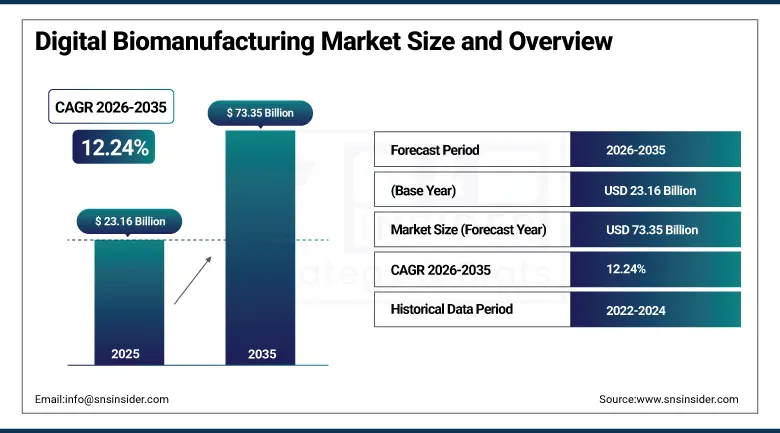
The Digital Biomanufacturing Market was valued at USD 23.16 billion in 2025 and is expected to reach USD 73.35 billion by 2035, growing at a CAGR of 12.24% from 2026–2035.
The digital biomanufacturing market is witnessing strong growth in the global market owing to increasing adoption of AI driven bioprocess optimization and automation. Rising demand for biologics and advanced therapies is supporting market expansion. Expanding digital transformation in pharmaceutical manufacturing is driving operational efficiency. Manufacturers are focusing on integrated data platforms and real time monitoring systems. Growing adoption of digital twins and predictive analytics is improving process accuracy. Increasing emphasis on compliance, quality control, and cost efficiency is further accelerating market adoption.
According to the FDA Emerging Technology Program and the EMA 2025 Advanced Manufacturing Guidance, the implementation of continuous bioprocessing for the manufacture of biologics has risen in regulated facilities, with more than 30% of biologics manufacturing submissions utilizing process analytical technology frameworks.
According to the implementation guidelines of the International Council for Harmonisation, the concept of continuous manufacturing has been adopted in more than 60% of the regulatory bodies belonging to its membership. Besides, the OECD biotechnology indicators state that more than 70% of the industrial biotech facilities have now adopted some form of digital process monitoring or automation technology.
To Get more information On Digital Biomanufacturing Market - Request Free Sample Report
Digital Biomanufacturing Market Trends
-
-
Artificial intelligence and machine learning have been adopted rapidly which makes bioprocess optimization and manufacturing more efficient worldwide.
-
Cloud solutions enable real-time availability of data and remote monitoring along with integration of biomanufacturing systems.
-
Industry 4.0 solutions have revolutionized the manufacturing process through automation and intelligent manufacturing process.
-
The need for biopharmaceuticals and personalized medicines has increased the adoption of digital biomanufacturing solutions globally.
-
Decentralization and flexibility in the manufacturing process ensures scalability and quick response to market needs.
-
The investments in digital ecosystems made by pharmaceutical companies have enhanced efficiency and productivity.
-
U.S. Digital Biomanufacturing Market Outlook.
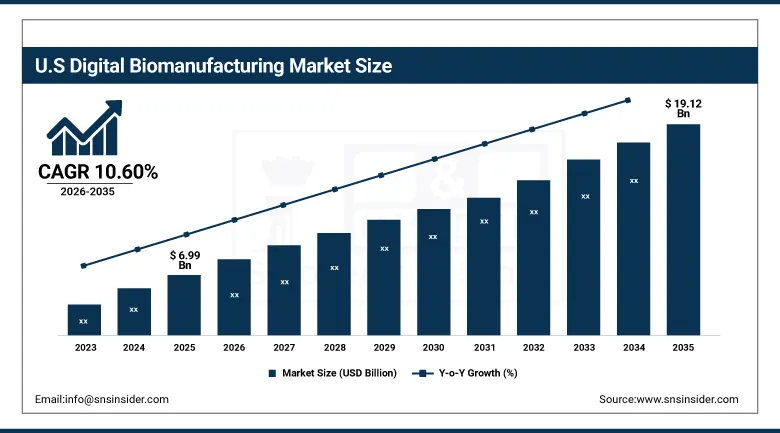
The U.S. Digital Biomanufacturing Market was valued at USD 6.99 billion in 2025 and is expected to reach around USD 19.12 billion by 2035, growing at a CAGR of 10.60% from 2026–2035.
The U.S. digital biomanufacturing market is witnessing strong growth owing to advanced biopharmaceutical manufacturing infrastructure. Increasing adoption of AI driven bioprocess automation is supporting market expansion. Rising demand for biologics and cell and gene therapies is driving digital transformation. Expansion of smart manufacturing execution systems is improving production efficiency. Growing use of digital twins and real time analytics is enhancing process accuracy. Increasing focus on regulatory compliance and quality optimization is further accelerating market adoption.
According to the highly developed manufacturing operations of the Food and Drug Administration in 2025 and the biomanufacturing innovations performed by the National Institute of Standards and Technology, more than 60% of biologics manufacturers in the USA use digital process control systems which involve automated bioreactors and real-time analytics. According to the HHS’ updates regarding its strategy for pandemic preparedness and bioindustries, the percentage of continuous manufacturing in the approved biologics manufacturing facilities is greater than 25%.
Digital Biomanufacturing Market Segment Analysis
-
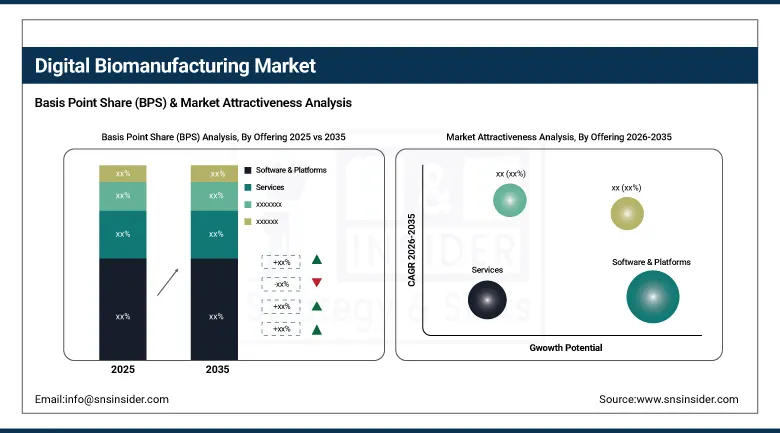
By Offering, software & platforms dominated the market with 52.35% share in 2025; while services are the fastest growing segment with CAGR of 16.03% during 2026 to 2035.
-
By Type, manufacturing execution & electronic batch records dominated the market with 30.80% share in 2025; while AI, machine learning & advanced analytics is the fastest growing segment with CAGR of 19.28% during 2026 to 2035.
-
By Application, commercial GMP manufacturing execution dominated the market with 36.75% share in 2025; while technology transfer & facility digitalization is the fastest growing segment with CAGR of 16.38% during 2026 to 2035.
-
By End User, pharmaceuticals & biotechnology companies dominated the market with 58.90% share in 2025; while CMOs & CDMOs is the fastest growing segment with CAGR of 16.18% during 2026 to 2035.
By Offering, software & platforms dominated the digital biomanufacturing market, while services are the fastest growing segment.
The software & platforms market segment was leading the digital biomanufacturing market based on the highest revenue share in 2025. The major factors contributing to the dominance of this market segment include high acceptance of digital technologies such as manufacturing execution systems, electronic batch record systems, and data integration platforms that facilitate real-time monitoring and process optimization and ensure compliance requirements. The growing necessity for scalable and automated biomanufacturing processes further augments the demand for these digital tools among pharma and biotechnology organizations across the globe.
The services market segment is projected to register the fastest CAGR from 2026-2035. The key factors behind the fast-paced growth of this market segment include the increasing demand for implementation services, integration services, and managed services in digital biomanufacturing. The organizations are now relying on third-party service providers for implementing and validating AI technologies.
By Type, manufacturing execution & electronic batch records dominated the digital biomanufacturing market, while AI, machine learning & advanced analytics is the fastest growing segment.
Manufacturing Execution & Electronic Batch Records Segment captured the dominated revenue share in digital biomanufacturing market in 2025 owing to the essentiality of the segment for compliance, batch traceability, and standardization of production processes. Increasing implementation of MES software solutions in biopharmaceutical manufacturing plants will ensure better control and higher data integrity. Increased demand for automation of documentation and production process monitoring adds value to the market's growth.
AI, Machine Learning, & Advanced Analytics Segment is projected to register the fastest CAGR during 2026-2035 owing to growing adoption of intelligent bioprocess optimization and predictive models. This will facilitate faster decision making and greater yield efficiencies as well as reduce production cost. Increasing adoption of digital twin and cloud computing platforms will expedite innovations. Increased adoption for personalized medicines and development of biologics will fuel market growth.
By Application, commercial GMP manufacturing execution dominated the digital biomanufacturing market, while technology transfer & facility digitalization is the fastest growing segment.
Commercial GMP Manufacturing Execution Segment dominated digital biomanufacturing market with the dominated market share in 2025 because of its significant contribution to biologics manufacture on large scale. The segment ensures regulatory compliance, standardization of processes, and real-time monitoring of all the manufacturing activities. High adoption of MES solutions and electronic batch records makes it efficient and effective in terms of data management. Rising demand for biologics and stringent GMP guidelines contribute to its strong position in global biomanufacturing industry.
Technology Transfer & Facility Digitalization Segment is anticipated to grow with the fastest CAGR during 2026-2035 owing to increasing requirement for biologics scaling from R&D to commercial manufacture. The segment helps in transferring knowledge, maintaining consistency in process development, and making the facilities digitized. Increasing adoption of cloud platforms, digital twins, and connected manufacturing systems helps in fostering collaboration. Rising number of pipelines and expanding global manufacturing further drives the adoption of this segment in biomanufacturing industry.
By End User, pharmaceuticals & biotechnology companies dominated the digital biomanufacturing market, while CMOs & CDMOs is the fastest growing segment.
Pharmaceuticals & Biotechnology Companies segment is the leading segment that accounted for the dominated revenue share in the digital biomanufacturing market in 2025. Advanced digital manufacturing technologies have been highly adopted by pharmaceutical and biotechnology companies. High investment in AI-driven process optimization and automation in biologics is another factor contributing to the dominance of the segment. In addition, increasing need for biologics and cell and gene therapies also supports dominance in the segment. The existing infrastructure, large-scale manufacturing, and stringent regulations compliance are the key factors propelling the adoption of digital biomanufacturing technologies in this segment.
The CMOs & CDMOs segment is anticipated to witness the fastest CAGR growth from 2026 to 2035 owing to the outsourcing of biologics manufacturing services by pharmaceutical companies. Rising demand for cost effective and flexible production has led to increased adoption in the segment. These companies have been fastly adopting technologies such as digital twin, real-time monitoring, and advanced analytics solutions.
Regional Analysis
|
Region |
Major Country |
Share within Region, 2025(%) |
|---|---|---|
|
North America |
United States |
78.50% |
|
Europe |
Germany |
28.40% |
|
Asia Pacific |
China |
44.10% |
|
Middle East & Africa |
UAE |
18.20% |
|
Latin America |
Brazil |
46.10% |
North America Digital Biomanufacturing Market Insights.
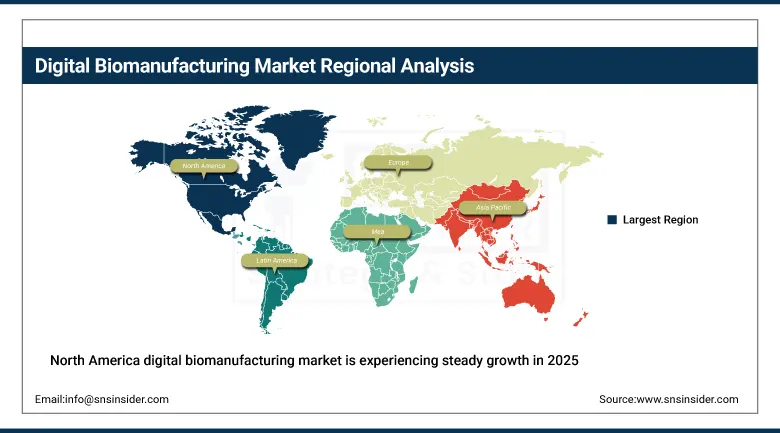
North America digital biomanufacturing market is experiencing steady growth in 2025, accounting for about 38.45% share of the global market, owing to strong biopharmaceutical manufacturing base. The region benefits from advanced digital infrastructure and early adoption of AI driven bioprocess systems. Increasing use of automation and real time monitoring is improving production efficiency. Expansion of biologics manufacturing and cell and gene therapies is driving demand. Strong focus on regulatory compliance and quality standards is further supporting market growth.
According to the U.S. Food and Drug Administration and National Institute of Standards and Technology biomanufacturing modernization initiatives, over 60% of FDA-regulated biologics manufacturing facilities in the United States have adopted at least one form of advanced process analytical technology by 2025. As per the U.S. Department of Health and Human Services and Biomedical Advanced Research and Development Authority, continuous bioprocessing systems are increasingly integrated into vaccine and biologics production platforms, with more than 40% of federally supported biomanufacturing projects incorporating digital twins, automation, and AI-driven process optimization to improve yield consistency and regulatory compliance.
Get Customized Report as per Your Business Requirement - Enquiry Now
Europe Digital Biomanufacturing Market Insights.
Europe digital biomanufacturing market is characterized by stable growth in 2025 owing to strong regulatory frameworks and sustainability driven manufacturing policies. Key countries include Germany, France, United Kingdom, and Switzerland. Rising adoption of Industry 4.0 technologies is driving digital transformation in biopharma production. Increasing focus on process optimization and quality control is supporting market expansion. Growing investment in biologics and advanced therapies is further strengthening adoption of digital biomanufacturing solutions across the region.
According to the “Digital Europe Programme” of the European Commission in 2025 and the Bioeconomy Monitoring Framework developed by the Joint Research Centre, more than 65% of the pharmaceuticals/biotech companies in the EU have digitalized their production process.
Asia Pacific Digital Biomanufacturing Market Insights.
Asia Pacific is the fastest growing region in the digital biomanufacturing market, registering a CAGR of about 14.48% during 2026–2035. Rapid expansion of biopharmaceutical manufacturing and rising healthcare demand are driving strong growth across China, India, Japan, South Korea, and Southeast Asia. Increasing investment in digital infrastructure and smart factories is boosting adoption. Expanding clinical research and biologics production is further accelerating market development. Government initiatives supporting biotechnology innovation are enhancing regional market expansion.
As per the WHO Global Health Observatory Repository and ITU Digital Development Reports 2025, more than half of internet users globally belong to the Asia-Pacific region, thus facilitating integration of digital health and biomanufacturing in the region. According to Asian Development Bank, more than 60% of manufacturing companies in East and Southeast Asia have implemented technologies of Industry 4.0, including automation and digitalization in manufacturing processes. OECD biotechnology policy indicators have also revealed that more than 70% of APAC nations possess bioeconomy or life sciences digitalization policies, allowing use of digital biomanufacturing platforms in pharmaceuticals/biologics manufacturing.
Middle East & Africa and Latin America Digital Biomanufacturing Market Insights.
The Middle East & Africa along with Latin America regions are witnessing steady growth due to increasing investments in healthcare infrastructure and biotechnology development. Key contributing countries include Brazil, Mexico, UAE, Saudi Arabia, and South Africa. Rising demand for biologics and pharmaceutical production is driving adoption of digital manufacturing technologies. Expansion of contract manufacturing and clinical research activities is further supporting market growth. Increasing focus on modernization of healthcare systems is boosting regional digital transformation.
As per the World Health Organization Global Health Observatory and UNIDO 2025 indicators of industrial development, Latin America is responsible for more than 8% of global pharmaceuticals manufacture, where Brazil produces more than 40% of the region’s total production, promoting the uptake of digital biomanufacturing technologies. As per OECD health biotechnology statistics, less than 30% of the manufacturing plants in the emerging countries in Latin America and Africa have implemented bioprocessing automation technology.
Market Dynamics
Growth Drivers: Increasing adoption of AI driven bioprocess optimization and advanced automation in biomanufacturing facilities
Rapid integration of technology such as artificial intelligence, machine learning, and automation has transformed biomanufacturing process. Technology ensures real-time monitoring, analysis, and optimization of the process. Efficiency, fewer errors in the operation process, and better quality of products are among the benefits that result from the process. The increasing demand for biologics and personalized medicine has made it possible to adopt an intelligent manufacturing process. Digitalization has played an important role in ensuring scalability and flexibility in the process.
As per FDA Emerging Technology Program and ICH Q13 Guidance for Continuous Manufacturing Guidelines, more than 70% of new biologic drug products manufacturing approvals in recent years have involved the inclusion of some form of continuous or automation process. As per the IFPMA 2025 metrics on digital health and biomanufacturing, over 60% of the biopharmaceutical firms around the world have already implemented AI based process analytics in their upstream/downstream process operations.
Restraints: Data security risks and regulatory complexity in digital biomanufacturing operations
The increasing use of interconnected systems poses the problem of cybersecurity and data security. The confidential data from the bioprocess and patients must be secured to ensure the protection of data. There are varying regulations regarding digital manufacturing in different parts of the world, thus, making the application challenging. The need for adhering to GMP and data integrity is another challenge in implementing the technology. The integration of various digital technologies poses an additional threat to breach security.
Opportunities: Growing adoption of cloud-based platforms and Industry 4.0 technologies in biomanufacturing
With the rise of cloud computing, Internet of Things (IoT), and Industry 4.0 technologies, the landscape of biomanufacturing is changing. Through technology, one can have real-time data, remote monitoring, and integration of systems. There have been huge investments from pharmaceutical companies towards establishing a digital ecosystem, aiming to make things more efficient. The need for decentralization and flexibility in production has driven this trend.
As per IFPMA and OECD digital health and biomanufacturing indicators for 2025, more than 70% of big biopharma companies have used at least one Industry 4.0 technologies like automation, AI-driven analytics, or digital twin in the production processes. Besides, per the WEF data on manufacturing transformation, cloud-based bioprocessing platforms are embedded in more than 60% of digitalized life science production facilities worldwide, which facilitate real-time data-based manufacturing operations.
Recent Developments
-
-
2026: Thermo Fisher Scientific enhances its digital biomanufacturing process by implementing cloud-based laboratory tools in addition to biologics manufacturing systems across its global locations.
-
2025: Danaher Corporation has enhanced the Cytiva single-use bioprocessing systems along with partnerships with biopharmaceutical manufacturing companies for producing advanced therapies.
-
2025: Roche has taken steps to increase the implementation of digital pathology and AI-based diagnostic tools in order to advance its precision medicine manufacturing processes.
-
2024: Sartorius AG has upgraded its bioprocessing portfolio using sensors, automation technologies, and laboratory solutions driven by data.
-
Digital Biomanufacturing Market Key Players are:
-
Danaher Corporation
-
Sartorius AG
-
Thermo Fisher Scientific
-
Merck KGaA
-
Lonza Group
-
FUJIFILM Holdings Corporation
-
Samsung Biologics
-
WuXi AppTec
-
Roche
-
Novartis
-
Pfizer
-
Bristol Myers Squibb
-
AstraZeneca
-
Siemens AG
-
Rockwell Automation
-
Schneider Electric
-
Emerson Electric
-
Honeywell International
-
Dassault Systèmes
-
SAP SE
Digital Biomanufacturing Market Report Scope:
| Report Attributes | Details |
|---|---|
| Market Size in 2025 | USD 23.16 Billion |
| Market Size by 2035 | USD 73.35 Billion |
| CAGR | CAGR of 12.24% From 2026 to 2035 |
| Base Year | 2025 |
| Forecast Period | 2026-2035 |
| Historical Data | 2022-2024 |
| Report Scope & Coverage | Market Size, Segments Analysis, Competitive Landscape, Regional Analysis, DROC & SWOT Analysis, Forecast Outlook |
| Key Segments | • By Offering (Software & Platforms, Hardware & Connected Equipment, Services) • By Type (Manufacturing Execution & Electronic Batch Records, Automation & Process Control, Process Analytical Technology & Real-time Monitoring, Digital Twins, Modeling & Simulation, AI, Machine Learning & Advanced Analytics, Bioprocess Data Management & Integration, Quality & Laboratory Informatics, Others) • By Application (Process Development & Scale-up, Commercial GMP Manufacturing Execution, Real-time Process Monitoring & Control, Quality Management & Batch Release, Technology Transfer & Facility Digitalization, Others) • By End User (Pharmaceuticals & Biotechnology Companies, Academic & Research Institutes, CMOs & CDMOs, Others) |
| Regional Analysis/Coverage | North America (US, Canada), Europe (Germany, UK, France, Italy, Spain, Russia, Poland, Rest of Europe), Asia Pacific (China, India, Japan, South Korea, Australia, ASEAN Countries, Rest of Asia Pacific), Middle East & Africa (UAE, Saudi Arabia, Qatar, South Africa, Rest of Middle East & Africa), Latin America (Brazil, Argentina, Mexico, Colombia, Rest of Latin America). |
| Company Profiles | Danaher Corporation, Sartorius AG, Thermo Fisher Scientific, Merck KGaA, Lonza Group, FUJIFILM Holdings Corporation, Samsung Biologics, WuXi AppTec, Roche, Novartis, Pfizer, Bristol Myers Squibb, AstraZeneca, Siemens AG, Rockwell Automation, Schneider Electric, Emerson Electric, Honeywell International, Dassault Systèmes, SAP SE |
Frequently Asked Questions
North America dominated the digital biomanufacturing market in 2025 due to strong biopharmaceutical infrastructure, AI adoption, automation, and regulatory support.
The Software & Platforms segment dominated the market in 2025 due to high adoption of manufacturing execution systems, electronic batch records, and integrated data platforms enabling real time monitoring and regulatory compliance in biomanufacturing operations.
The major growth factors include increasing adoption of AI driven bioprocess optimization, rising demand for biologics, digital transformation in pharma manufacturing, use of digital twins, and focus on compliance and efficiency.
The digital biomanufacturing market was valued at USD 23.16 billion in 2025.
