
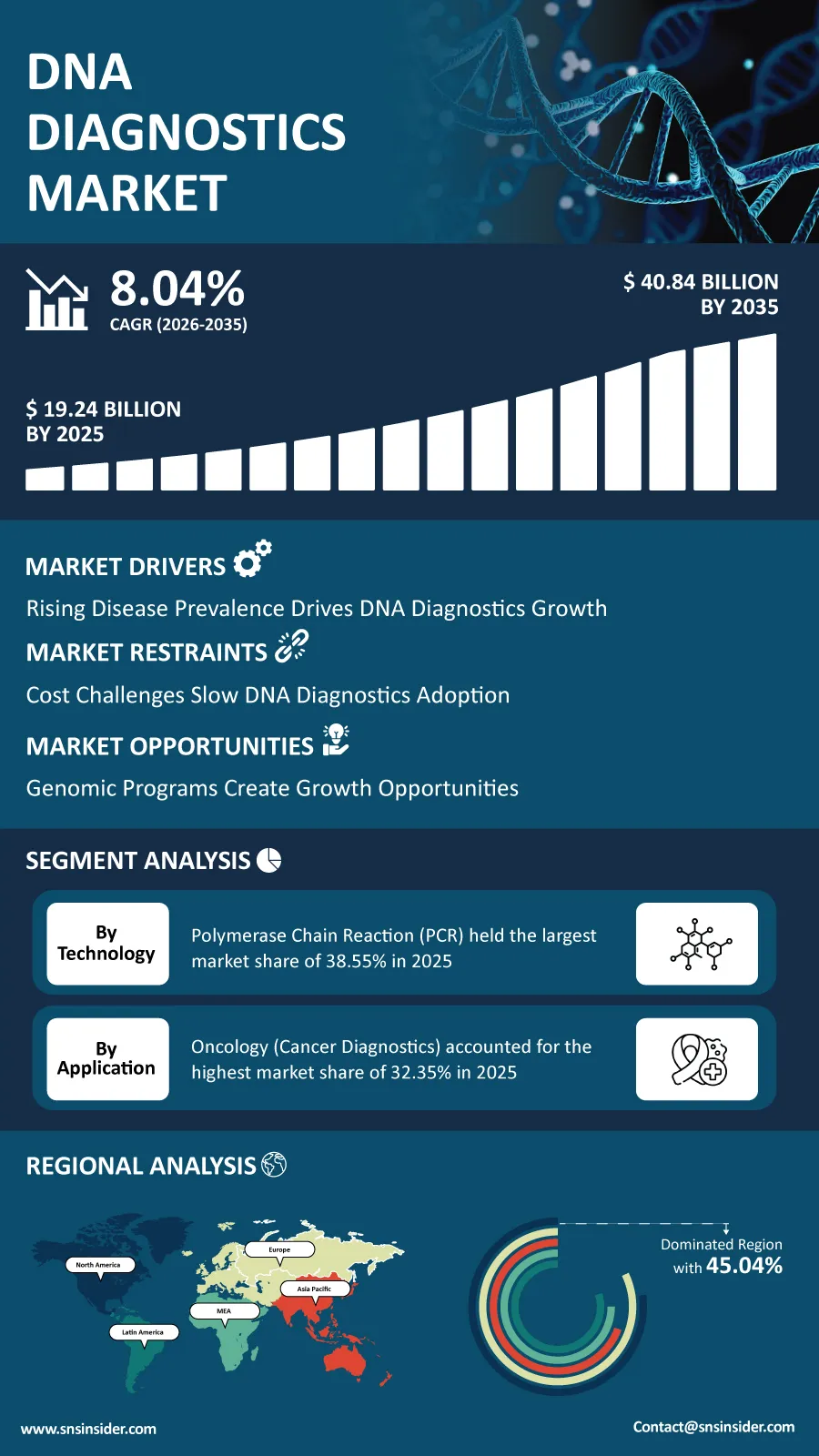
The global DNA Diagnostics Market is expected to experience substantial growth over the next decade health-care practitioners begin using genomics as part of their regular treatment process. “According to a recent study by SNS Insider, the global DNA Diagnostics Market size valued at USD 19.24 billion in 2025, is anticipated to grow to USD 40.84 billion by 2035, registering a CAGR of 8.04% over the 2026–2035 forecast period.”
Due to the increased focus on the early detection of diseases, personal treatment approaches and genomic medicine, the field of healthcare is being transformed. There is an increasing application of molecular diagnostic techniques in hospitals, diagnostic centers, and institutes due to these changing trends in the field of healthcare.
With further investments being made into precision healthcare by healthcare organizations, it has become vital to incorporate DNA diagnostics in disease prevention, assessment of risks and treatment across diverse medical disciplines.
To Get Detailed Insights on the DNA Diagnostics Market – Request a Sample Report
 View Full Infographic
Innovation in Genomic Technologies Drives Market Expansion
The fast development of sequencing technologies, molecular assays, and automation of laboratories contributes greatly to the current changes in the diagnostics industry globally. The use of innovative genomic technologies is being increasingly embraced by the medical industry for the purpose of providing comprehensive genetic assessment while increasing the efficiency of laboratories.
The use of AI and data analysis with the help of cloud computing and digital workflow in laboratories makes it possible for doctors to interpret genomic data and make evidence-based treatment decisions. These developments create additional possibilities for healthcare organizations seeking more effective solutions.
Growing collaboration between biotechnology companies, healthcare institutions, and research organizations continues to accelerate the development of next-generation genomic technologies capable of addressing evolving clinical needs.
Key Market Findings Highlight Emerging Opportunities
By technology segment, the Polymerase Chain Reaction (PCR) was expected to hold 38.55% of the global market revenue share in 2025 due to its continued significance as a popular molecular testing platform used in different healthcare and research facilities.
Moreover, it should be noted that the Next-Generation Sequencing (NGS) technology segment is expected to demonstrate the fastest growth rate between 2025 and 2035, with the Compound Annual Growth Rate (CAGR) of 9.34%.
Regarding application, there is the tendency to use genomic technologies more and more often in the field of disease management, which is evident from the fact that in 2025 Oncology was responsible for 32.35% of the total market revenue and was also expected to demonstrate the highest growth rate of all application segments with the CAGR of 9.57%.
In terms of end users, Hospitals & Clinics were responsible for 34.54% of the global market revenue in 2025 due to the widespread use of the molecular diagnostics in healthcare. In addition, Pharmaceutical & Biotechnology Companies were expected to grow with the CAGR of 9.24% due to the increased use of genomic technologies in drug discovery, biomarker research, and other activities.
Finally, from the testing point of view, Diagnostic Testing was responsible for 40.24% of the global market revenue in 2025, while Predictive & Presymptomatic Testing was expected to demonstrate the highest growth rate with the CAGR of 9.54% as preventive healthcare and personalized risk assessment continue gaining importance.
Precision Medicine Continues to Reshape Clinical Care
Global healthcare systems are becoming more inclined towards adopting precision medicine approaches based on genetic analysis in order to achieve early diagnosis and personalized treatment plans. The rising application of genomics across oncology, hereditary conditions, infections, fertility, and preventative care is generating increasing need for sophisticated DNA diagnostic tools.
Rising investments in genomics, screening programs, and digital healthcare platforms will help in boosting the use of molecular diagnostic tests in developed as well as emerging nations.
North America Led with 45.04% Market Share in 2025, While Asia Pacific to Grow at 9.19% CAGR Through 2035
The share of North America in the world market was 45.04% in 2025 due to its advanced healthcare facilities, genomics research, prevalence of molecular diagnostics and investments in precision medicine programs. It continues being a leader in the implementation of technologies and genomic tests.
On the other hand, the region that is forecasted to be the fastest-growing regional market during 2026-2035 at a CAGR of 9.19% is the Asia Pacific. There are huge opportunities there due to expansion of healthcare facilities, growth of genomics research, greater awareness of genetic diseases and increased investments into molecular diagnostics.
Leading Companies Continue to Advance Genomic Innovation
Competition within the DNA diagnostics market remains dynamic as industry leaders continue investing in next-generation sequencing technologies, molecular diagnostics, laboratory automation, and bioinformatics platforms. Strategic collaborations, product innovation, and expansion of genomic testing capabilities remain key priorities for companies seeking to strengthen their global market presence.
Key companies operating in the global DNA Diagnostics Market include F. Hoffmann-La Roche, Illumina, Thermo Fisher Scientific, Danaher Corporation, QIAGEN, Abbott Laboratories, bioMérieux, Siemens Healthineers, Agilent Technologies, and Hologic.
An SNS Insider analyst Parry Kardani commented, "DNA diagnostics is becoming a cornerstone of modern healthcare as advances in genomics, molecular testing, and data analytics continue to improve diagnostic precision and support personalized patient care. Continued innovation and expanding clinical applications are expected to create significant opportunities for industry participants throughout the coming decade."
About the Author

Get in touch




