
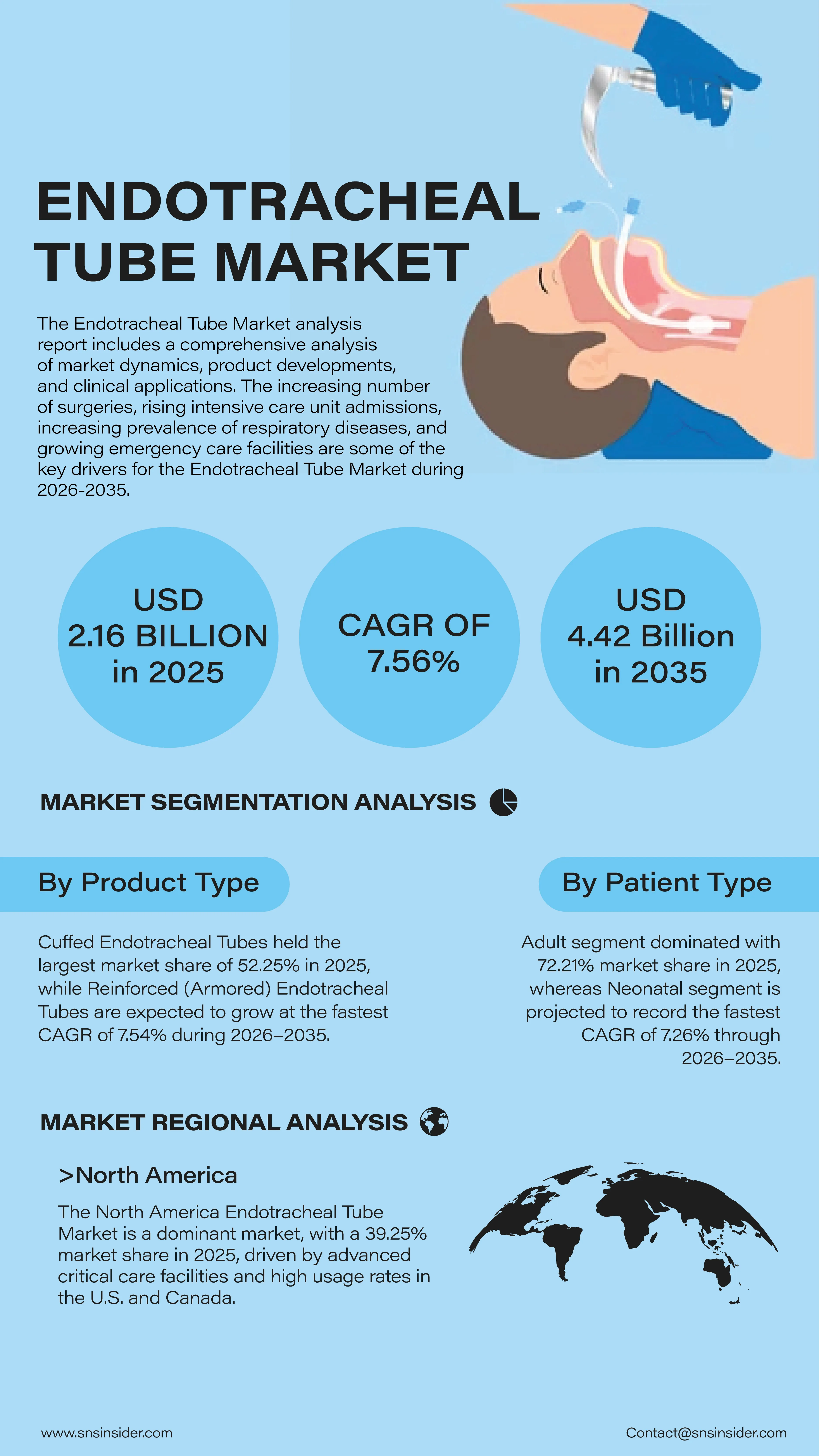
The global Endotracheal Tube Market is expected to witness substantial growth over the coming decade as healthcare systems continue expanding emergency care capabilities and investing in advanced respiratory support technologies. “According to a recent study by SNS Insider, the global Endotracheal Tube Market size valued at USD 2.16 billion in 2025, is anticipated to grow to USD 4.42 billion by 2035, registering a CAGR of 7.56% over the 2026–2035 forecast period.”
The growing demand for reliable airway management across operating rooms, intensive care units, trauma centers, and emergency medical services continues to strengthen market expansion. Increasing healthcare investments, rising procedural volumes, and greater emphasis on patient safety are encouraging hospitals and healthcare providers to adopt next-generation airway management solutions designed to improve clinical efficiency and reduce treatment-related complications.
As hospitals focus on improving their respiratory treatment capabilities and critical care readiness, innovations will continue at a rapid pace for producing better endotracheal tube technologies.
Innovation Continues to Enhance Airway Management
Technology has revolutionized airway management through the improvement of accuracy in procedures, increased ventilation efficiency, and infection reduction. The production of medical devices that increase clinician assurance and facilitate better patient results has been achieved through technological development.
The growing usage of specialized devices for airway management, development of innovative materials, and inclusion of infection control measures will aid the hospitals in achieving better respiratory management processes. With the healthcare organizations upgrading their critical care infrastructure, the need for advanced intubation devices is anticipated to be on a rise during the forecast period.
Surging collaboration between manufacturers of medical devices, health organizations, and clinical researchers is providing additional help to the process of innovation of new products in this sphere.
Key Market Findings Highlight Emerging Opportunities
Among product categories, the market share of cuffed endotracheal tubes in 2025 stood at 52.25%, owing to the extensive use of these products in healthcare settings.
Meanwhile, it is expected that the reinforced (armored) endotracheal tubes would witness the highest growth through 2035, growing at a CAGR of 7.54% owing to their higher usage in difficult surgeries requiring high flexibility.
By patient category, adult applications represented 72.21% of market revenue in 2025, supported by higher volumes of surgical interventions, respiratory disorders, and intensive care admissions. At the same time, the neonatal segment is expected to witness steady expansion at a CAGR of 7.26%, reflecting continued investments in neonatal intensive care and specialized pediatric respiratory support.
Healthcare facilities remain the primary users of airway management products. Hospitals accounted for 68.25% of global market revenue in 2025, while ambulatory surgical centers are anticipated to register the fastest growth at a CAGR of 7.24%, supported by increasing outpatient surgical procedures and growing demand for cost-effective healthcare delivery.
By intubation approach, orotracheal procedures represented 85.12% of market revenue in 2025, maintaining their position as the preferred airway management technique across emergency and surgical settings. Additionally, silicone-based endotracheal tubes are expected to expand at the fastest CAGR of 7.14%, reflecting growing demand for highly biocompatible materials in long-term respiratory care.
An Infographic Representation of the Global Endotracheal Tube Market
Healthcare Investments Continue to Support Market Expansion
There is a growing trend in the expansion of intensive care facilities, emergency medical services and surgery facilities in light of increased demand for patients in healthcare systems globally. This will result in the uptake of more advanced airway management devices that are capable of safely ventilating the patient through respiratory treatment.
Another important trend that is gaining popularity is that of infection control, training clinicians on proper usage and adopting of evidence-based guidelines for respiratory care, resulting in improvement of current airway management devices.
Regional Markets Present Strong Growth Potential
The share of North America in terms of market revenue globally is expected to be 39.25% in 2025 because of its well-developed healthcare infrastructure, presence of modern airway management equipment and continued investment in critical care. It is still considered an important center of development and application of medical devices.
Meanwhile, according to projections, Asia Pacific will become the fastest-growing regional market growing at a CAGR of 10.11% from 2020 through 2035. Opportunities for the global surgical staplers industry are being created due to the fast-paced development of health care facilities, rising volume of surgeries performed, better access to emergency medical services, and increased health care spending.
Industry Leaders Continue to Advance Product Innovation
The competitive environment within the endotracheal tube industry still appears vigorous due to the efforts made by the players in innovating products, establishing alliances, and expanding their portfolios. The current trend is to develop devices for airway management that would facilitate procedures, provide better protection against infections, and meet the clinical demands.
Key companies operating in the global endotracheal tube market include Medtronic, Teleflex, ICU Medical, Becton, Dickinson and Company, Cardinal Health, Ambu, ConvaTec, Vyaire Medical, Medline Industries, and Vygon.
An SNS Insider analyst Parry Kardani commented, "Growing investments in critical care infrastructure, continuous advancements in airway management technologies, and increasing emphasis on patient safety are reshaping the global endotracheal tube market. Innovation focused on infection prevention, clinical efficiency, and specialized respiratory care will remain central to future market growth."
About the Author

Get in touch




