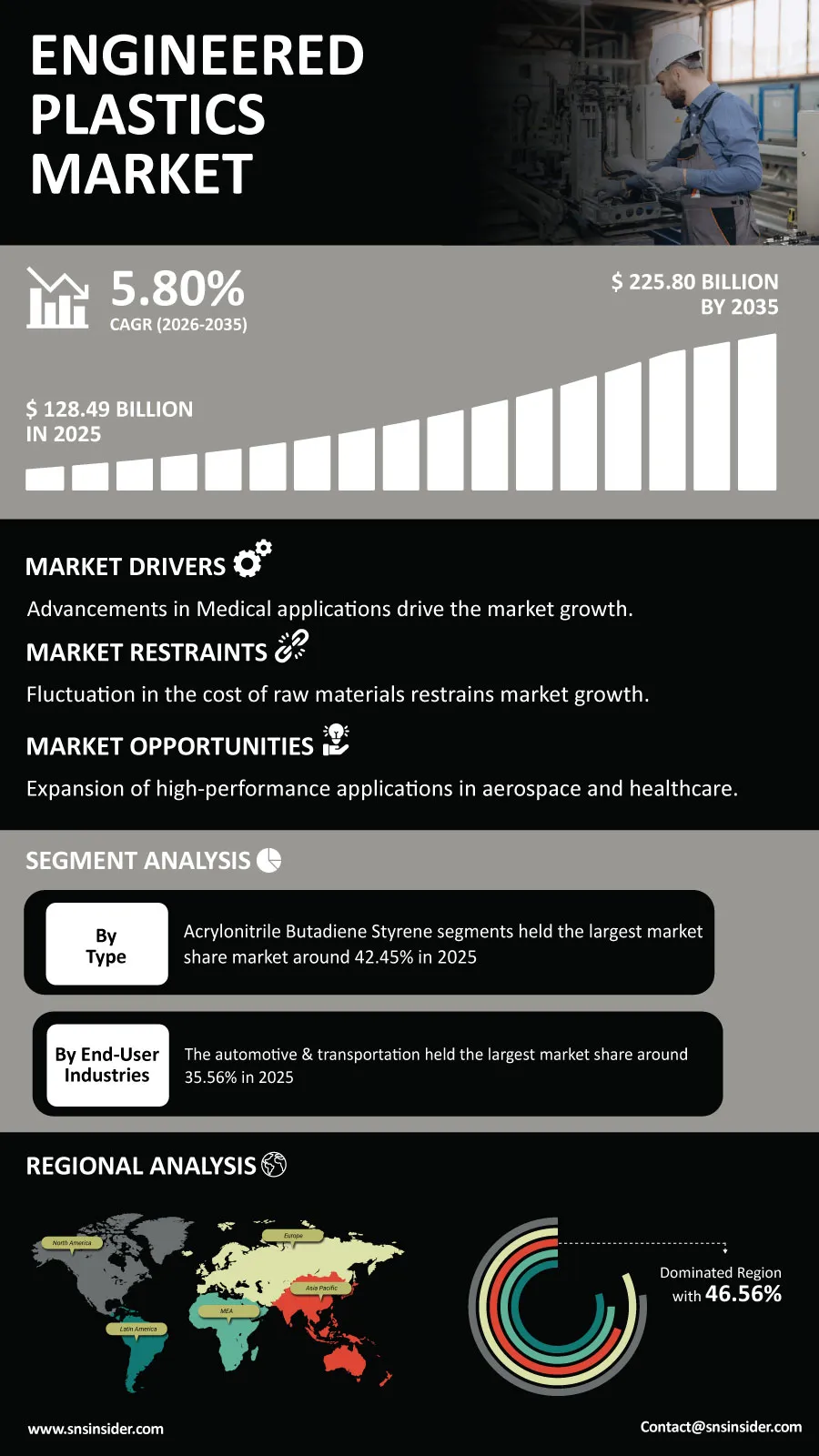
The global market for Engineered Plastics is forecasted to experience continuous growth due to the rising trend among manufacturers to use lightweight and high-performance materials for automotive, electronics, healthcare, aerospace, and industrial applications. “According to a recent study by SNS Insider, the global Engineered Plastics Market size valued at USD 128.49 Billion in 2025, is anticipated to grow to USD 225.80 Billion by 2035, registering a CAGR of 5.80% over the 2026–2035 forecast period.”
Mechanical strength, thermal stability, chemical resistance, and design flexibility, coupled with reduced weight of the end-product, have become primary considerations of various industries all over the world. Engineering plastics are continually replacing metal components in many uses, thereby allowing companies to achieve energy efficiency and enhanced durability along with cost savings in manufacturing. New developments in polymer science and sustainable materials further fuel the growth trend.
To Get Detailed Insights on the Engineered Plastics Market – Request a Sample Report
Advanced Manufacturing and Healthcare Applications Unlock New Opportunities
The adoption of engineered plastics for the development of modern medical technology is providing some notable opportunities for future development among manufacturers. Engineering polymers are increasingly being adopted in the manufacture of surgical tools, diagnostics, and implants due to their sterilization properties, biocompatibility, and excellent performance. With more investment from health care professionals on advanced medical technologies, the demand for engineering polymers is set to grow.
On the other hand, the fast pace of development in additive manufacturing is making way for some notable applications. The use of high-performance polymers is increasingly being used for faster production of customized parts like medical implants, prototypes and parts for precision engineering. Manufacturers are also developing bio-based and recyclable engineering plastics to be in line with global efforts towards sustainability.
Key Market Insights Reflect Expanding Industrial Demand
In terms of type, Acrylonitrile Butadiene Styrene (ABS) held a share of 42.45% of the total revenue generated by the market in 2025 due to its high resistance to impacts, dimensional stability, chemical compatibility, and processability. The wide range of applications of ABS in automotive parts, consumer electronics, home appliances, and building materials further emphasizes its market dominance.
On the basis of end use industry, Automotive & Transportation sector constituted 35.56% of the total revenue generated by the market in 2025. The rising production of lightweight automobiles, electric vehicle production, and stringent fuel efficiency norms have continued to boost the demand for advanced polymer materials to replace heavy metal products.
Material Innovation Accelerates Next-Generation Product Development
However, one of the biggest drivers of growth is still advances in technology across the engineered plastics sector. Next generation polymers that can handle higher temperature, more mechanical stress and harsh chemical environment while facilitating miniaturization across next gen electronic devices.
The electrical & electronics industry still generates high demand for engineered plastics with optimal insulating characteristics, flame retardancy as well as durability properties. Now, in late 2023, advances in polymer chemistry are yielding new high-performing polyamides and specialty polymers that enable manufacturers to design increasingly compact electrical connectors, fiber optic components, and electronic assemblies. And you will continue to be active in research and development is expected to accelerate commercialization of Sustainable, high-performance polymer solutions targeting emerging industrial applications.
Asia Pacific Captured 46.56% of Engineered Plastics Market Revenue in 2025, Driven by Automotive and Electronics Growth
By 2025, Asia Pacific held the highest revenue with a global Engineered Plastics Market share of 46.56%. A mature manufacturing ecosystem, rapid industrialization, scaling automotive production, strong electronics manufacturing and rising healthcare investments are all favorable for the region. As frequent-producing and technology-evolving countries, China, Japan, India and South Korea are still consolidating territorial demand.
The North American market growth is stable and driven by rising adoption of engineered plastics in end-use industries, including aerospace, medical devices, electronics, and automotive manufacturing. Europe is far from finished, with further sustainability regulations on the way alongside high EV production and innovations in specialty polymer applications, España says during a keynote speech. At the same time, Latin America and Middle East & Africa are steadily consuming more with increasing infrastructure investment, industrial development, and manufacturing in these emerging markets.
Leading Companies Invest in High-Performance and Sustainable Polymer Solutions
The global Engineered Plastics Market competition continues to stand on product innovation, progressive polymer technologies and sustainable manufacturing processes. Global players continue to focus on R&D to develop new material properties, improve recyclability and manufacture materials that can support next-generation applications in areas such as automotive, electronics, healthcare and industrial manufacturing. Long-term competitive strategies are still based on strategic collaborations, capacity expansions and development of specialty engineering polymers.
Key companies operating in the global Engineered Plastics Market include SABIC, LANXESS AG, Covestro AG, BASF SE, Mitsubishi Chemical Holdings Corporation, Celanese Corporation, Evonik Industries AG, The Dow Chemical Company, Solvay S.A., and LG Chem Ltd.
An SNS Insider analyst Himanshu Sharma commented, "The continued shift toward lightweight, durable, and high-performance materials across transportation, electronics, healthcare, and industrial manufacturing is creating sustained opportunities for engineered plastics. Companies investing in advanced polymer innovation, sustainable material technologies, and specialty engineering solutions will be well positioned to benefit from the expanding demand for next-generation industrial materials over the coming decade."
About the Author

Get in touch