
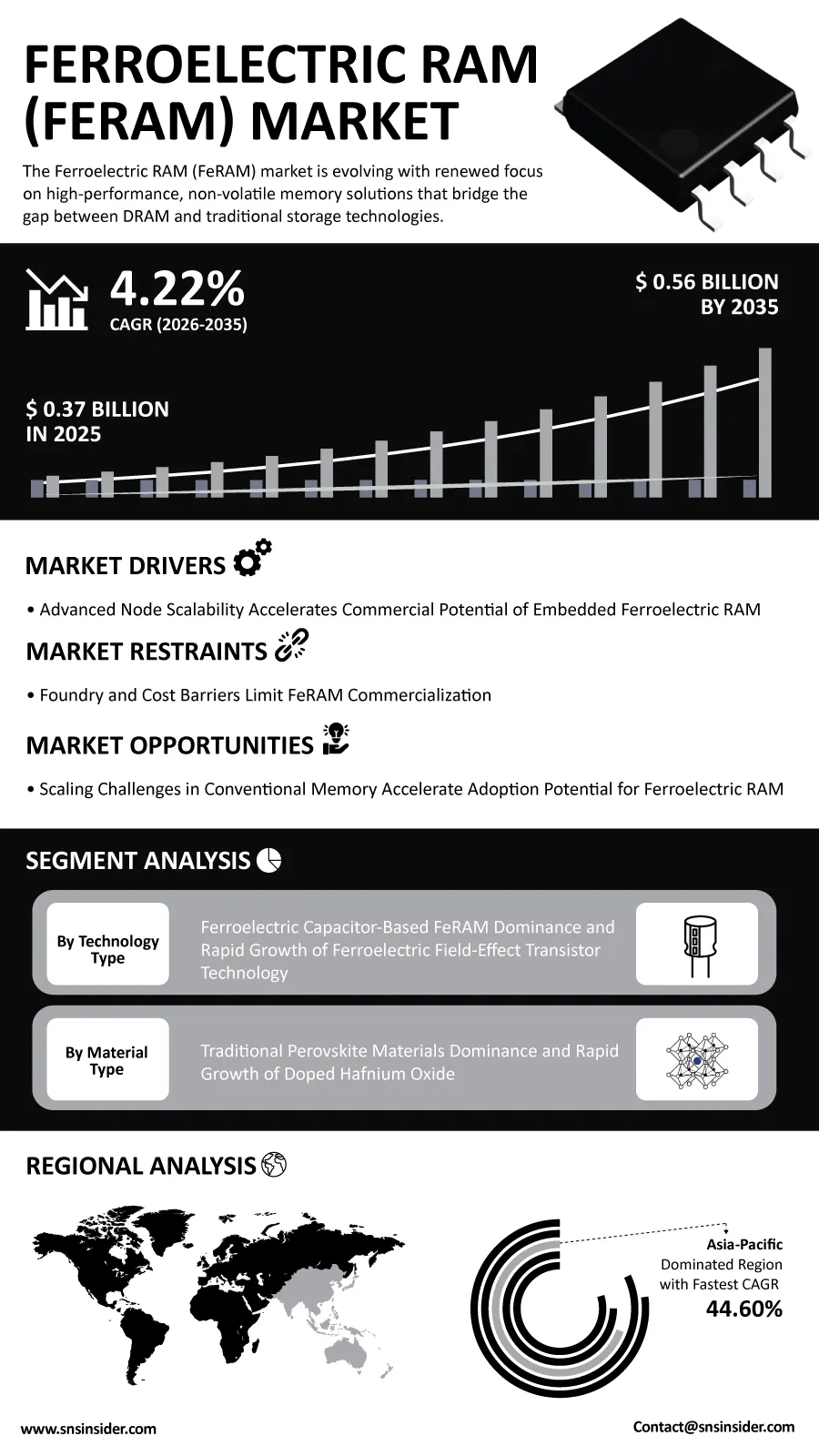
The global Ferroelectric RAM (FeRAM) Market is poised for steady growth over the coming decade as semiconductor manufacturers and electronics companies increasingly adopt high-speed, low-power, non-volatile memory technologies for next-generation computing platforms. According to a recent study by SNS Insider, the global Ferroelectric Random Access Memory Market size valued at USD 0.37 billion in 2025, is anticipated to grow to USD 0.56 billion by 2035, registering a CAGR of 4.22% over the 2026–2035 forecast period.
The growing need for memory architectures which consume less power is making the environment favorable for adoption of FeRAM technology. With connected gadgets becoming increasingly intelligent and data-intensive, there is a trend among gadget manufacturers to adopt memory technologies that ensure high endurance, quick writes, and immediate data retention while consuming less power.
Recent progress in CMOS-friendly hafnium oxide-based ferroelectrics is dramatically enhancing the scalability and commercial feasibility of the technology. Such advancements have helped semiconductor manufacturers introduce FeRAM in advanced process technologies, thus widening the applicability of the technology in various embedded systems and microcontrollers.
To Get Detailed Insights on the Ferroelectric RAM Market – Request a Sample Report
Advanced Semiconductor Technologies Drive New Growth Opportunities
Next generation embedded memory products remain one of the key areas of investment by the semiconductor industry owing to the scaling challenges posed by current memory technologies. The FeRAM device technology has become an interesting choice because of its unique combination of the benefits of volatile and nonvolatile memories by offering reliable memory operation and fast performance speeds.
Rapid deployment of AI-based edge devices, Industrial Internet of Things (IIoT), self-driving cars, and advanced driver assistance system (ADAS) is expected to further fuel growth of the market owing to the need for a memory product that can operate effectively in harsh environments.
Furthermore, increased investments into semiconductor fabrication as well as partnerships between memory manufacturers and foundries are anticipated to facilitate faster adoption of next generation FeRAM devices.
Key Market Insights Highlight Shifting Demand Patterns
On the basis of technology, it is expected that ferroelectric capacitor-based FeRAM will hold the largest share of 43.20% of the global market revenue in 2025 due to the established design of the technology and its high reliability and broad adoption among industrial and automotive sectors. On the other hand, FeFET technology will demonstrate the highest CAGR of 5.82% by 2035 owing to its superior scalability and low power consumption.
By material type, the conventional perovskite materials will account for 38.36% of the market revenue in 2025 owing to the availability of the mature production infrastructure. In addition, doped hafnium oxide will be the fastest-growing segment by 2035 due to the growing adoption of CMOS compatible materials among the semiconductor manufacturers.
On the basis of interface, it is expected that serial I2C interface will generate 41.60% of the global market revenue in 2025 due to the extensive use of the interface in embedded electronic devices. In addition, serial SPI interface will record the highest CAGR by 2035 at 5.63% on account of increasing need for the higher data transfer rate.
By density range, it is expected that medium-density FeRAM solutions will generate 45.30% of the market revenue in 2025 owing to its cost-effective nature along with good performance in industrial and automotive sectors. Moreover, high-density solutions will register the highest CAGR by 2035 due to the need of increased memory for AI computing and advanced embedded systems.
The automotive industry is anticipated to remain the leading end-use sector throughout the forecast period, supported by expanding vehicle electrification, increasing electronic content, and rising deployment of ADAS and connected vehicle technologies.
Embedded Memory Innovation Accelerates Across Emerging Applications
FeRAM devices with improved endurance, write speed, and power efficiency are under development by manufacturers to comply with the demands of contemporary semiconductor architectures. Ongoing innovations in materials, embedded memory, and process engineering are ensuring the viability of FeRAM as a promising option in cases where the capabilities of standard flash memory fall short.
In addition to computer applications, FeRAM technology is also being considered for use in aerospace, industrial control systems, smart infrastructures, medical electronics, and critical computing environments.
Asia Pacific Holds 41.40% Market Share in 2025, Driven by Semiconductor and EV Growth
Asia Pacific region is anticipated to generate 41.40% of total global market revenues by 2025, due to the presence of large-scale semiconductor manufacturing infrastructure, increasing demand for electric vehicles and investments in embedded memory technologies. Nations such as China, Japan, South Korea, and Taiwan are constantly consolidating their market presence in the region through investment in chip manufacturing and AI hardware development.
North America is projected to maintain strong market momentum throughout the forecast period, driven by ongoing innovation in semiconductor technologies, defense electronics, industrial automation, and artificial intelligence applications. Continued investments in domestic semiconductor manufacturing and advanced research initiatives are expected to support regional expansion.
As governments and private companies continue investing in resilient semiconductor supply chains, demand for advanced non-volatile memory technologies such as FeRAM is expected to strengthen across multiple high-growth industries.
Industry Participants Focus on Next-Generation Memory Innovation
The competitive landscape remains innovation-driven as semiconductor companies continue investing in advanced materials, embedded memory architectures, and foundry partnerships to improve performance, scalability, and manufacturing efficiency. Companies are emphasizing higher memory density, improved endurance, and seamless integration with advanced semiconductor nodes to strengthen their market position.
Key companies operating in the global Ferroelectric Random Access Memory Market include Infineon Technologies AG (Cypress FeRAM Division), Weebit Nano Ltd., LAPIS Semiconductor Co., Ltd. (ROHM Group), Texas Instruments Incorporated, STMicroelectronics N.V., Taiwan Semiconductor Manufacturing Company (TSMC), Micron Technology, Inc., Panasonic Holdings Corporation, Toshiba Electronic Devices & Storage Corporation, RAMXEED Limited, Radiant Technologies, Inc., Ferroelectric Memory Company (FMC), Advanced Memory Technologies, SK Hynix Inc., Samsung Electronics Co., Ltd., Nantero, Inc., NXP Semiconductors N.V., Renesas Electronics Corporation, Intel Corporation, and GlobalFoundries Inc.
An SNS Insider analyst Sushant Kadam commented, “As semiconductor architectures continue evolving toward higher efficiency and greater intelligence, Ferroelectric RAM is emerging as an increasingly important embedded memory technology. Manufacturers that focus on scalable materials, advanced process integration, and application-specific innovation will be well positioned to capitalize on future opportunities across automotive, industrial, AI, and edge computing markets.”
About the Author

Get in touch




