
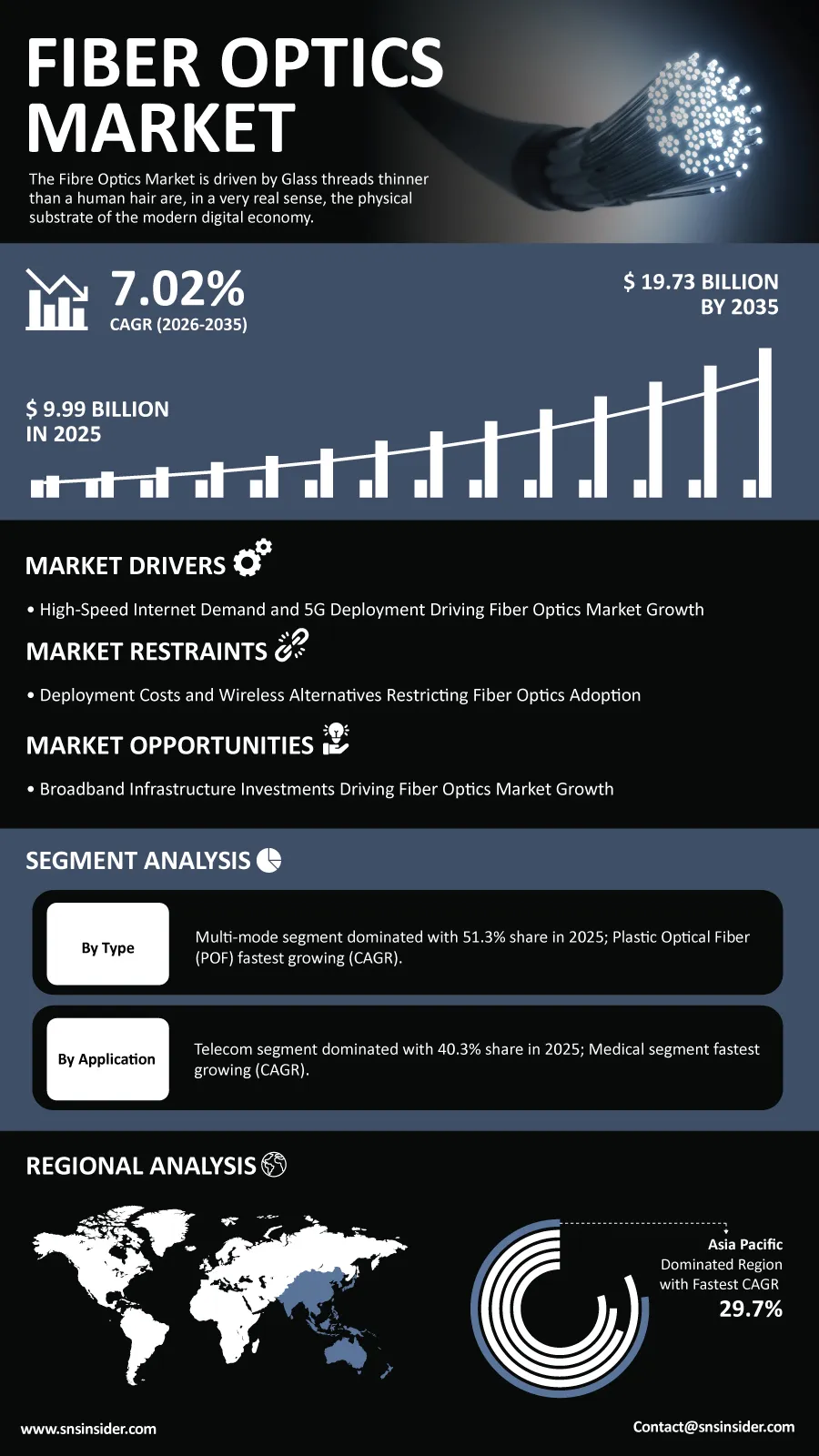
The global Fiber Optics Market is entering a sustained growth phase as rising data consumption, 5G deployment, cloud computing, and artificial intelligence infrastructure accelerate demand for high-capacity connectivity. According to a recent study by SNS Insider, the global Fiber Optics Market size valued at USD 9.99 billion in 2025, is anticipated to grow to USD 19.73 billion by 2035, registering a CAGR of 7.02% over the 2026–2035 forecast period.
There is increasing demand for faster speed, reduced latency, and secure data delivery due to fast-growing usage of digital services. Fiber-optic technology is now becoming an integral part of broadband infrastructure, mobile network infrastructure, corporate network infrastructure, and even the infrastructure of data centers as users continue to generate larger amounts of digital data.
Also, there is an increase in investment into national broadband systems and future generation telecommunication infrastructure, which drives growth. On the other hand, an increase in usage of hyperscale data centers and high-performance computing systems drives the need for fiber optic connectivity solutions for intensive AI and cloud computing tasks.
To Get Detailed Insights on the Fiber Optics Market – Request a Sample Report
5G and AI Infrastructure Create New Growth Opportunities
The increasing global deployments of 5G networks are leading to many demands for fiber backhaul and front haul solutions, as operators densify their networks and deploy new base stations. The fiber infrastructure plays an important role in connecting mobile access sites to core networks, thus presenting a promising market for cable and optical networking equipment makers.
Moreover, the fast-growing demand for AI computing is opening up a further channel for developing new markets. The hyperscale data centers need a lot of fiber optic networks for interconnecting servers, for switching and connections between different geographically spread computing centers. With the increasing demand for AI computing, the demand for optical infrastructure will increase.
Government-backed broadband programs are also supporting fiber deployment in underserved and rural communities, creating a broader addressable market for fiber-to-the-home networks.
Key Market Insights Highlight Shifting Demand Patterns
By type, multi-mode fiber is expected to account for approximately 51.3% of global market revenue in 2025, supported by widespread use in enterprise networks, data centers, campus infrastructure, and short-distance high-bandwidth applications. Plastic Optical Fiber (POF) is projected to be the fastest-growing type through 2035 as its lightweight construction, flexibility, and ease of installation support increasing adoption in automotive networks and consumer electronics.
Based on application, telecommunications is anticipated to hold 40.3% of market revenue in 2025, driven by ongoing 5G network expansion, broadband deployment, and fiber-to-the-home initiatives. The medical segment is expected to register the fastest growth as healthcare providers increase investment in optical technologies for minimally invasive imaging, surgical systems, telemedicine infrastructure, and high-speed clinical data transmission.
Fiber Connectivity Becomes Critical to Digital Transformation
The increasing reliance on cloud computing, connectivity, streaming, and artificial intelligence applications means that fiber optics is changing from a telecommunications product to a digital infrastructure product. There is an increasing demand for networking systems that are able to transmit massive amounts of data while maintaining speed and reliability.
There has also been increased use of fiber optic technology by healthcare institutions due to the increased adoption of high-resolution imaging systems, remote diagnostics, and clinical digital applications. At the same time, there are automobile companies looking into using plastic fiber optics in their automobiles' communication system.
Submarine cable investment is also gaining momentum as international data traffic increases and cloud providers expand global computing capacity.
North America and Asia Pacific Drive the Next Phase of Fiber Optic Cable Market Growth
North America continues to be an important region in terms of the market, as it has benefited from substantial investments in broadband, 5G networks, and data centers. In particular, the United States stands to benefit from investments in the development of fiber to the home networks and connectivity infrastructure.
Asia Pacific is forecasted to keep up its strong growth trajectory owing to substantial digital infrastructure programs, increasing internet access and manufacturing, and 5G implementation. Fiber networks are being widely used in China, India, Japan, and South Korea.
As governments and telecommunications providers prioritize nationwide broadband coverage and next-generation communication infrastructure, the region is expected to remain a key contributor to future market expansion.
Industry Participants Focus on Capacity Expansion and Network Innovation
The competitive landscape remains active as manufacturers and technology providers expand production capabilities and develop advanced optical solutions for telecommunications, data centers, broadband networks, and specialized applications. Companies are focusing on high-capacity cables, advanced optical components, submarine connectivity, and solutions designed to support AI-driven data traffic.
Key companies operating in the global Fiber Optics Market include Corning Inc., Cisco Systems, Inc., Prysmian Group, CommScope Holding Company, Inc., Nexans S.A., Sumitomo Electric Industries, Ltd., Fujikura Ltd., OFS Fitel, LLC, LS Cable & System Ltd., Hengtong Group, Sterlite Technologies Ltd., Broadcom Inc., Huawei Technologies Co., Ltd., TE Connectivity Ltd., Zyxel Communications, Lumentum Holdings Inc., II-VI Incorporated (Coherent Corp.), AFL Global, Belden Inc., and Optical Cable Corporation (OCC).
An SNS Insider analyst Sushant Kadam commented, “The accelerating demand for broadband, 5G connectivity, cloud computing, and AI infrastructure is strengthening the strategic importance of fiber optics across the global digital ecosystem. Companies that expand production capacity while delivering high-performance and application-specific optical solutions will be well positioned to benefit from the next phase of network modernization.”
About the Author

Get in touch




