
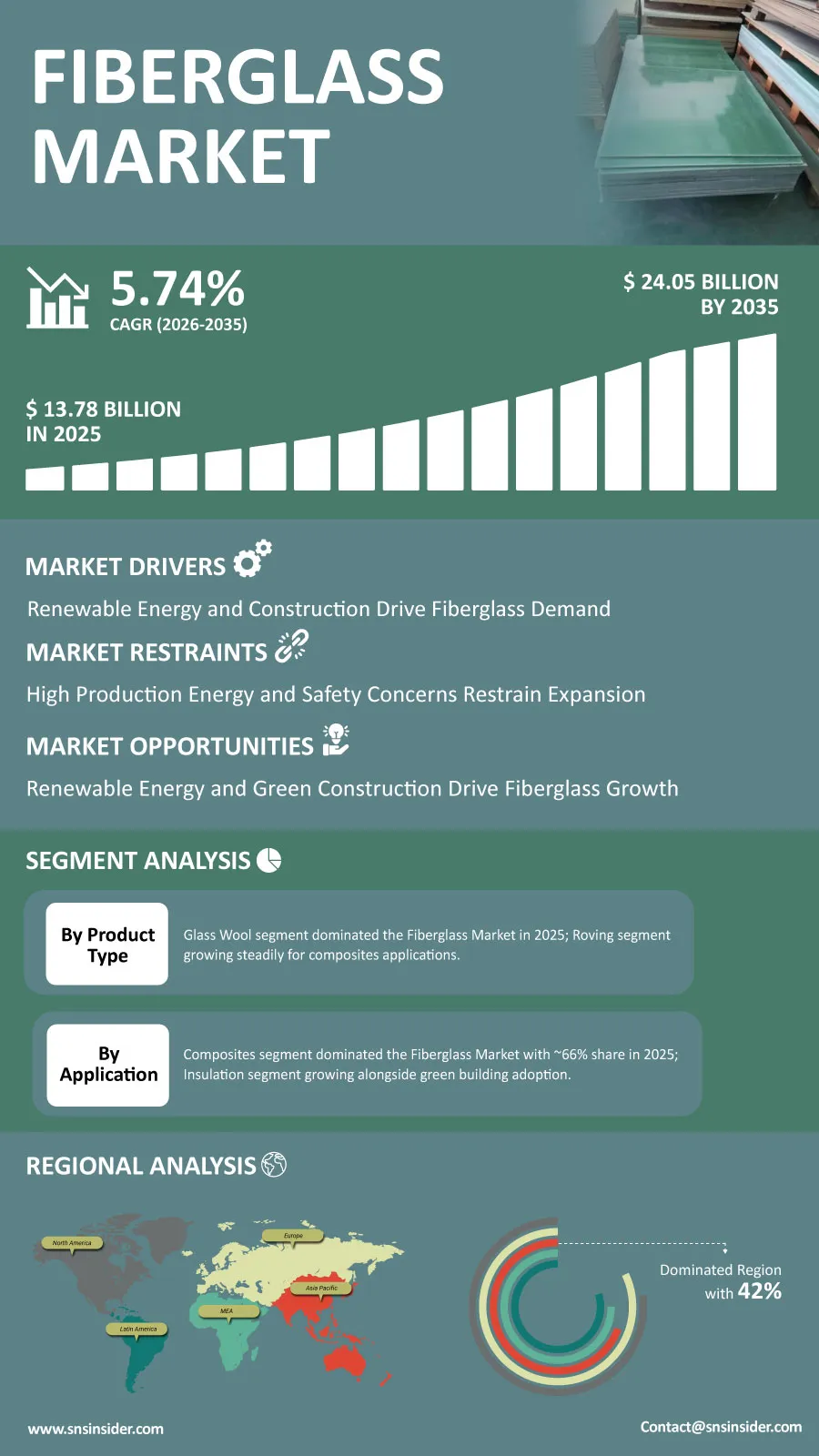
The global Fiberglass market is experiencing consistent momentum due to the increasing investments by manufacturers in advanced composite materials for construction, transportation, renewable energy, and industries. “According to a recent study by SNS Insider, the global Fiberglass Market size valued at USD 13.78 Billion in 2025, is anticipated to grow to USD 24.05 Billion by 2035, registering a CAGR of 5.74% over the 2026–2035 forecast period.”
The increasing importance being placed on products made from durable, lightweight, and non-corrosive material is making a huge impact in many different industries. The use of fiberglass is increasing greatly because of the high strength, heat-insulating property, and long service life of the material. The increasing number of wind energy installations, modernization of infrastructure, and electric car production is driving the increased fiberglass demand.
To Get Detailed Insights on the Fiberglass Market – Request a Sample Report
Renewable Energy and Infrastructure Investments Unlock Long-Term Opportunities
Clean energy infrastructure investments worldwide are constantly producing huge potential for fiberglass manufacturers. Contemporary wind energy plants feature ever-longer blades, which creates a growing need for high-quality fiberglass composites that will be able to provide maximum strength at minimum weight. With an increased number of offshore wind energy facilities being built in Europe, Asia-Pacific, and North America, manufacturers are increasing their capacity to meet growing demands for composite materials.
Modernization of infrastructure is another great opportunity for the growth of the industry. Government initiatives aimed at construction of energy-efficient buildings, anti-corrosion utility systems, and resilient transportation infrastructure will lead to greater use of fiberglass insulation, reinforced panels, pipes, and rebar. In addition, the development of recyclable composite materials and bio-based resins contributes to sustainable manufacturing processes.
Key Market Insights Reflect Expanding Composite Applications
By product type, Glass Wool was the largest in Fiberglass Market in 2025 due to its extensive usage in thermal and acoustic insulation in both residential and commercial constructions. Roving segment is projected to record steady growth through 2035, driven by growing need for reinforced composite material in the production of transportation and industrial machinery parts, marine and renewable energy products.
By application, Composites held about 66% share in the market revenues in 2025 due to their wide use in automotive parts, aerospace parts, wind turbine blades, industrial machinery parts, and marine products. The Insulation segment is growing in tandem with energy efficiency regulations across the world.
By end-use industries, Construction industry was the largest revenue generator in 2025 as well as promising long term growth opportunities. Wind Energy is projected to show the highest CAGR in terms of revenue growth through 2035 driven by rapid growth in renewable electricity generation and large size of turbines that requires larger amount of fiberglass composites.
Advanced Manufacturing Technologies Strengthen Industry Competitiveness
The manufacturers of fiberglass are now putting considerable investment in automating their manufacturing processes through the application of energy-efficient technologies for manufacturing fiberglass. The use of artificial intelligence for furnace management, automatic fiber-forming systems, and precise quality inspection technologies are aiding the manufacturers to increase efficiency in their operations as well as reducing wastage.
There have been considerable developments in the field of sustainable composite technology. Companies are now developing fiberglass products that utilize recycled glass, environmentally friendly manufacturing technologies, and high-performance resins to increase their durability. This will help the fiberglass become competitive in various industries including transport, industrial manufacturing, and green construction industries.
Asia Pacific Captured 42% of the Global Fiberglass Market in 2025, Fueled by China’s Manufacturing Strength and Infrastructure Expansion
The Asia Pacific region contributed about 42% of the Fiberglass Market share in 2025 owing to the supremacy of China in producing fiberglass products, massive infrastructural development, increased automobile production, and significant investment in renewable energy. The swift industrialization taking place in India and Southeast Asia will fuel regional demand for insulating products and engineered composite materials.
North America is an economically strategic region on account of energy-efficient building constructions, growth in wind energy generation, and production of electric vehicles. Europe still stands to gain from the aggressive renewable energy utilization, massive refurbishment of buildings, and sustainable building construction practices. On the other hand, Middle East & Africa, and Latin America regions will create new opportunities for market participants via infrastructural projects, desalination plants, industrial development, and wind energy generation.
Industry Participants Expand Capacity and Sustainable Product Portfolios
The competition in the international Fiberglass Market is more and more focusing on efficiency of production, increased capacity, product innovation sustainability, and composite technology advancement. The top companies in this industry keep investing in large-scale production plants, digital manufacturing, use of recycled materials, and innovations in fiberglass that will satisfy the needs of customers.
Key companies operating in the global Fiberglass Market include Owens Corning, Saint-Gobain S.A., Johns Manville (Berkshire Hathaway), China Jushi Co., Ltd., Taishan Fiberglass Inc., Nippon Electric Glass Co., Ltd., PPG Industries, Inc., AGY Holding Corp., Knauf Insulation GmbH, Isover (Saint-Gobain), 3B The Fibreglass Company, Chongqing Polycomp International Corp. (CPIC), BGF Industries Inc., Hexcel Corporation, Chomarat Group, SAERTEX GmbH & Co. KG, Sinoma Science & Technology Co., Ltd., Taiwan Glass Ind. Corp., Porcher Industries, and Ahlstrom-Munksjö Oyj.
An SNS Insider analyst Himanshu Sharma commented, "Increasing investments in renewable energy infrastructure, lightweight transportation materials, and energy-efficient construction are creating long-term demand for advanced fiberglass solutions. Manufacturers that prioritize sustainable production technologies, high-performance composites, and capacity expansion will be well positioned to capitalize on the industry's next phase of global growth."
About the Author

Get in touch




