
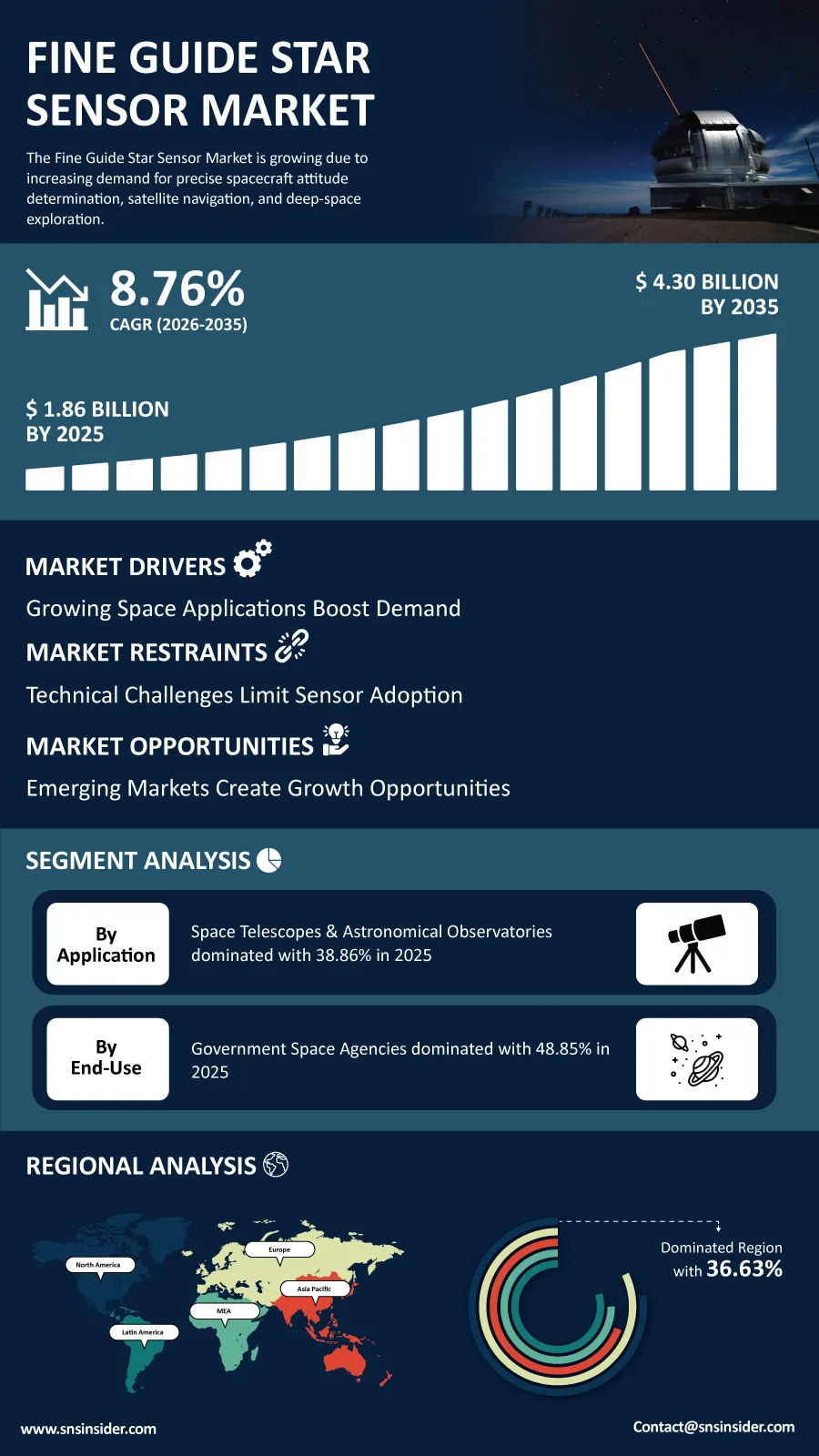
The global Fine Guide Star Sensor market is expected to witness strong growth over the next decade as governments, commercial space companies, and research organizations accelerate investments in satellite navigation, deep-space exploration, and advanced astronomical missions. According to a recent study by SNS Insider, the global Fine Guide Star Sensor (FGSS) market size valued at USD 1.86 billion in 2025, is anticipated to grow to USD 4.30 billion by 2035, registering a CAGR of 8.76% over the 2026–2035 forecast period.
The increasing use of Earth observation satellites, space telescopes, and satellite constellations necessitates accurate determination of the spacecraft attitude. Highly accurate fine guide star sensors have become vital elements used in order to ensure accurate positioning, stability, and effective navigation while performing complex space tasks.
The rapid development of modern imaging systems based on CCD, CMOS, and hybrid sensors improves their performance, energy efficiency, and precision. As a result, there appears an opportunity to manufacture miniaturized spacecraft navigation systems that are highly efficient both in government programs for exploration and in the commercial sector.
To Get Detailed Insights on the Fine Guide Star Sensor (FGSS) Market – Request a Sample Report
Expanding Space Programs Create Long-Term Growth Opportunities
With the increasing importance being placed on space exploration, satellite communication, and science research, the demand for cutting-edge navigation equipment is set to keep growing. National space organizations are making more and more investments into moon exploration and planetary observation projects, while commercial aerospace businesses are launching new rockets and putting more satellites into orbit.
In addition to that, there is an increased interest in small satellites and CubeSats constellations, which is leading to the development of compact guidance devices with excellent pointing precision, but at the same time with no decrease in load capacity. New technologies for sensors, aimed at improving their operation in low light conditions and reducing power consumption, are being developed as well.
Increased cooperation between aerospace corporations, sensor producers, and national governments is likely to help boost innovation and find new ways of commercializing products.
Key Market Insights Highlight Shifting Demand Patterns
By sensor technology, CCD-based Fine Guide Star Sensors are expected to account for 43.86% of global market revenue in 2025 due to their superior sensitivity, precision, and long-standing reliability in demanding space missions. CMOS-based Fine Guide Star Sensors are projected to register the fastest growth through 2035, supported by improvements in power efficiency, faster processing speeds, and cost-effective manufacturing.
Based on application, Space Telescopes & Astronomical Observatories are anticipated to contribute 38.86% of market revenue in 2025 owing to the growing need for ultra-precise celestial tracking and scientific observation. Spacecraft Attitude Determination & Control Systems are expected to emerge as the fastest-growing application as satellite launches and interplanetary missions continue to expand globally.
By end use, Government Space Agencies are forecast to generate 48.85% of market revenue in 2025 as national space programs continue investing in advanced spacecraft navigation technologies. Commercial Satellite & Space System Manufacturers are projected to witness the fastest growth due to increasing private sector participation in satellite deployment and commercial space exploration.
In terms of platform, Earth Observation Satellites are expected to account for 34.74% of market revenue in 2025, driven by rising demand for environmental monitoring, disaster management, and precision mapping. Small Satellites & CubeSats are anticipated to record the fastest growth through 2035 as launch costs decline and commercial satellite constellations continue expanding worldwide.
Precision Navigation Technologies Continue to Transform Space Missions
Modern space missions rely more and more on sophisticated navigation systems that can provide remarkable precision in demanding operating environments. By combining cutting-edge image processing, artificial intelligence, and next-generation optical technologies that improve spacecraft stability and mission performance, fine guide star sensors are growing more complex.
To address the changing demands of scientific research, Earth observation, communications, and defense applications, manufacturers are concentrating on increasing sensor longevity, minimizing system size, and maximizing power efficiency. It is anticipated that these technological advancements will facilitate wider implementation on both big spacecraft and small satellite platforms.
North America to Hold 36.63% Market Share in 2025, While Asia Pacific Grows at 9.76% CAGR
With robust government funding, cutting-edge aerospace infrastructure, and ongoing investments in satellite programs and deep-space research activities, North America is predicted to generate 36.63% of global market revenue in 2025. Leading space agencies, reputable defense companies, and a growing commercial aerospace ecosystem all benefit the area.
Asia Pacific is expected to increase at the fastest rate throughout the forecast period, with a compound annual growth rate (CAGR) of 9.76% through 2035. Regional market potential continues to be strengthened by the rapid expansion of state space programs in China, India, and Japan, as well as by expanding private satellite ventures and rising investments in research infrastructure.
As governments and commercial operators expand their space capabilities, demand for highly accurate spacecraft guidance technologies is expected to rise steadily across global markets.
Industry Participants Focus on Innovation and Advanced Space Navigation
The competitive landscape remains highly dynamic as aerospace companies continue investing in precision navigation technologies, advanced imaging sensors, and next-generation spacecraft guidance systems. Continuous research into hybrid sensor platforms, lightweight electronics, and improved optical performance is strengthening product capabilities while supporting increasingly sophisticated space missions.
Key companies operating in the global Fine Guide Star Sensor (FGSS) market include Honeywell Aerospace, Northrop Grumman Corporation, Lockheed Martin Corporation, Raytheon Technologies Corporation, BAE Systems plc, Thales Group, L3Harris Technologies Inc., General Dynamics Corporation, Airbus Defence and Space, Boeing Defense, Space & Security, Sierra Nevada Corporation, Ball Aerospace & Technologies Corp., Teledyne Technologies Incorporated, Moog Inc., OHB System AG, RUAG Space, QinetiQ Group plc, Sensonor AS, Adcole Corporation, and Kongsberg Gruppen ASA.
An SNS Insider analyst Sushant Kadam commented, “Growing investments in satellite constellations, scientific exploration, and precision spacecraft navigation are driving sustained demand for advanced fine guide star sensor technologies. Companies that continue advancing sensor accuracy, miniaturization, and energy efficiency will be well positioned to capitalize on expanding opportunities across the global space industry.”
About the Author

Get in touch




