
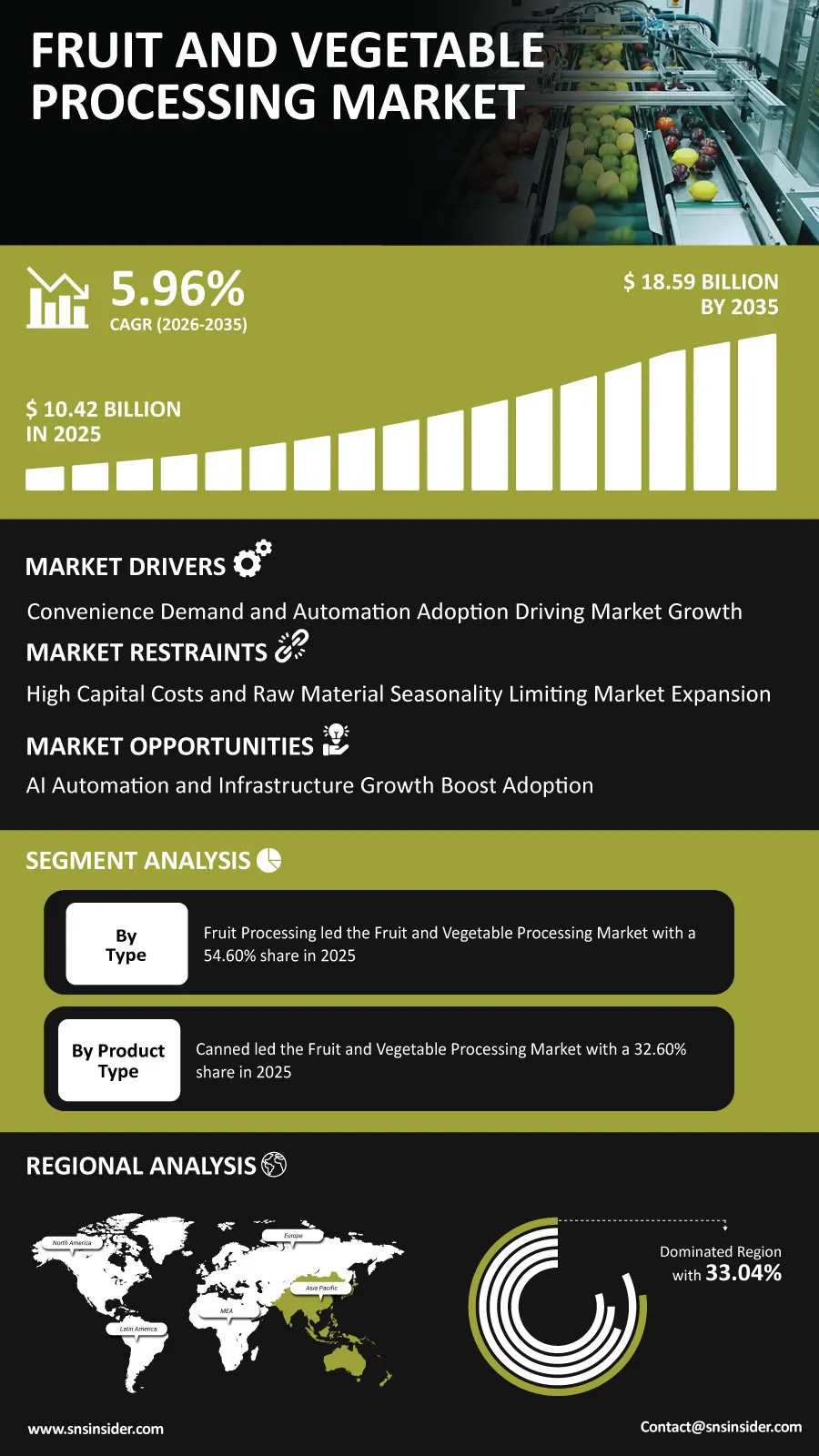
The global Fruit and Vegetable Processing Market is set for significant expansion as manufacturers worldwide continue investing in automated, AI-driven processing equipment. "According to a recent study by SNS Insider, the global Fruit and Vegetable Processing Market size valued at USD 10.42 billion in 2025, is anticipated to grow to USD 18.59 billion by 2035, registering a CAGR of 5.96% over the 2026-2035 forecast period."
There have been tremendous changes within fruit and vegetable processing technology over time due to which many manufacturers who aim at improving product quality can take advantage of this trend. This includes the need for more efficient, automated equipment that will provide processors with the ability to extend shelf life and reduce waste. This applies in situations where processing equipment is used for canning, freezing, drying, and fresh-cut preparation.
Manufacturers are constantly working hard to ensure that their processing equipment performs better than before in order to meet various needs of food processors and foodservice operators.
To Get Detailed Insights on the Fruit and Vegetable Processing Market – Request a Sample Report
Automated Processing Ecosystems Create New Demand
The fruit and vegetable processing market has evolved from basic canning and freezing to more advanced AI-driven and fresh-cut use cases. The growing investment in hyperspectral imaging, predictive maintenance platforms, and turnkey processing solutions for a variety of applications has required the development of more efficient and reliable processing systems.
New designs of processing equipment can increase throughput, reduce waste, and allow for extended shelf life. This gives food manufacturers the possibility to be more effective when producing goods and doing better cost management.
Equipment manufacturers, food processors, and foodservice companies are increasingly cooperating thanks to the growing interest in developing future solutions for efficient food processing.
Key Market Findings Highlight High-Growth Segments
The fruit processing segment dominated all categories in the fruit and vegetable processing market share with a market revenue share of 54.60% in 2025 due to its broad global cultivation base.
The fastest growing category is expected to be vegetable processing which will grow at a CAGR of 6.40% through 2035. This will be possible owing to the increasing need for frozen and fresh-cut vegetable products.
By product type, canned products held the largest share of total market revenue of 32.60% in 2025 due to their extended shelf life and established distribution. The fresh-cut segment will see the fastest growth in revenue generation at a CAGR of 7.60%.
Based on mode of operation, automatic equipment generated a share of 61.40% of market revenue in 2025 thanks to labor cost pressures favoring automation. On the other hand, semi-automatic equipment will be the segment recording the fastest revenue growth at a CAGR of 6.80%.
Distributive trends are changing as well. Food processing industry end use accounted for a 58.60% revenue share in 2025. But foodservice and HoReCa will turn out to be the fastest-growing end use through 2035, on the back of restaurant expansion, urbanization, and increased demand from commercial kitchens.
Efficiency, Quality, and Sustainability Gain Importance
In this regard, food processors have been looking at equipment that would make their operations more efficient and require less waste and be more sustainable.
Innovation in AI-driven sorting, energy-efficient heat exchangers, and predictive maintenance has been making it possible for companies to come up with products that can operate effectively across demanding processing conditions. In addition to that, increasing emphasis on traceability and food safety is also making it possible for companies to find solutions that optimize processing performance.
Such trends are likely to become even more prominent in the future.
Asia Pacific Emerges as the Largest Market with 33.04% Revenue Share Amid Rising Processing Demand
The Asia Pacific region represented 33.04% share of global market revenue in 2025 and was the largest regional market, owing to advancements in post-harvest infrastructure, high agricultural output, and expanding processing capabilities. In addition, the Middle East & Africa region is expected to be the fastest-growing market during the forecast period, propelled by heavy government investment in cold-chain infrastructure and applications across the region's fast-growing food processing industries.
On the other hand, North America represented a significant share of global market revenue in 2025, aided by rising single-person households and a favorable framework for processing equipment innovation.
Leading Companies Drive Innovation and Competition
The environment continues to stay very dynamic since players continue innovating on products and technologies as well as forming partnerships in order to enhance their position in the industry.
Some of the major companies that operate in the global fruit and vegetable processing market are GEA Group AG, Bühler Holding AG, Krones AG, Heat and Control Inc., Conagra Brands Inc., Nestlé S.A., Olam International Limited, Marel hf., JBT Corporation, and Tetra Pak International S.A.
An SNS Insider Analyst Parry Kardani commented, "The rapid commercialization of AI-driven processing technology is creating unprecedented demand for high-performance fruit and vegetable processing equipment. Manufacturers that successfully combine automation, quality control, sustainability, and advanced engineering capabilities will be best positioned to capitalize on emerging opportunities across food processing, foodservice, and retail applications."
About the Author

Get in touch




