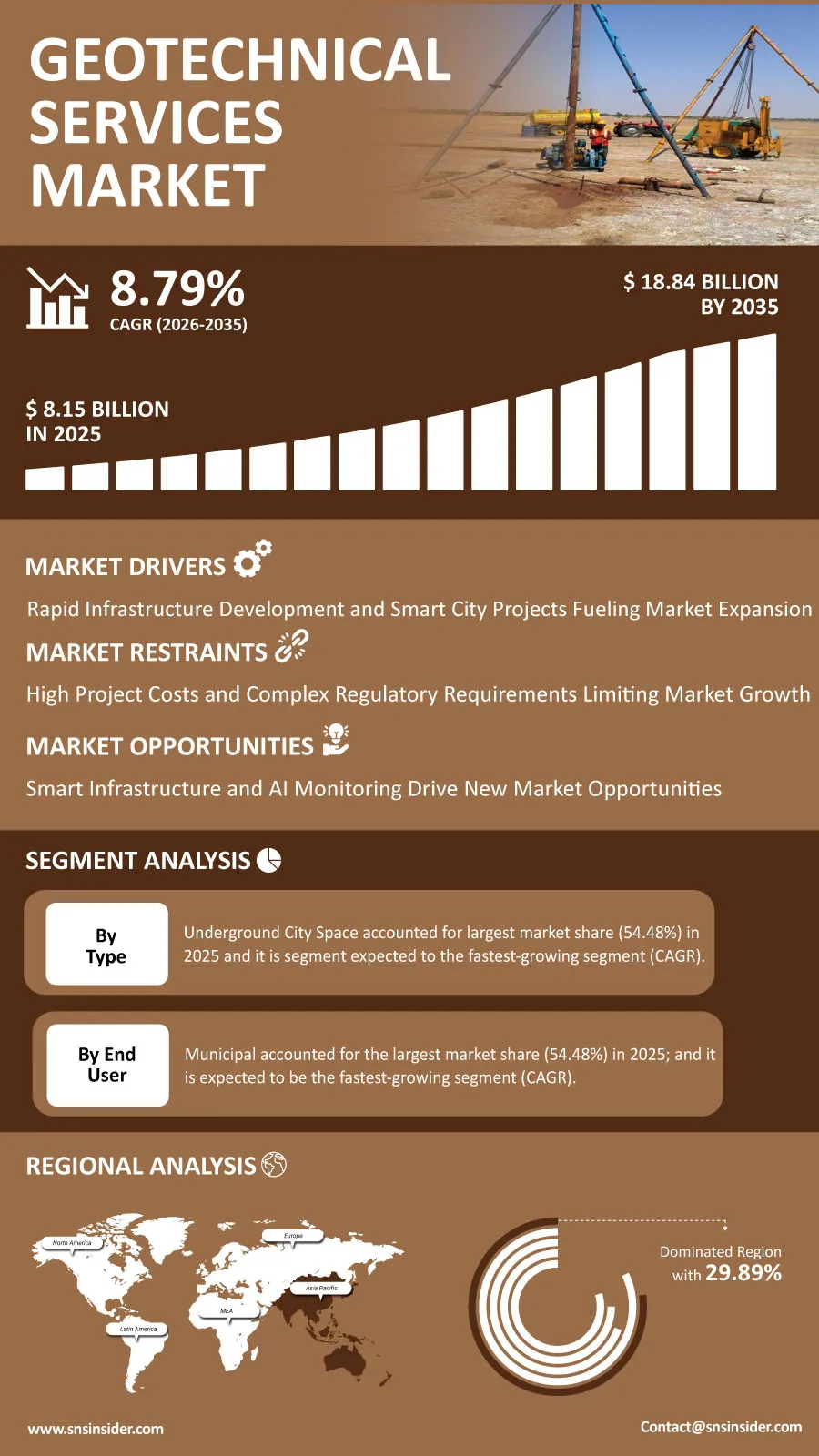
The global Geotechnical Services Market is experiencing a new phase of growth owing to the emphasis on building resilient infrastructures and underground construction by governments and private entities. “According to a recent study by SNS Insider, the global Geotechnical Services Market size valued at USD 8.15 Billion in 2025, is anticipated to grow to USD 18.84 Billion by 2035, registering a CAGR of 8.79% over the 2026–2035 forecast period.”
The increasing investments made in the development of highways, bridges, tunnels, metro railway systems, renewable energy systems, and commercial projects have increased the need for geotechnical engineering services in all parts of the world. The need for geotechnical investigation services has increased because of the use of these engineering services for improving construction safety and efficiency. The adoption of digital technology by engineers has improved the efficiency of investigation services at different construction sites.
To Get Detailed Insights on the Geotechnical Services Market – Request a Sample Report
Smart Infrastructure Investments Create Long-Term Market Opportunities
Urban renewal projects and smart city projects are creating an increasing need for high-end geotechnical engineering services. The increasing development of skyscrapers and underground transportation systems makes it important for cities to undertake comprehensive soil characterization and foundation designs before embarking on large-scale infrastructure development projects.
Geotechnical engineers are being presented with new areas where their skills can be utilized. This includes projects such as wind farms, solar power plants, hydroelectric power stations and energy transmission lines that require detailed geological surveys due to different environmental factors that affect their structure. In addition, there are developments in the field of artificial intelligence, remote sensing technology and drone surveying that enable engineers to enhance project efficiency and reduce operational risk.
Key Market Insights Highlight Infrastructure-Led Demand
Segment-wise, the market revenue share held by the Underground City Space segment was at 54.48% in 2025 owing to increasing investments in metro railways, utility tunnels, tunnels, and smart city infrastructure. This segment is also anticipated to maintain its position as the fastest growing segment, owing to increasing investments in underground transport and utilities infrastructure by governments.
End-user wise, the Municipal segment captured 54.48% of the market in 2025 because of increasing investments in roads, bridges, drainage, public transport, and urban infrastructure. The municipalities have been increasing their investments in soil investigation, slope analysis, and foundation engineering in order to ensure sustainable development of infrastructure in compliance with engineering standards.
AI and Digital Technologies Transform Geotechnical Engineering
The geotechnical services industry is seeing tremendous technological evolution as engineering companies adopt digital technology into every phase of project implementation. The use of artificial intelligence monitoring systems, automated data analysis, and geotechnical sensors that provide real-time data has helped to enhance decision-making process and lower uncertainty surrounding subsurface conditions.
Remote sensing platforms, drone technology, geographic information systems, and predictive analytics have also made it easier for engineers to conduct investigations before the start of the project. These technologies enable engineers to spot ground movements, design foundations, and plan construction projects before the digging process starts.
Regional Markets Continue Expanding with Infrastructure Modernization
The Asia Pacific region occupied 29.89% of the share in the global Geotechnical Services Market in 2025 due to factors like rapid urbanization, expansion of the transportation network, mining operations, and extensive construction of tunnels and bridges in China, India, Japan, and South Korea. The investment in smart cities and underground constructions would continue to drive regional growth over the forecast period.
North America occupied 23.67% of the share in global revenue in 2025 due to infrastructure modernization, renewable energy projects, commercial construction, and increasing adoption of artificial intelligence based geotechnical monitoring system solutions. The share of Europe in the market was 10.67% in 2025 due to factors like transportation modernization, renewable energy projects, and environmentally sustainable construction methods. The Middle East & Africa and Latin America are witnessing increasing opportunities due to urban infrastructures, mining projects, transportation, and energy projects.
Industry Participants Strengthen Digital Engineering Capabilities
However, competition in the Geotechnical Services Market around the globe is becoming increasingly fierce, considering that some of the top engineering firms are focusing on using advanced technologies for site investigations, artificial intelligence analytics, digital monitoring tools, and engineering solutions. It is through investment in automation, environmental consultancy, underground engineering skills, and renewable energy infrastructure that they can increase their project portfolios across the globe.
Key companies operating in the global Geotechnical Services Market include AECOM, WSP Global Inc., Jacobs Solutions Inc., Tetra Tech Inc., Stantec Inc., Fugro N.V., Keller Group plc, HDR Inc., Golder Associates Corporation, Terracon Consultants Inc., GeoEngineers Inc., Arcadis N.V., Mott MacDonald Group Limited, Ramboll Group A/S, Bechtel Corporation, Black & Veatch Holding Company, Schnabel Engineering LLC, Geosyntec Consultants Inc., COWI A/S, and Aurecon Group Pty. Ltd.
An SNS Insider analyst Himanshu Sharma commented, "Global investment in resilient infrastructure, underground transportation, renewable energy, and smart urban development is significantly increasing the need for advanced geotechnical expertise. Organizations that combine digital ground investigation technologies, AI-enabled monitoring, and comprehensive engineering capabilities will be well positioned to support the next generation of complex infrastructure projects worldwide."
About the Author

Get in touch