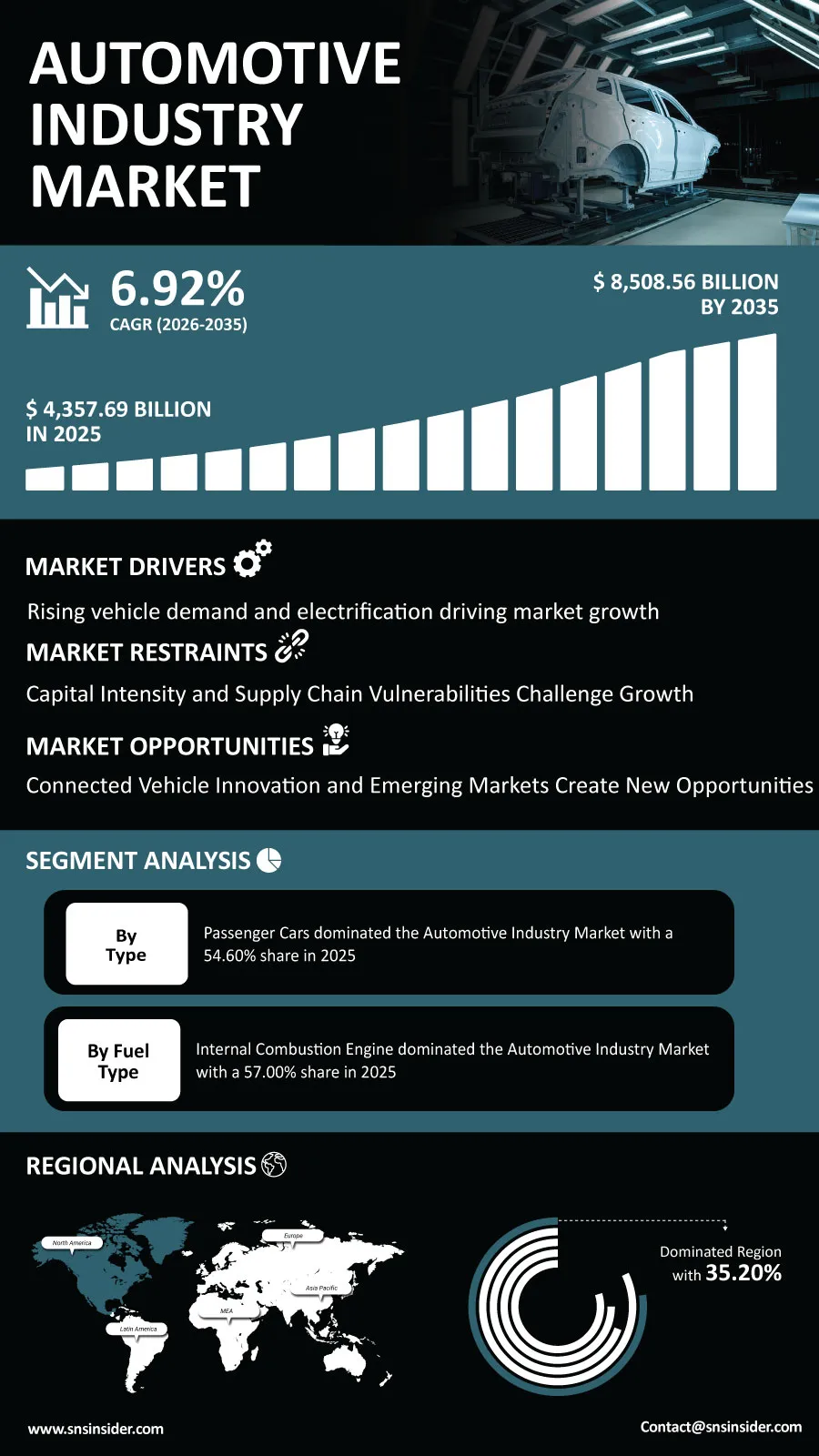
The Automotive Industry Market is set for substantial expansion as electrification, digitalization, and connected mobility reshape vehicle manufacturing and consumer purchasing behavior worldwide. “According to a recent study by SNS Insider, the Automotive Industry Market size valued at USD 4,357.69 billion in 2025, is anticipated to grow to USD 8,508.56 billion by 2035, registering a CAGR of 6.92% over the 2026–2035 forecast period.”
There have been tremendous changes within vehicle technology over time, due to which many automakers who aim at improving performance and consumer appeal of their vehicles can take advantage of this trend. This includes the need for more sophisticated electric powertrains, software-defined architectures, and connected services that meet evolving regulatory and consumer expectations. This applies in situations where automakers serve passenger, commercial, and increasingly electrified vehicle segments across both mature and rapidly growing emerging markets. Automakers are constantly working to ensure their vehicle platforms perform better than before in order to meet various regulatory, safety, and consumer connectivity requirements.
To Get Detailed Insights on the Automotive Industry Market – Request a Sample Report
Electrification and Software-Defined Architecture Create New Demand
The automotive industry has changed from being simply mechanical production to a more software-driven one. The increasing investments by all sizes of automakers in terms of electric propulsion, autonomous technology, and connectivity have necessitated the creation of complex vehicle platforms.
Advanced vehicle platforms will be able to enhance energy efficiency, lower emissions, and provide ongoing over-the-air software updates through the lifetime of the vehicle, thereby giving automakers the chance to create connected service revenue streams and also enhance the driving experience of the consumer.
There has been cooperation between automakers, semiconductor providers, and battery providers due to the increasing interest in creating future technologies for electrification and software-driven mobility.
Key Market Findings Highlight High-Growth Segments
The passenger cars segment dominated all categories in theAutomotive Industry Market share with a market revenue share of 54.60% in 2025 due to its wide application across personal transportation worldwide. The fastest growing category is expected to be electric vehicles which will grow at a CAGR of 14.80% through 2035, owing to tightening emissions regulations and falling battery costs.
By fuel type, internal combustion engine vehicles held the largest share of total market revenue at 57.00% in 2025 due to established fueling infrastructure and strong consumer familiarity in developing economies. The electric segment will see the fastest growth in revenue generation at a CAGR of 15.60%, supported by expanding government incentives and charging infrastructure.
Based on sales channel, dealerships generated a share of 61.40% of market revenue in 2025 thanks to their established role in financing, trade-in, and after-sales service. On the other hand, online retail will be the fastest-growing sales channel through 2035, on the back of growing consumer comfort with digital vehicle configuration and direct-to-consumer purchasing models.
Distributive vehicle size trends are changing as well. Mid-size vehicles accounted for a 38.70% revenue share in 2025 as the preferred choice across the broadest range of consumer segments. But the luxury segment will turn out to be the fastest-growing vehicle size category through 2035, on the back of rising disposable incomes and middle-class expansion in emerging economies.
Connectivity, Efficiency, and Sustainability Gain Importance
In this regard, automakers have been looking at vehicle architectures that would make their products more energy-efficient, better connected, and increasingly software-upgradable throughout their operational life.
Innovation in battery chemistry, power electronics, and vehicle software platforms has been making it possible for companies to come up with products that operate more efficiently while offering richer connected experiences. In addition to that, increasing emphasis on sustainability and emissions reduction is also making it possible for automakers to find solutions that meet tightening regulatory standards. Such trends are likely to become even more prominent in the future.
North America Emerges as the Largest Market with 85.00% Regional Revenue Share Amid Rising Electric Vehicle Demand
The North America region represented the largest share of regional market revenue in 2025, aided by strong consumer demand for electric vehicles and advanced safety systems, robust domestic manufacturing infrastructure, and continued innovation in connected and autonomous vehicle technology. On the other hand, Asia Pacific is expected to be the fastest-growing market during the forecast period through 2035, propelled by robust manufacturing potential, high urbanization, and huge spending on electric vehicles and supporting infrastructure, particularly in China and India.
Leading Companies Drive Innovation and Competition
The environment continues to stay very dynamic since players continue innovating on products and electrification strategies as well as forming partnerships in order to enhance their position in the industry. Some of the major companies that operate in the Automotive Industry Market are Toyota Motor Corporation, Volkswagen AG, Stellantis, General Motors, Ford Motor Company, Hyundai Motor Company, Honda Motor Co., BMW Group, Mercedes-Benz Group, and Tesla, Inc.
An SNS Insider analyst Santosh Bhul commented, "The rapid electrification and digitalization of the vehicle fleet is creating unprecedented demand for integrated, software-defined automotive platforms. Automakers that successfully combine electrification, connectivity, and manufacturing efficiency will be best positioned to capitalize on emerging opportunities across passenger, commercial, and premium vehicle segments."
About the Author

Get in touch