
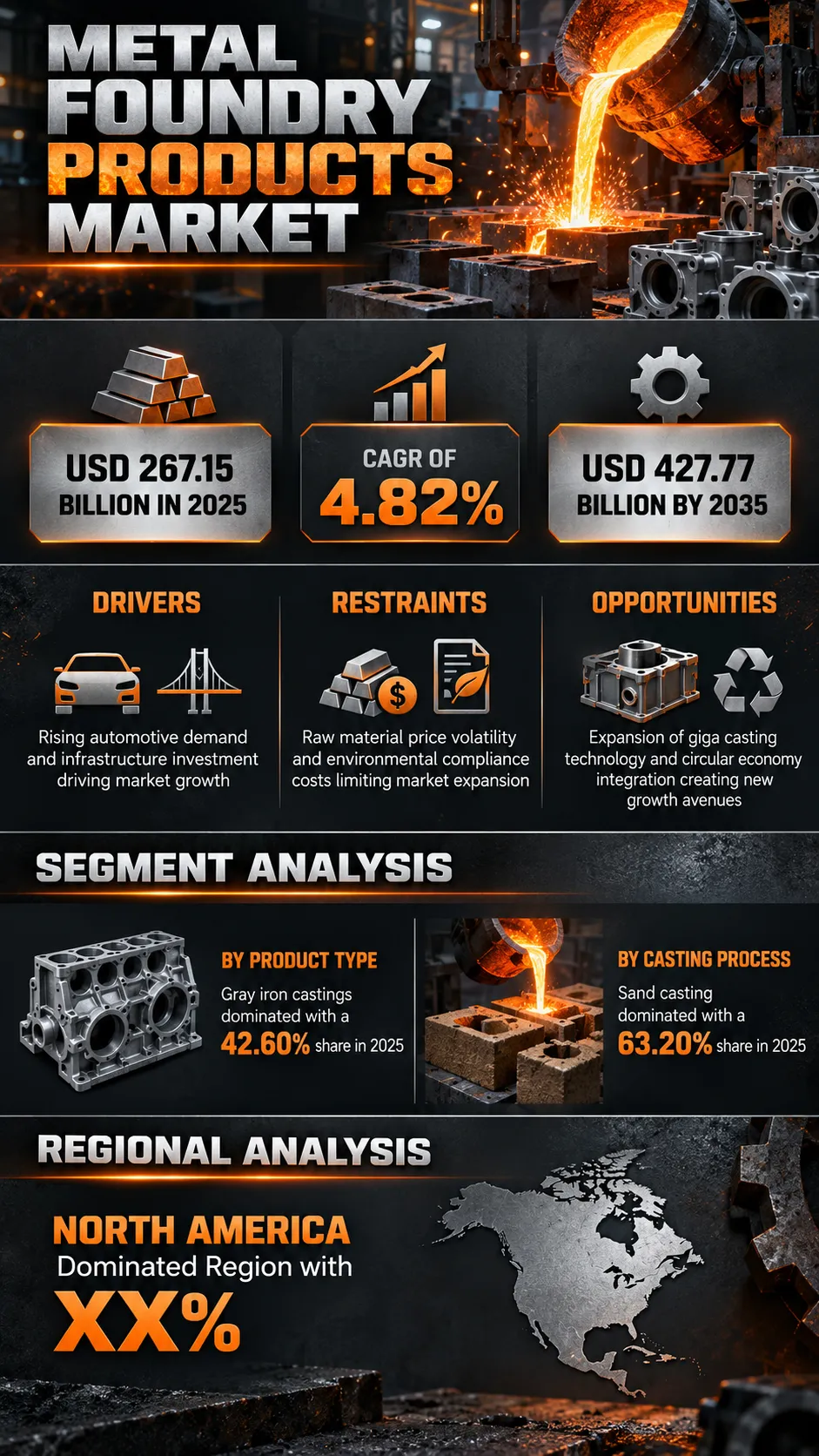
The global Metal Foundry Products Market is set for significant expansion as automotive demand and infrastructure investment continue to reshape cast metal component manufacturing worldwide. “According to a recent study by SNS Insider, the global Metal Foundry Products Market size valued at USD 267.155 billion in 2025, is anticipated to grow to USD 427.775 billion by 2035, registering a CAGR of 4.82% over the 2026–2035 forecast period.”
There have been notable changes within metal casting process technology over time, due to which many foundry operators who aim at improving efficiency and sustainability of their products can take advantage of this trend. This includes the need for more advanced giga casting and digitalized quality control techniques that will provide automotive and industrial manufacturers with the ability to access reliable, lightweight cast components. This applies in situations where metal foundry products support automotive, aerospace, construction, and industrial machinery applications. Foundry operators are constantly working hard to ensure that their casting products perform better than before in order to meet various lightweighting and sustainability requirements.
To Get Detailed Insights on the Metal Foundry Products Market – Request a Sample Report
Giga casting Technology and Circular Economy Integration Create New Demand
The metal foundry products market has evolved from conventional sand casting processes to increasingly sophisticated, large-format aluminum die-casting and digitalized quality control technology. The growing investment in giga casting capability, aluminum recycling infrastructure, and Industry 4.0 digitalization across foundry operators of all sizes has required the development of more efficient and sustainable metal casting products.
Advances in casting and recycling technology will be able to contribute towards increased efficiency of production processes, improved sustainability credentials, and further development of more varied applications of automotive, aerospace, and industrial machine parts. It enables companies to decrease the number of parts in their vehicles while meeting carbon accounting demands.
Foundry operators, automotive manufacturers, and infrastructure developers are increasingly cooperating thanks to the growing interest in developing future solutions for lightweight, sustainably produced metal casting products.
Key Market Findings Highlight High-Growth Segments
Distributive product type trends are changing as well. Gray iron castings accounted for the largest revenue share owing to established, cost-effective production infrastructure. But ductile iron castings will turn out to be the fastest-growing product category through 2035, on the back of growing usage in public infrastructure under massive investment legislation.
By casting process, sand casting maintained about 63.2% of revenue share due to its technical advantages including temperature resistance and cost-effectiveness. Die-casting will see the fastest growth in revenue generation at a 7.40% CAGR, driven by automotive structural applications and giga casting technology adoption.
Based on application, automotive accounted for approximately 47% of market revenue thanks to metal castings' essential role across engine blocks and structural parts. On the other hand, industrial machinery will be the segment recording the fastest revenue growth at a 6.80% CAGR, supported by investments in automation and renewable energy infrastructure.
Lightweighting, Sustainability, and Manufacturing Efficiency Gain Importance
In this regard, automotive and industrial manufacturers have been looking at metal foundry products that would deliver more consistent lightweighting performance while requiring greater sustainability credentials and manufacturing efficiency.
Innovation in gigacasting capability, aluminum recycling infrastructure, and Industry 4.0 digitalization has been making it possible for companies to come up with products that appeal to increasingly automation-focused and sustainability-conscious manufacturers. In addition to that, increasing emphasis on infrastructure application development is also making it possible for foundry operators to find solutions that address public sector investment priorities. Such trends are likely to become even more prominent in the future.
North America Emerges as the Largest Market Amid Robust Automotive Demand
The North America region represented the largest share of regional market revenue in 2025, driven by robust automotive demand and substantial infrastructure investment. On the other hand, Asia-Pacific is the fastest-growing region during the forecast period through 2035, reflecting increasing investments in infrastructure and manufacturing across China, India, and South Korea.
Leading Companies Drive Innovation and Competition
The environment continues to stay very dynamic since players continue innovating on gigacasting technology and circular economy integration as well as forming partnerships in order to enhance their position in the industry. Some of the major companies that operate in the global metal foundry products market are Alcoa, ArcelorMittal, Thyssenkrupp, Nucor Corporation, Hindalco Industries, OMCO INTERNATIONAL, Toyota Industries Corporation, Bakgiyam Engineering, Nelcast, and Morgan Advanced Materials.
An SNS Insider analyst Himanshu Sharma commented, "The growing convergence of automotive electrification and infrastructure investment is creating sustained demand for lightweight, sustainably produced metal casting products. Foundry operators that successfully combine gigacasting innovation, circular economy integration, and application-specific expertise will be best positioned to capitalize on emerging opportunities across automotive, aerospace, and industrial machinery segments."
About the Author

Get in touch




