
The global Glycerin Market could witness highly steady growth during the period of projection, with increasing investments by manufacturers to venture into sustainable chemicals, pharmaceutical-grade ingredients for food and pharmaceuticals, and renewable feedstocks. “According to a recent study by SNS Insider, the global Glycerin Market size valued at USD 4.00 Billion in 2025, is anticipated to grow to USD 6.46 Billion by 2035, registering a CAGR of 6.24% over the 2026–2035 forecast period.”
The glycerin market growth in terms of application is attributed to the replacement of fossil-derived materials with renewable sources in various industries driven by increasing focus on sustainable manufacturing. Glycerin remains in demand thanks to its versatility, safety and compatibility with sustainable production as a key ingredient in cosmetics, food processingand pharmaceuticals as well as specialty chemicals.
Rising biodiesel manufacturing is again strengthening market development by sustaining an constant supply of crude glycerin which is then refined into top quality grades for business use. Companies are also developing advanced purification processes for producing pharmaceutical- and food-grade glycerin that meets increasingly strict international quality standards.
To Get Detailed Insights on the Glycerin Market – Request a Sample Report
Bio-Based Manufacturing and Pharmaceutical Expansion Create Long-Term Opportunities
Glycerin generation is being delivered in gentle of worldwide endeavors to hasten bio-based producing. More and more companies are turning to glycerin as their green raw material for specialty chemicals, polymers and advanced coatings & high-end industrial formulations which help industries with sustainability initiatives.
With production of injectable medicines, oral formulations, topical therapies and healthcare products expanding globally, demand from pharmaceutical manufacturers remains strong. Moderate investments in pharmaceutical manufacturing capacity are anticipated across emerging economies, creating demand for high quality glycerin conforming to global pharmacopeia specifications over the short run.
Furthermore, continued technological innovation is further enabling producers to fine-tune product purity and operational output efficiency in addition to more reliably managing supply chain capacity, all of which are creating avenues through which such producers can effectively compete directly on premium-value applications while still supporting a sustainable business case for market expansion.
Key Market Insights Highlight Shifting Demand Patterns
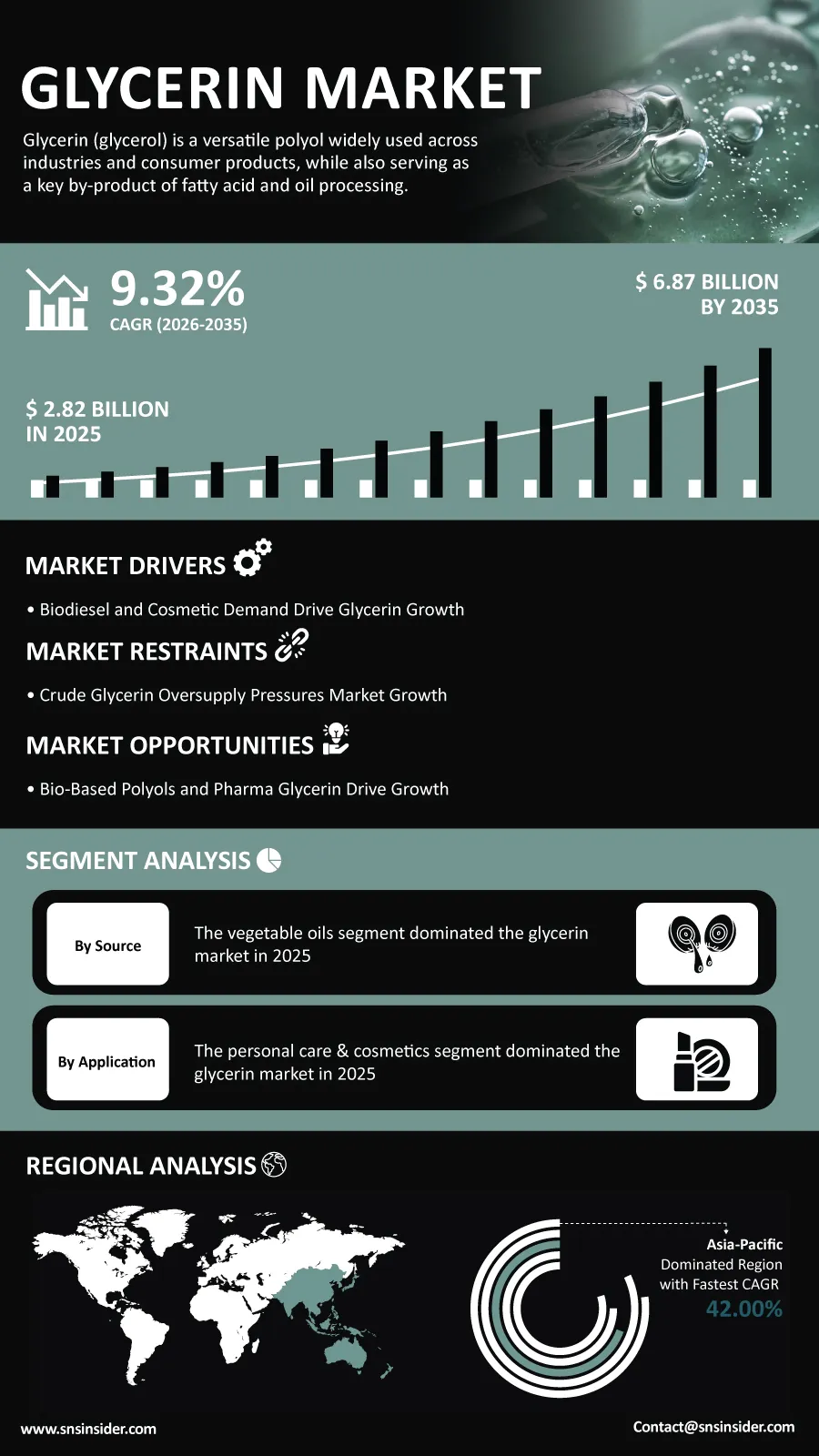
In 2025, as per source, Vegetable Oils had maximum share of revenue in market owing to its availability and processing infrastructure are well established. On the other hand, biodiesel by-product segment is projected to grow at the fastest rate through 2035 as global production of biofuels will continue to increase.
Based on the grade, glycerin with technical application was the leading volume segment owing to its widespread usage in industrial applications. Nevertheless, pharmaceutical-grade (USP) glycerin segment is anticipated to report the highest growth rate during 2023–2430 owing to increasing demand from healthcare & life sciences sectors.
Based on application, the personal care and cosmetics segment was the largest revenue-share category in 2025 due to high consumption of glycerin for skincare, haircare and hygiene formulations. We see pharmaceuticals and healthcare providing the highest growth as we go out to 2035, owing to a continued ramp-up in global medicine production and investment in healthcare.
Advanced Refining Technologies Strengthen Industry Competitiveness
Glycerin industry is experiencing technological advancements in the purification facilities installed and enhancing production efficiency. High-purity refining systems are on the rise for consistent production of pharmaceutical, food, and cosmetic-grade glycerin as well as an increased focus on operational sustainability.
Companies are also working to strengthen their competitiveness with renewable processing technologies, quality assurance systems and integrated supply chains. Developments like these are supporting manufacturers as they face rising requirements from both consumers and regulatory authorities for more traceable, high-performance and environmentally sustainable ingredients in local and global markets.
Asia Pacific Retained Market Leadership with 42% Share in 2025; U.S. Held 82.47% of North American Revenue
In 2025, Asia Pacific continued to dominate the global market and accounted for nearly 42% share of worldwide market revenue on account of its well-established vegetable oil processing and increasing biodiesel production as well as robust manufacturing base for pharmaceuticals, personal care products, and specialty chemicals. China accounted for nearly 38.47% of regional revenue, bolstered by extensive domestic production along with widespread industrial consumption in the region.
North America is projected to be the fastest-growing regional market through 2035, on account of growing pharmaceutical manufacturing, rise in renewable ingredient adoption, increasing biodiesel plants and expanding investments in domestic refining capacity. North America revenue share through 2025 was approximately 82.47% driven be mature pharmaceutical, food processing and personal care industries in the U.S.
Stable demand from an established pharmaceutical and specialty chemical industry in Europe, coupled with increasing opportunities in Latin America due to biodiesel expansion, oleochemical production and growing industrial applications in the Middle East & Africa will continue to bolster overall market growth.
Industry Participants Focus on Capacity Expansion and High-Purity Production
Competition in the overall glycerin market worldwide remains fierce as manufacturers add refining capacity, enhance production processes, and pursue quality product development. Pharmaceutical-grade manufacturing, supply chain resilience and sustainable processing technologies are allowing firms to increase demand in global markets while increasing market demand HEA adaption across health care, cosmetics, food and industrials.
Key companies operating in the global Glycerin Market include Wilmar International Ltd., KLK OLEO, Cargill Incorporated, BASF SE, Procter & Gamble Chemicals, Archer Daniels Midland Company, Emery Oleochemicals Group, IOI Corporation Berhad, Godrej Industries Ltd., Kao Corporation, Vantage Specialty Chemicals Inc., Croda International PLC, Oleon NV, Global Green Chemicals PCL, Glycotech Inc., Granol Industria Comercio e Exportacao SA, Musim Mas Holdings Pte. Ltd., PT Ecogreen Oleochemicals, INEOS Oxide Ltd., and Twin Rivers Technologies Inc.
An SNS Insider analyst Himanshu Sharma commented, "The accelerating transition toward renewable chemicals, pharmaceutical manufacturing expansion, and sustainable industrial production is strengthening long-term demand for high-quality glycerin. Companies investing in advanced refining technologies, bio-based innovation, and premium-grade product development will be well positioned to capitalize on emerging global market opportunities."
About the Author

Get in touch




