
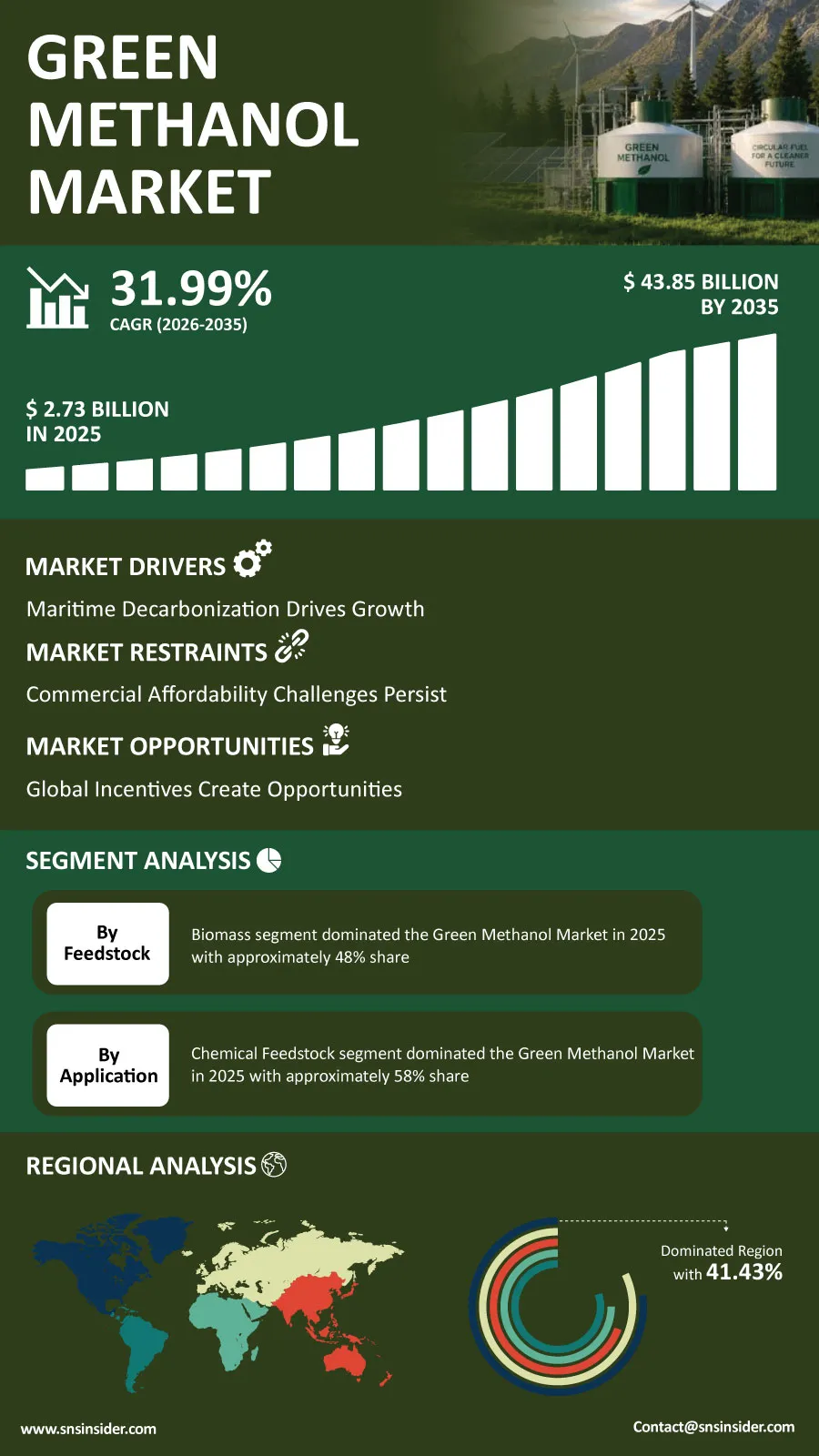
The worldwide Green Methanol Market is expanding quickly throughout the following couple of years up to 2023 as this time we have governments and enterprises trying their earnest endeavors at accomplishing diminishing carbon emissions and moving towards practical fuels. “According to a recent study by SNS Insider, the global Green Methanol Market size valued at USD 2.73 Billion in 2025, is anticipated to grow to USD 43.85 Billion by 2035, registering a CAGR of 31.99% over the 2026–2035 forecast period.”
Its rising global demand for marine fuels, low-carbon chemical feedstocks and clean industrial energy sources is making green methanol one of the most promising alternative fuel markets in the world. Companies are increasing their investments in renewable hydrogen production and carbon capture and power-to-methanol technologies that allow for the commercialisation of these processes while supporting global decarbonisation targets.
Long-term supply contracts or investments in infrastructure are being accelerated by the shipping companies, chemical manufacturers and energy developers replaced conventional fossil-based fuels stimulating demand due to stricter environmental regulations. Ongoing improvements in electrolysis, biomass conversion, and carbon utilization technologies are enhancing production efficiency and commercial viability.
To Get Detailed Insights on the Green Methanol Market – Request a Sample Report
Renewable Fuel Investments Create Long-Term Growth Opportunities
The investments in renewable energy infrastructure by public and private sectors are paving the way for large-scale green methanol production. All over the globe governments are still rolling out tax benefits, grants and carbon reduction policies that promote industry to switch their fuels and speed up energy transition processes.
Green methanol continues to be one of the most compelling growth drivers of shipping industry. With global fleets moving towards reduced emission propulsion systems, demand for renewable marine fuel is projected to continue growing. The establishment if methanol bunkering infrastructure and the rollout of dual-fuel vessels is bolstering the commercial outlook for producers throughout global markets.
Ongoing innovation in renewable hydrogen generation and carbon capture integration are creating further opportunities for green methanol producers. Carbon utilization technologies enabling the production of ultra-low-carbon fuel while supporting circular carbon utilization strategies across several industrial sectors.
Key Market Insights Highlight Rapid Industry Transformation
Due to the commercial production pathway already available for commercially viable routes and high availability of agricultural, forestry & municipal waste resources in 2025, Biomass segment based on feedstock held over 48% revenue share across the global market. Globally, the Green Hydrogen segment is projected to recording maximum growth from 2026-2035 as renewable electricity generation and deployment of electrolyzers continue.
By derivative, formaldehyde accounted for around 43% of market demand in 2025 due to its widespread use in construction materials (including insulation and flooring), engineered wood products (such as plywood and particleboard), automotive components and industrial chemicals. The Methanol-to-Olefin (MTO) segment is expected to grow the fastest as manufacturers look for lower-carbon pathways to sustainable petrochemical feedstocks.
Based on the application, the market is segmented as Chemical Feedstock, Plastic & Elastomers and Lubricant Base Oil. High growth for the Fuel segmentThe wide-scale use of renewable methanol across marine transportation, power generation and heavy-duty mobility applications is expected to drive high growth in this segment.
Technology Innovation Accelerates Commercial Deployment
The production of green methanol is advancing quickly with constant maturation in renewable hydrogen generation, carbon capture systems and biomass gasification technologies. Cumulatively, companies are investing in second-generation electrolyzers that boast improved process automation and integrated carbon utilization platforms to better the economics of production and lower lifecycle emissions.
Strategic partnerships of energy companies with shipping operators, engineering firms and technology providers are speeding up the commercialization of large-scale production facilities. These collaborations are aimed at creating secure supply chains that can meet the rising industrial demand for renewable fuels and sustainable chemical products.
North America Captured 41.43% of the Global E-Methanol Market in 2025, While Asia Pacific Emerges as the Fastest-Growing Region
North America grabbed around 41.43% revenue share of the global market in 2025, owing to major investments for establishment renewable fuel infrastructure together with carbon capture projects, and hydrogen production plants. Government support for clean energy transition and industrial decarbonization strong in leading regional markets.
Asia Pacific will witness the fastest growth in regional markets over the forecast period. The strong economic base offered by China, Japan, South Korea and Australia all serve to support rapid industrialization, an expanding renewable energy capacity baseline and increased hydrogen investment as new technology evolves along with growing market opportunities for green fuels.
Europe remains exceptionally well-positioned, with its bold climate neutrality targets backed by fast-tracking renewable hydrogen projects and adoption of low-carbon fuels in the maritime and chemicals sectors. By contrast, the Middle East, Africa, and Latin America are reinforcing their market share with renewable energy investments, fuel projects catering to foreign markets coupled with international partnerships.
Industry Participants Focus on Scaling Renewable Fuel Production
Competitive environment will remain dynamic due to increased production capabilities by leading firms, development of e-methanol technology, and building strategic alliances within renewable energy, shipping and chemicals industries value chain. More money is being allocated towards carbon capture integration, renewable hydrogen facilities, and fuel production.
Key companies operating in the global Green Methanol Market include Methanex Corporation, OCI N.V., Carbon Recycling International, Enerkem Inc., Proman AG, Södra, European Energy, Liquid Wind AB, Topsoe A/S, SunGas Renewables, GIDARA Energy, WasteFuel, Linde plc, Johnson Matthey Plc, thyssenkrupp Uhde GmbH, HIF Global, BASF SE, Mitsui & Co. Ltd., C2X, and Praj Industries Ltd.
An SNS Insider analyst Himanshu Sharma commented, "Growing commitments toward net-zero emissions, rapid investments in renewable hydrogen, and expanding adoption of sustainable marine fuels are establishing green methanol as a critical component of the future low-carbon energy economy. Organizations investing in scalable production technologies and integrated renewable fuel infrastructure are expected to gain significant long-term competitive advantages."
About the Author

Get in touch




