
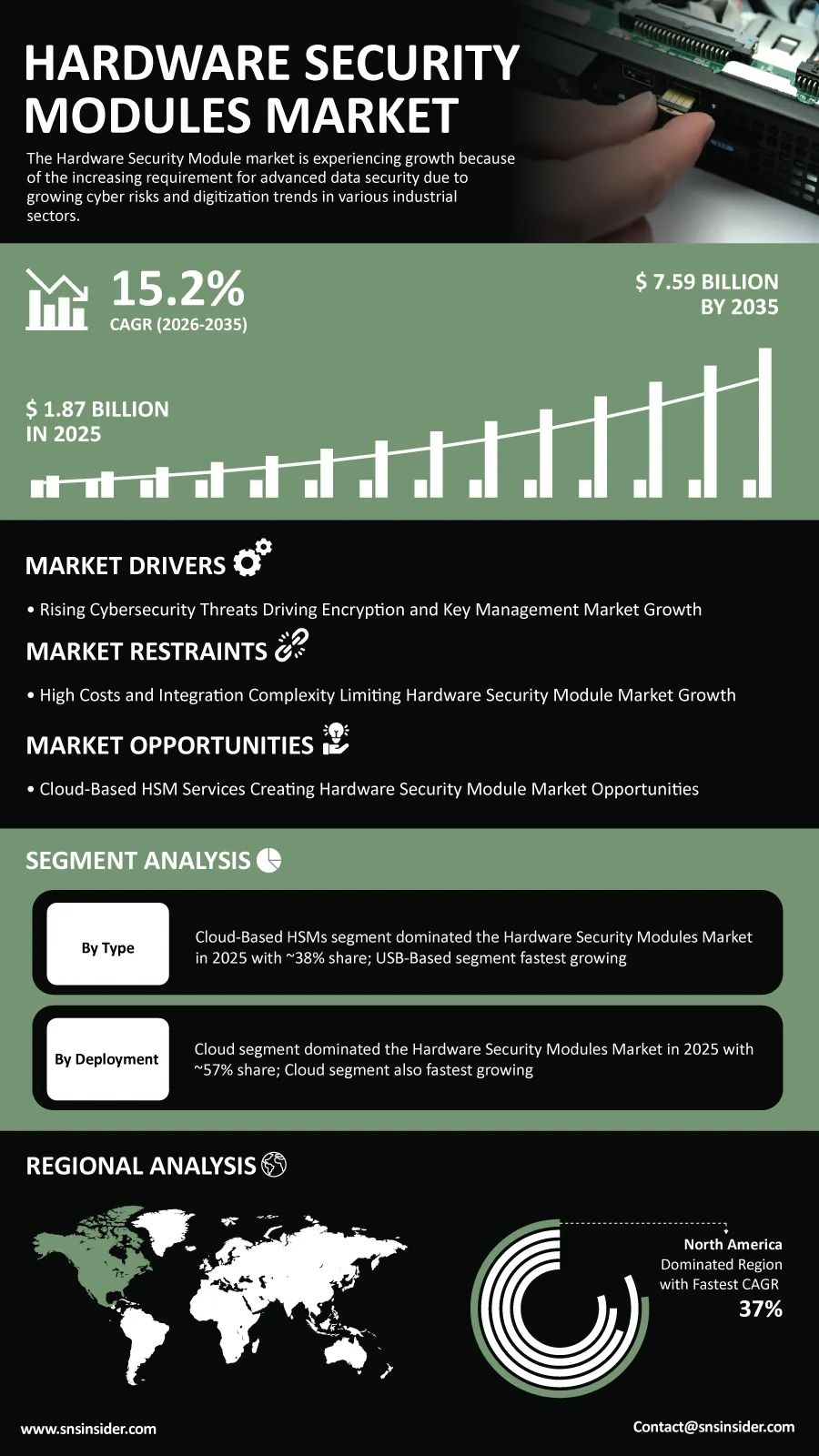
The global Hardware Security Modules Market is entering a period of accelerated growth as organizations strengthen cryptographic security to protect digital identities, payment credentials, encryption keys, and sensitive information. According to a recent study by SNS Insider, the global Hardware Security Modules Market size valued at USD 1.87 billion in 2025, is anticipated to grow to USD 7.59 billion by 2035, registering a CAGR of 15.2% over the 2026–2035 forecast period.
With the growing adoption of cloud-based services, banking, connected devices, and e-commerce, there is an increasing need for data that needs to be protected using cryptography. This calls for businesses to invest in security architecture that will protect encryption keys while meeting regulatory and cybersecurity standards.
There is also growing demand due to the trend towards distributed computing by businesses. Financial firms, healthcare firms, governments, and technology firms all want security architecture that will enable them to protect their digital transactions and digital identity management systems.
To Get Detailed Insights on the Hardware Security Modules Market – Request a Sample Report
Cloud Security Modernization Creates New Growth Opportunities
The trend towards cloud first businesses is providing great prospects for HSMs. Cloud HSMs and managed HSMs allow firms to obtain advanced cryptographic tools without making as much of an initial infrastructure investment as required by the conventional approach.
With enterprises increasing their reliance on artificial intelligence, Internet of Things technologies, and digital identity solutions, there is an ever-growing demand for security regarding the generation, storage, and management of encryption keys. Advancements in the realm of cryptography which is resistant to quantum computing attacks are also contributing to the reconsideration of the security strategies by enterprises.
The increasing connectivity between HSMs and cloud technology, payments, and enterprise software is anticipated to boost access and adoption among firms seeking cybersecurity solutions.
Key Market Insights Highlight Shifting Demand Patterns
By type, cloud-based HSMs segment accounted for approximately 38% of global market revenue in 2025, supported by rising demand for flexible cryptographic infrastructure and easier integration with digital platforms. USB-based HSMs are projected to register the fastest growth as smaller organizations and specialized users seek portable, cost-effective solutions for secure authentication and encryption.
Based on deployment, cloud-based solutions segment were anticipated to dominate with around 57% of market revenue in 2025 and are also expected to remain the fastest-growing deployment category. Growing enterprise migration to cloud environments and increasing demand for HSM-as-a-Service are strengthening adoption across industries.
By application, payment processing was forecasted to contribute approximately 34% of market revenue in 2025, reflecting the critical role of HSMs in protecting payment credentials, transaction authentication, and encryption keys. IoT security is expected to experience the fastest growth as connected vehicles, industrial equipment, smart infrastructure, and consumer devices require secure device identities and encrypted communications.
By end use, BFSI held approximately 41% of market revenue in 2025 due to the sector's extensive dependence on secure transactions, identity verification, and regulatory compliance. Automotive is projected to be the fastest-growing end-use segment as connected and software-defined vehicles increase the need for secure communications, digital certificates, and protected software updates.
Rising Cybersecurity Risks Keep Secure Key Management in Focus
With the rise in the advancement of cyber threats and breaches in the number of data breaches, enterprises are motivated to upgrade their cryptography platform. HSMs offer secure execution environment for cryptographic activities and hence are becoming more important for the organizations handling digital valuables.
Moreover, with the advent of interconnected systems in the enterprise, the need for this technology is rising. Device provisioning and authentication have become mandatory for IoT environments, whereas car manufacturers are implementing more cybersecurity measures for their vehicles and digital communications channels.
North America Holds 37% Hardware Security Module Market Share in 2025 as Asia Pacific Emerges as the Fastest-Growing Region
North America is projected to account for about 37% of the total market in 2025 owing to its strong cyber security framework, extensive usage of digital payments, well-established cloud computing infrastructure, and investments in critical infrastructure protection. The U.S. will be the major contributor to the North American demand due to financial services, government, healthcare, and technology applications.
Asia Pacific will register the fastest growth among all regions owing to increased adoption of digital payments, connected devices, cloud computing, and digital identification by governments in China, India, Japan, and South East Asia. Asia Pacific is one of the major manufacturers of technology and hence a lot of potential for HSM usage in the region.
As enterprises across emerging markets increase investments in secure digital infrastructure, demand for scalable cryptographic protection is expected to rise significantly.
Industry Participants Focus on Cloud and Post-Quantum Security Innovation
The competitive landscape is evolving as cybersecurity companies and technology providers invest in cloud-native HSM architectures, high-performance cryptographic processing, IoT provisioning, and post-quantum security capabilities. Vendors are increasingly focusing on flexible deployment models that enable enterprises to manage cryptographic assets across hybrid and multi-cloud environments.
Key companies operating in the global Hardware Security Modules Market include Thales, Utimaco Management Services GmbH, Futurex, Entrust Corporation, IBM, Atos SE, Infineon Technologies AG, STMicroelectronics, Microchip Technology Inc., Yubico, DINAMO NETWORKS, Securosys, Spyrus, Adweb Technologies, Lattice Semiconductor, ellipticSecure, Amazon Web Services, Inc., and ETAS.
An SNS Insider analyst Sushant Kadam commented, “The rapid expansion of cloud computing, digital payments, connected devices, and data-intensive applications is making cryptographic protection a core component of enterprise security strategies. Providers that combine strong key protection with cloud scalability, compliance readiness, and post-quantum capabilities will be well positioned to capture the next wave of HSM market growth.”
About the Author

Get in touch




