
Healthcare Logistics Market is entering a new phase of global expansion due to increasing investment in robust supply chains by pharma companies, health care institutions, and logistics firms. The need for biological drugs, specialty pharmaceutical products, and healthcare services delivered directly to patients is driving modernization of the world’s storage, delivery, and monitoring operations.
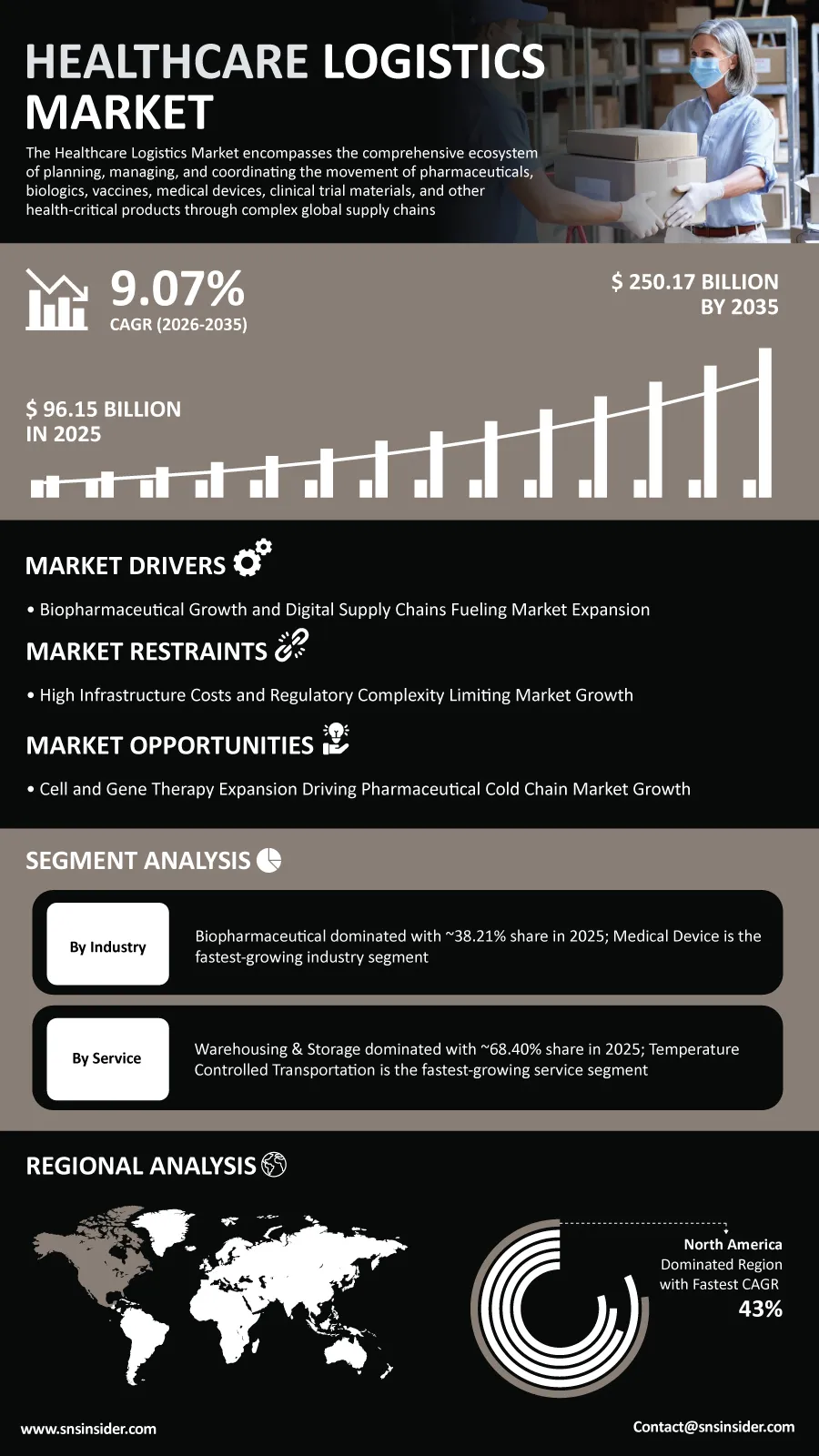
According to a recent study by SNS Insider, the global Healthcare Logistics Market size valued at USD 96.15 Billion in 2025, is anticipated to grow to USD 250.17 Billion by 2035, registering a CAGR of 9.07% over the 2026–2035 forecast period. The industry's outlook is being strengthened by continued investments in cold chain infrastructure, AI-enabled logistics platforms, regulatory compliance technologies, and expanding healthcare access across both developed and emerging markets.
Due to increasing complexity and increasing sensitivity of health care products to temperature, logistics firms are emphasizing precision handling, shipment visibility in real time, and distribution expertise. This is changing healthcare logistics from being a transportation issue to becoming a part of healthcare strategy.
To Get Detailed Insights on the Healthcare Logistics Market – Request a Sample Report
Advanced Cold Chain Networks Become a Strategic Priority
There will be an increase in the need for complex cold chains because of the increase in the use of biological drugs, vaccines, cell therapies, and gene therapies that need stringent temperature management during the distribution chain. The healthcare sector is also adopting homecare and direct-to-patient delivery solutions and this creates new possibilities in last-mile logistics.
Technology plays a key role in this change. The use of artificial intelligence can lead to improved demand prediction and route optimization, while the use of blockchain for traceability and connected systems of monitoring helps to enhance visibility and compliance within the supply chain.
Market Segments Highlight Emerging Growth Opportunities
By industry, the biopharmaceutical industry held a market share of around 38.21% in 2025 due to increased usage of biologics and specialty drugs. The medical device industry will witness the highest growth in the forecast period at a CAGR of 11.20% owing to increased demand for diagnostic devices, surgical instruments, and point-of-care testing systems.
Among services, warehousing and storage accounted for almost 68.40% of overall revenue in 2025 due to rising need for GDP compliant pharmaceutical warehouses. The temperature controlled transportation service will gain popularity at the highest rate as global transportation of biologics and specialty therapies increases.
Within supply chain operations, non-cold chain logistics dominated the market with a market share of around 70.19% in 2025, but cold chain logistics is predicted to grow the most in the coming years due to increasing commercialization of advanced medicines that require high-controlled environment during transportation.
Outsourcing was the leading business model in 2025, holding around 83.20% of the overall revenue as a specialized third-party logistics becomes more and more popular. Pharmaceutical and Biotechnology Companies held the highest share of approximately 63.10% in 2025, whereas healthcare facilities are predicted to be the fastest-growing end user segment.
Regional Investments Continue to Strengthen Global Supply Chains
North America continued to lead the market during 2025 owing to its advanced pharmaceutical industry, stringent regulations, and investments in healthcare logistics technology. In the region, the U.S. generated about 43% of the regional revenue. The U.S. Healthcare Logistics Market generated USD 28.92 Billion revenue in 2025 and is expected to generate revenue of USD 61.45 Billion in 2035, growing at a CAGR of 11.14%.
The Asia Pacific region is expected to have the highest regional growth rate, which is estimated to be 11.89% from 2026 to 2035, owing to the rising capacity of pharmaceutical manufacturing in countries, such as China and India, among others. In the region, China generated about 35% of the regional revenue.
Across other regions, the contribution of United Kingdom toward Europe was about 21%, that of Brazil toward Latin America was almost 44%, and that of the UAE to the Middle East and Africa was about 29%.
Industry Leaders Expand Global Healthcare Infrastructure
Healthcare logistics providers continue strengthening their global capabilities through acquisitions, infrastructure investments, and technology deployment. During 2026, DHL Group announced the expansion of its GDP-compliant pharmaceutical logistics network across Asia Pacific through a healthcare investment program valued at approximately USD 2 billion, including new specialized facilities in Singapore, India, and Japan.
Earlier, in 2025, UPS Healthcare completed the USD 1.6 billion acquisition of Andlauer Healthcare Group, significantly expanding its temperature-controlled logistics capabilities throughout North America.
Major companies operating in the global Healthcare Logistics Market include McKesson Corporation, Cardinal Health, DHL Supply Chain, UPS Healthcare, FedEx Healthcare Solutions, Owens & Minor, Inc., Baxter International Inc., Omnicell, Inc., Zipline International Inc., Stryker Corporation, Cencora, Kuehne + Nagel International AG, DB Schenker, CEVA Logistics, GEODIS, SF Express, Sinotrans Limited, Yusen Logistics, DSV, and Nippon Express Holdings.
An SNS Insider analyst Parry Kardani commented, "Healthcare logistics is becoming increasingly critical as pharmaceutical innovation advances toward biologics, personalized medicine, and cell and gene therapies. Organizations capable of delivering compliant, technology-enabled, and temperature-controlled logistics services will be best positioned to support the next generation of global healthcare supply chains.
About the Author

Get in touch




