
Healthcare Logistics Market Report Scope and Overview:
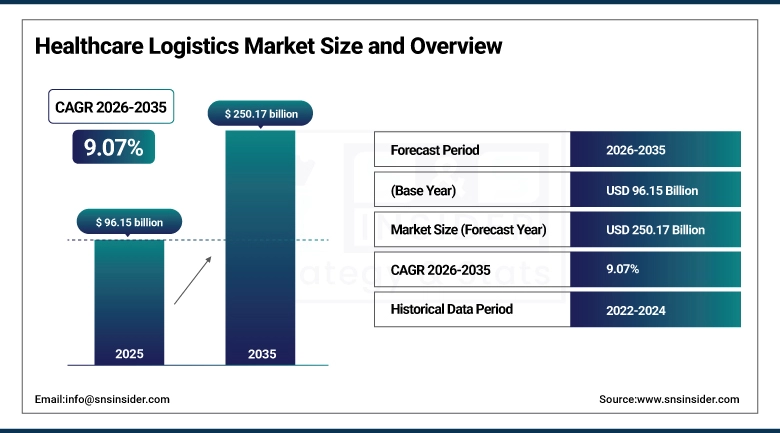
The Healthcare Logistics Market was valued at USD 96.15 Billion in 2025 and is expected to reach USD 250.17 Billion by 2035, growing at a CAGR of 9.07% from 2026-2035.
The Healthcare Logistics Market encompasses the comprehensive ecosystem of planning, managing, and coordinating the movement of pharmaceuticals, biologics, vaccines, medical devices, clinical trial materials, and other health-critical products through complex global supply chains from manufacturers to end-users across hospitals, pharmacies, clinics, and research facilities. Healthcare logistics integrates multiple specialized service modalities including temperature-controlled cold chain transportation, GDP-certified warehousing and storage, air and sea freight, last-mile delivery solutions, and digital track-and-trace platforms into unified end-to-end supply chain environments that enable pharmaceutical manufacturers, medical device companies, and healthcare providers to ensure product integrity, regulatory compliance, and timely delivery across all distribution channels.
The global pharmaceutical industry continues to generate substantial demand for specialized logistics infrastructure. According to the International Air Transport Association (IATA), more than 30% of pharmaceutical products are discarded annually because of logistics-related issues, while temperature-sensitive pharmaceuticals account for a significant share of air cargo shipments. This is accelerating investment in cold-chain transportation, real-time tracking, temperature monitoring, and specialized healthcare warehousing.
To Get more information on Healthcare Logistics Market - Request Free Sample Report
Healthcare Logistics Market Trends:
-
The use of artificial intelligence and machine learning in healthcare logistics is enhancing demand forecasting, route optimization, warehouse automation, and temperature monitoring, thus minimizing spoilage.
-
There is rapid growth in cold chain logistics due to increased demand for biological drugs, mRNA vaccines, and cell and gene therapy products that require low temperatures and enhanced monitoring systems.
-
Acquisitions and consolidations between competing logistics firms are increasing competition, where firms invest in expanding biopharmaceutical logistics, clinical trials logistics, and GDP-certified healthcare logistics networks.
-
Blockchain technology is increasingly used in pharmaceutical logistics for traceability to enhance transparency in the supply chain and mitigate counterfeiting risks and regulatory requirements.
-
Direct-to-patient and home healthcare logistics are gaining popularity, thus creating demand for specialized last-mile logistics, cold chain logistics, and real-time monitoring systems.
U.S. Healthcare Logistics Market Outlook
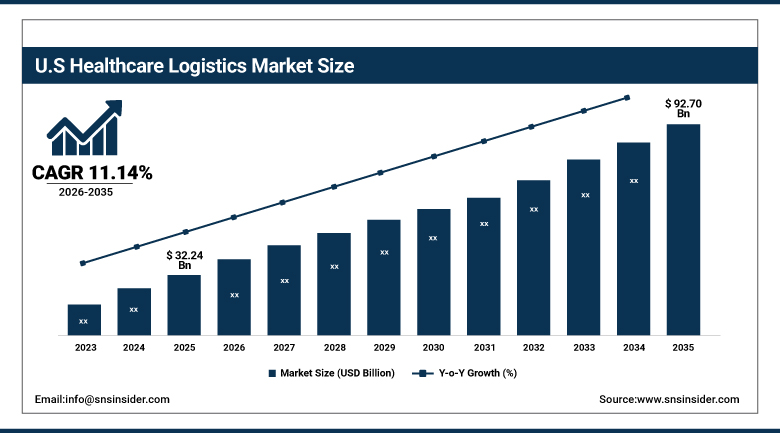
The U.S. Healthcare Logistics Market was valued at USD 32.24 Billion in 2025 and is expected to reach USD 92.70 Billion by 2035, growing at a CAGR of 11.14%.
The United States forms the major national market in North America, supported by the world's biggest pharmaceutical and biotech industry that generates sales worth more than USD 635 billion annually, the highest density of specialty pharmaceutical and biologic production companies that demand high-end cold chain logistics management skills, and global leaders in logistics services such as UPS Healthcare, FedEx Healthcare Solutions, McKesson Corporation, Cardinal Health, and AmerisourceBergen (Cencora). The U.S. FDA DSCSA serialization and GDP regulations are making substantial investments in advanced logistics technology systems, thereby contributing to the growth of the market.
Healthcare Logistics Market Segment Analysis:
-
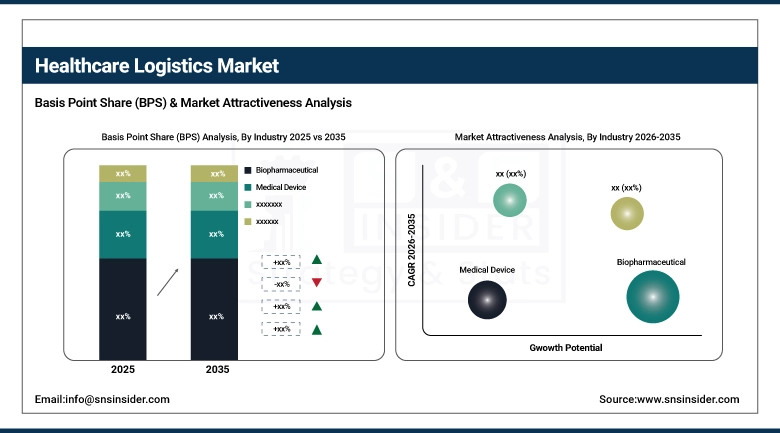
By Industry, Biopharmaceutical dominated with ~38.21% share in 2025; Medical Device is the fastest-growing industry segment.
-
By Service, Warehousing & Storage dominated with ~68.40% share in 2025; Temperature-Controlled Transportation is the fastest-growing service segment.
-
By Supply Chain, Non-Cold Chain dominated with ~70.19% share in 2025; Cold Chain is the fastest-growing supply chain segment.
-
By Mode, Outsourcing dominated with ~83.20% share in 2025.
-
By End User, Pharmaceutical & Biotechnological Companies dominated with ~63.10% share in 2025; Healthcare Facilities is the fastest-growing end-user segment.
By Industry, Biopharmaceutical dominates, Medical Device fastest-growing
The Biopharmaceutical segment dominated the total Healthcare Logistics Market during 2025. The high dominance of biopharmaceutical logistics comes down to the rapid growth on the international level in biologics, mRNA vaccines, monoclonal antibodies, as well as cell and gene therapies that require very complex and highly technical cold chain logistics infrastructures. Biopharmaceutical logistics implies the handling of temperature-sensitive and environment-sensitive goods that require extremely sensitive and carefully maintained conditions for their shipment and storing in cold chain logistics facilities from 2°C to 8°C in case of conventional vaccines and insulin to -60°C for mRNA vaccines and even lower – to -196°C for cell and gene therapies.
The Medical Devices sector will demonstrate the highest CAGR of 11.20% throughout the forecasted time frame due to an increasing demand for diagnostic equipment, surgical tools, implantable medical devices, and Point-of-Care Testing (POCT) systems all over the world. The medical devices' logistics implies special measures such as maintaining sterility, protection from physical damages, and careful inventory management.
By Service, Warehousing & Storage dominates, Temperature-Controlled Transportation fastest-growing
The Warehousing & Storage dominated the Healthcare Logistics Market in 2025 due to the significance of having GDP compliance-compliant warehousing systems for pharmaceuticals as the foundation of healthcare logistics operations. Pharmaceutical and biopharmaceutical companies need robust warehouse infrastructure that meets the criteria of being temperature-controlled and being regulated and monitored by security protocols to ensure their products remain high-quality. Due to increasing product diversity, there is an increased need for multi-temp warehouse spaces to accommodate simultaneous storage at ambient, refrigerated, and frozen temperatures.
The fastest CAGR during the forecast period will be achieved by Temperature-Controlled Transportation as a result of the increasing commercialization of biological products, the global spread of vaccine distribution schemes, and direct delivery of specialty pharmaceuticals.
By Supply Chain, Non-Cold Chain dominates, Cold Chain fastest-growing
Non-Cold Chain accounted highest market share in Healthcare Logistics in 2025, based on the widespread range of drugs, medical devices, and healthcare supplies that did not need temperature-controlled logistics and could be handled via regular ambient logistics chains. The non-cold chain category includes a number of solid dosage pharmaceutical forms such as tablets and capsules; durable medical devices; personal protection equipment; surgical supplies; and diagnostic reagents, making up the bulk of the healthcare logistics supply chain.
The Cold Chain segment is expected to register the highest growth rate during the forecast period, making it the most vibrant and vital one in the entire healthcare logistics sector. The demand for cold chain logistics has been steadily growing due to structural reasons such as the biologics boom globally, the quick emergence of new cell and gene therapies, and the need for vaccines and immunoglobulin for influenza and coronavirus pandemic control, among others.
By Mode, Outsourcing dominates, In-house second largest
The Outsourcing segment dominated the Healthcare Logistics Market in 2025, accounting for the widespread trend towards 3PL service agreements within the global pharmaceutical and healthcare market. There has been an increase in the outsourcing of logistics activities by healthcare organizations to 3PL specialists, allowing them to utilize state-of-the-art facilities, regulatory know-how, and technological systems without having to invest in the development of their own logistics infrastructure. The compliance challenges associated with pharmaceutical logistics, which include GDP standards, cold chain validation procedures, and more stringent traceability regulations, act as motivators for healthcare firms to make use of the compliance frameworks offered by logistics providers.
By End User: Pharmaceutical & Biotechnological Companies dominates
The share of the Healthcare Logistics market was dominated by the Pharmaceuticals and Biotechnology Companies in 2025. This is attributed to the massive need for logistics by pharmaceutical manufacturing companies and biotech companies that offer a broad range of products on a global scale. The Pharmaceuticals and Biotechnology Companies make up the biggest and most challenging end-user industry for healthcare logistics.
Regional Analysis
|
Region |
Major Country |
Share within Region 2025 (%) |
|---|---|---|
|
North America |
United States |
~43.00% |
|
Europe |
United Kingdom |
~21.00% |
|
Asia Pacific |
China |
~35.00% |
|
Middle East and Africa |
UAE |
~29.00% |
|
Latin America |
Brazil |
~44.00% |
North America Healthcare Logistics Market Insights:
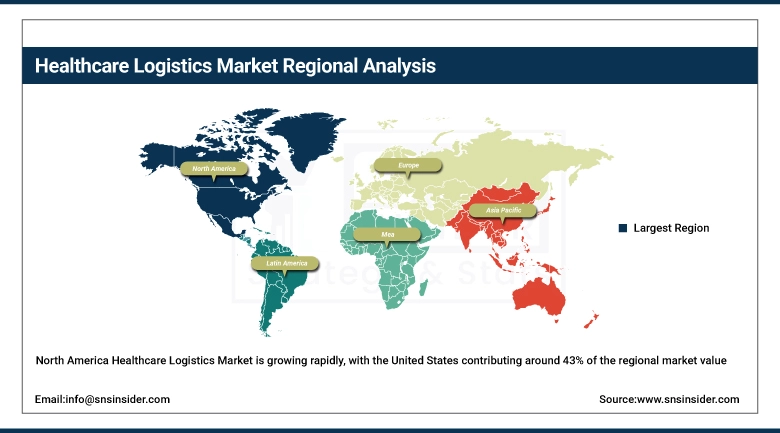
North America Healthcare Logistics Market is booming, with the United States accounting for approximately 43% of the total market value in the region. The market dominance of North America in the healthcare logistics market is backed by the dominance of the United States as the largest pharmaceutical market in the world, with annual sales of more than USD 635 billion and the highest density of companies specializing in biopharmaceutical manufacturing, specialty pharmaceutical distribution, and healthcare logistics solutions. The stringent regulatory framework for the pharmaceutical industry in the form of FDA GDP, DSCSA serialization requirements, and DEA controlled substance distribution regulations ensure that constant investment in compliance and logistics technologies ensures premium service quality and high visibility of supply chains.
Get Customized Report as per Your Business Requirement - Enquiry Now
Europe Healthcare Logistics Market Insights:
Europe comes in as the second-biggest regional healthcare logistics market, with Germany, UK, France, Switzerland, and Netherlands being key national markets. Germany is the biggest national market in Europe due to the country's role as Europe's biggest producer of pharmaceutical products coupled with the importance of clinical trials logistics in Germany, thanks to its GDP 3PL infrastructure and proximity to Eastern European markets. Europe's high investment in healthcare logistics is attributable to the stringent standards required by the European Medicines Agency with regard to good distribution practice as well as EU Falsified Medicines Directive requirements for track and trace systems. The United Kingdom boasts of a solid foundation in pharmaceuticals with the presence of international giants such as AstraZeneca and GSK.
Asia Pacific Healthcare Logistics Market Insights:
Asia Pacific is set to be the fastest-growing Healthcare Logistics Market regionally, recording a CAGR of 11.89% during the forecast period, the highest among all regions. The country with the largest Healthcare Logistics Market in Asia Pacific is China, owing to its government's 'Made in China 2025' healthcare logistics initiative that is fueling large-scale domestic production capabilities in the pharmaceutical industry, along with increasing local demand for biopharmaceuticals, specialty drugs, and advanced medical devices due to the emergence of an increasingly prosperous middle class in the country that is now seeking access to high-end healthcare services. India is a major emerging market in the region, backed by the Indian government's PLI scheme for pharmaceuticals, increased local vaccine manufacturing capabilities, and exporting generic pharmaceuticals and API.
Latin America Healthcare Logistics Market Insights:
The Latin American Healthcare Logistics Market is expanding continuously, with Brazil, Mexico, Colombia, and Argentina being the major national markets in this region. Brazil leads in terms of national market size in Latin America due to the pharmaceutical market in Brazil that is valued at USD 35 billion, the presence of robust public procurement activities in the national healthcare system in Brazil, and the presence of multinational pharmaceutical companies that require advanced cold chain logistics in order to distribute biologics in Brazil's expansive geography. Meanwhile, Mexico has a growing market, with an expanding pharmaceutical production in Mexico under the USMCA agreement, with Monterrey and Guadalajara leading as pharmaceutical production centers in Mexico.
Middle East & Africa Healthcare Logistics Market Insights:
The Middle East & Africa Healthcare Logistics Market is experiencing rapid growth, with Saudi Arabia, the UAE, Egypt, and South Africa being key national markets. The GCC countries constitute the most developed healthcare logistics markets in the region, thanks to robust national health transformation strategies such as the Saudi Arabia Vision 2030 strategy for the development of the health sector and the health infrastructure expansion plans of the UAE. The Saudi Arabian pharmaceutical market, backed by the health benefit programs of Saudi Aramco and its extensive hospital network under the Ministry of Health, necessitates efficient cold chain logistics services for the transport of biopharmaceutical products. FedEx, DHL, and Kuehne+Nagel offer GDP-compliant pharmaceutical logistics services in Saudi Arabia.
Market Dynamics
Growth Drivers: Rising biopharmaceutical demand, cold chain infrastructure expansion, and digital supply chain transformation creating structural growth for market
The healthcare logistics industry enjoys the backing of a number of powerful and complementary structural demand generators. The tremendous worldwide expansion of biopharma products such as monoclonal antibodies, mRNA vaccines, gene-based treatments, and cell-based medicines is spurring an extraordinary need for complex cold chain logistics systems as biologics now constitute more than 35% of worldwide pharmaceutical spending, according to IQVIA forecasts for 2025, and this trend will continue to rise throughout the forecast horizon. Population aging trends around the world are contributing to steady increases in pharmaceutical demand as the number of people globally aged 65 years and above is forecasted to touch 1.5 billion by 2030, thus leading to increased consumption of services.
Restraints: High infrastructure costs, regulatory complexity, cold chain failures, and skilled talent shortages creating adoption barriers
Logistics in the healthcare sector faces several major obstacles that hinder its development beyond the level of theoretical demand capacity. The requirement of significant investments in the construction and operation of GDP-compliant cold chain infrastructure such as temperature-controlled facilities, refrigerated fleets, and monitoring technology poses high barriers to entry for small logistics companies and limits the possibilities for expansion of the existing players in the market. Temperature deviations in cold chains continue to be one of the most persistent problems in pharmaceutical transportation around the world, with losses from pharmaceutical waste caused by these temperature excursions estimated at USD 35 billion annually.
Opportunities: Cell and gene therapy logistics, emerging market infrastructure development, and AI-enabled supply chain platforms creating long-term growth
In the healthcare logistics industry, there exist significant business opportunities from various strategic angles. One of the most sophisticated and valuable logistics opportunities currently being developed in the healthcare logistics industry is the cell and gene therapy commercial market due to the complex logistics processes involved in transporting and handling advanced therapy medicinal products (ATMPs). ATMPs are products that involve logistics operations such as personalized logistics, where the product is collected from patients, processed through manufacturing, and delivered to patients through infusion procedures within specified time periods using cold-chain logistics systems. Globally, the cell and gene therapy market size is estimated to reach USD 35 billion by 2030.
Recent Developments:
-
2026: The DHL Group made an announcement regarding the expansion of its GDP-compliant Pharma Hub logistics infrastructure throughout Asia Pacific as part of its overall healthcare logistics investment program worth around USD 2 billion, which entails setting up new dedicated pharmaceutical logistics centers in Singapore, India, and Japan to address the increasing demand for biologics logistics solutions in the region.
-
2025: The UPS Healthcare division completed its takeover of Andlauer Healthcare Group at a valuation of USD 1.6 billion, further enhancing its temperature-controlled biologics logistics capabilities in North America, including in the United States and Canada.
Healthcare Logistics Market Key Players:
-
McKesson Corporation
-
Cardinal Health
-
DHL Supply Chain
-
UPS Healthcare
-
FedEx Healthcare Solutions
-
Owens & Minor, Inc.
-
Baxter International Inc.
-
Omnicell, Inc.
-
Zipline International Inc.
-
Stryker Corporation
-
Cencora (formerly AmerisourceBergen)
-
Kuehne + Nagel International AG
-
DB Schenker
-
CEVA Logistics
-
GEODIS
-
SF Express
-
Sinotrans Limited
-
Yusen Logistics
-
Panalpina / DSV
-
Nippon Express Holdings
| Report Attributes | Details |
|---|---|
| Market Size in 2025 | USD 96.15 Billion |
| Market Size by 2035 | USD 250.17 Billion |
| CAGR | CAGR of 9.07% From 2026 to 2035 |
| Base Year | 2025 |
| Forecast Period | 2026-2035 |
| Historical Data | 2022-2024 |
| Report Scope & Coverage | Market Size, Segments Analysis, Competitive Landscape, Regional Analysis, DROC & SWOT Analysis, Forecast Outlook |
| Key Segments | • By Industry (Biopharmaceutical, Medical Device, Pharmaceutical) • By Service (Transportation, Warehousing & Storage, Others) • By Supply Chain (Cold Chain, Non-Cold Chain) • By Mode (In-house, Outsourcing) • By End User (Pharmaceutical & Biotechnological Companies, Medical Device Companies, Healthcare Facilities, Others) |
| Regional Analysis/Coverage | North America (US, Canada), Europe (Germany, UK, France, Italy, Spain, Russia, Poland, Rest of Europe), Asia Pacific (China, India, Japan, South Korea, Australia, ASEAN Countries, Rest of Asia Pacific), Middle East & Africa (UAE, Saudi Arabia, Qatar, South Africa, Rest of Middle East & Africa), Latin America (Brazil, Argentina, Mexico, Colombia, Rest of Latin America). |
| Company Profiles | McKesson Corporation, Cardinal Health, DHL Supply Chain, UPS Healthcare, FedEx Healthcare Solutions, Owens & Minor, Inc., Baxter International Inc., Omnicell, Inc., Zipline International Inc., Stryker Corporation, Cencora (formerly AmerisourceBergen), Kuehne + Nagel International AG, DB Schenker, CEVA Logistics, GEODIS, SF Express, Sinotrans Limited, Yusen Logistics, Panalpina / DSV, Nippon Express Holdings |
Frequently Asked Questions
McKesson Corporation, Cardinal Health, DHL Supply Chain, UPS Healthcare, FedEx Healthcare Solutions, Owens & Minor, Baxter International, Cencora, Kuehne + Nagel, and CEVA Logistics.
Cell and gene therapy logistics, emerging-market infrastructure, cold chain expansion, and AI-enabled supply chain platforms offer major opportunities.
Rising biopharmaceutical demand, expanding cold chain requirements, and digital transformation of healthcare supply chains are major growth drivers.
Warehousing & Storage dominated with 68.40%, Outsourcing with 83.20%, and Pharmaceutical & Biotechnological Companies with 63.10% share in 2025. Biopharmaceutical led the industry segment with 38.21%.
North America is the leading regional market, while Asia Pacific is the fastest-growing region at a CAGR of 11.89%.
