
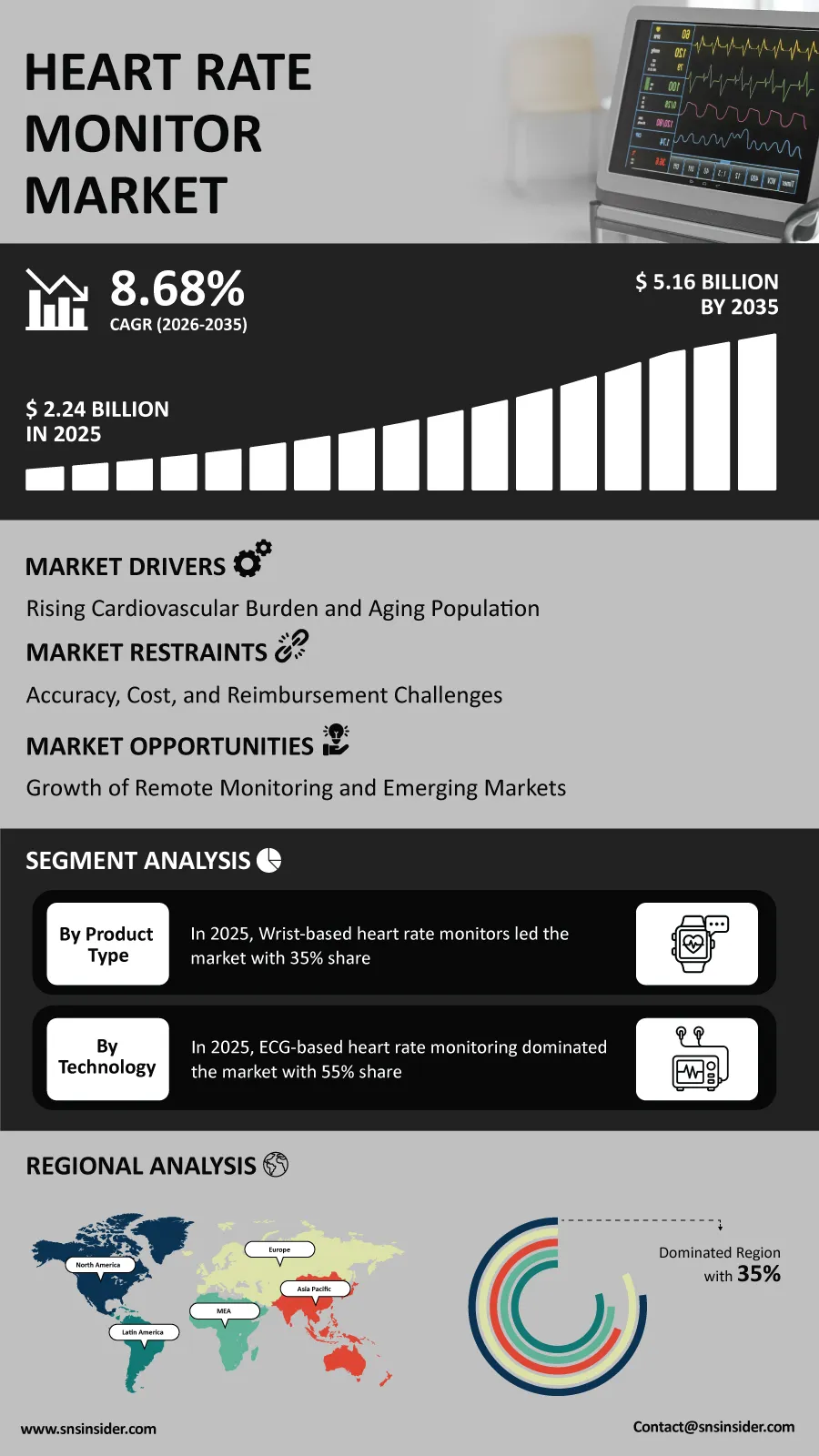
The global Heart Rate Monitor Market is poised for significant expansion as healthcare providers, consumers, and fitness enthusiasts increasingly embrace connected monitoring technologies for proactive health management. “According to a recent study by SNS Insider, the global Heart Rate Monitor Market size valued at USD 2.24 billion in 2025, is anticipated to grow to USD 5.16 billion by 2035, registering a CAGR of 8.68% over the 2026–2035 forecast period.”
Increased importance being placed on preventative healthcare, widespread adoption of digital health ecosystems, and heightened interest in cardiovascular health are all contributing to the changing way that heart health is being tracked. Modern heart rate monitoring devices are becoming a crucial part of the provision of healthcare services through their ability to provide continuous monitoring and personalized treatment plans.
At the same time, healthcare providers are increasingly employing connected monitoring devices outside of the hospital environment, allowing for constant cardiac evaluation in outpatient settings and at home.
To Get Detailed Insights on the Heart Rate Monitor Market – Request a Sample Report
Connected Health Technologies Accelerate Market Evolution
Breakthroughs in areas such as wearables, wireless technology, artificial intelligence, and cloud-based healthcare systems have significantly changed the domain of heart rate monitoring. New heart rate monitors are coming up from various manufacturers offering more convenience, better analysis tools, and easy incorporation into the existing digital healthcare systems.
With technological breakthroughs in intelligent software, real-time analytics, and smartphone connectivity, healthcare practitioners, as well as consumers, can benefit from improved cardiovascular monitoring and personalized treatment plans.
The ever-growing trend of integrating consumer technologies and professional cardiac monitoring devices will create new possibilities for manufacturers to produce flexible devices that can be used both in daily activities and healthcare environments.
Key Market Findings Highlight Strong Growth Opportunities
Among product categories, wrist-based heart rate monitors accounted for 35% of global market revenue in 2025, reflecting strong consumer preference for convenient, wearable monitoring solutions.
Meanwhile, remote cardiac telemetry monitors are expected to emerge as the fastest-growing product segment through 2035, driven by increasing adoption of virtual care models and continuous cardiac monitoring programs.
From a technology perspective, ECG-based heart rate monitoring represented 55% of total market revenue in 2025, maintaining its position as the preferred solution for high-accuracy cardiac assessment across healthcare settings. At the same time, hybrid sensing technologies are projected to experience the fastest growth during the forecast period, reflecting growing demand for monitoring systems that combine multiple sensing methods to improve accuracy and reliability.
Application trends continue to evolve as healthcare delivery becomes increasingly decentralized. Medical and clinical monitoring accounted for 42% of market revenue in 2025, while remote patient monitoring is expected to register the fastest growth through 2035, supported by expanding telehealth services and increasing demand for home-based healthcare.
Among end users, hospitals and clinics held 48% of the global market in 2025, whereas home healthcare settings are projected to witness the strongest expansion over the forecast period, highlighting the ongoing transition toward patient-centered care outside traditional healthcare facilities.
Remote Monitoring Expands Healthcare Opportunities
Healthcare organizations across the globe have kept on investing in technology that can enable constant patient engagement and clinical interventions. The use of remote monitoring technology helps clinicians in managing chronic diseases without bringing patients to hospitals. Moreover, it helps in identifying changes in health status at an early stage.
Increased use of connected healthcare platform technology is fostering collaboration among healthcare providers, IT companies, and medical devices to provide integrated solutions.
With continued focus on preventive medicine and personalized approaches in treatment, there is going to be high demand for heart rate monitoring technologies.
Regional Markets Continue to Strengthen
North America contributed to over 35% of the total market revenue in 2025 due to the presence of highly developed healthcare infrastructure, increased penetration of digital health solutions, and rising use of connected monitoring devices.
On the other hand, Asia Pacific is expected to witness the fastest growth among all regions with a CAGR of 11.48% until 2035. The increasing investments in healthcare, adoption of wearable devices, growth of telemedicine, and improvements in healthcare access offer many growth opportunities.
Industry Leaders Continue Driving Innovation
Competition within the heart rate monitor market remains dynamic as manufacturers continue investing in sensor technologies, artificial intelligence, software development, and connected healthcare solutions. Companies are focused on improving monitoring accuracy, expanding digital health capabilities, and delivering more personalized user experiences.
Leading companies operating in the global heart rate monitor market include Apple, Garmin, Fitbit, Samsung Electronics, Philips, GE HealthCare, Medtronic, Omron Healthcare, Masimo, and Abbott Laboratories.
An SNS Insider analyst Parry Kardani commented, "The integration of connected health technologies, artificial intelligence, and remote patient monitoring is redefining cardiovascular care worldwide. As healthcare increasingly shifts toward continuous, personalized monitoring, heart rate monitoring solutions will play an even greater role in supporting preventive healthcare and long-term disease management."
About the Author

Get in touch




