
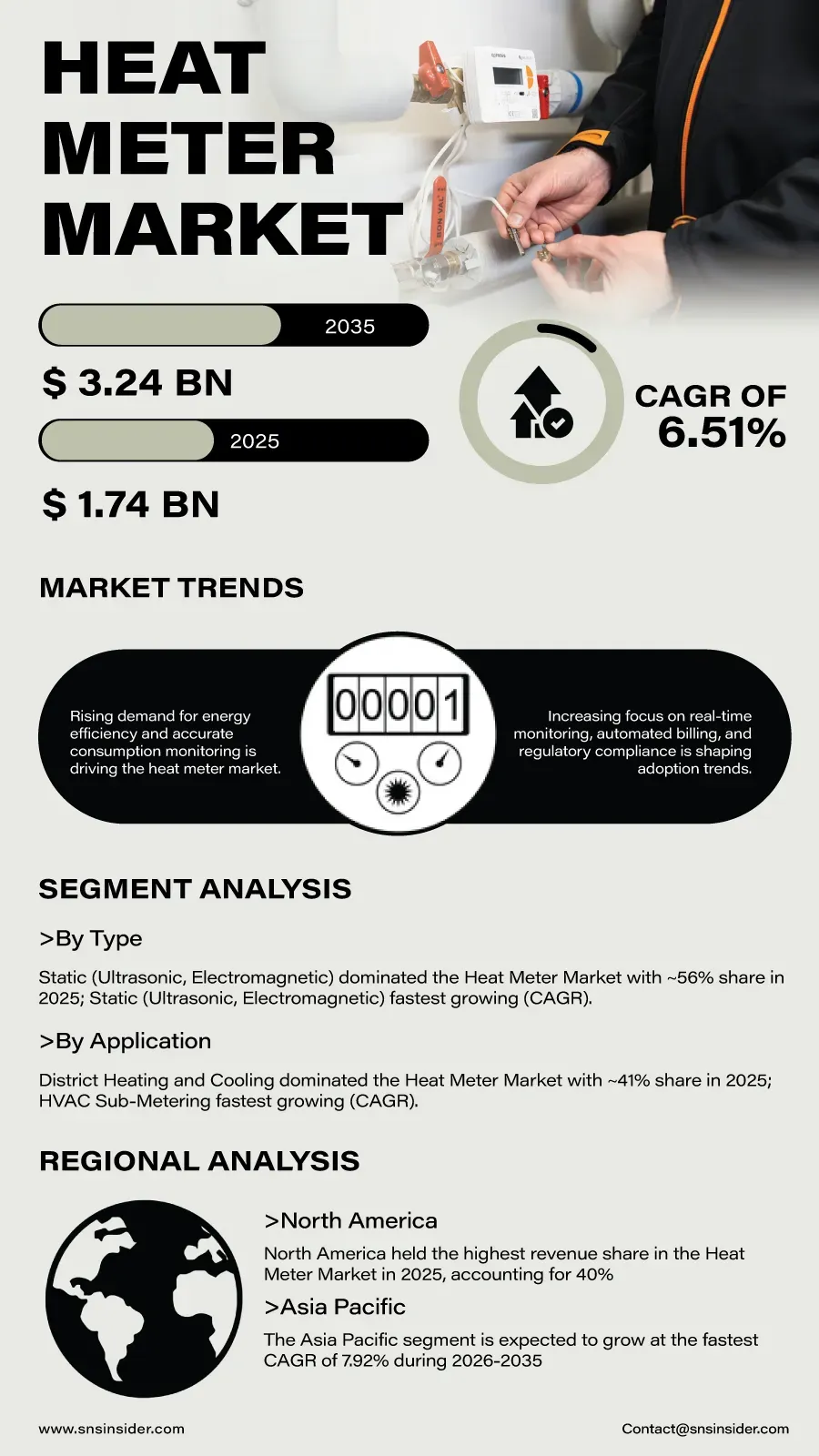
The global Heat Meter Market is poised for sustained growth over the coming decade as governments, utilities, and property owners accelerate investments in energy-efficient heating infrastructure and digital energy management. According to a recent study by SNS Insider, the global Heat Meter Market size valued at USD 1.74 billion in 2025, is anticipated to grow to USD 3.24 billion by 2035, registering a CAGR of 6.51% over the 2026–2035 forecast period.
The growing trend of minimizing energy losses along with increasing billing transparency is driving the adoption of sophisticated heat metering technologies. With the expansion of district heating infrastructures as well as the emergence of smart buildings, there is an increasing need for energy measuring solutions that can accurately measure heat across the developed and developing nations.
The developments in ultrasonic sensing technology, wireless connectivity, and IoT-powered measurement solutions have revolutionized heat metering technologies. Today’s advanced heat meters offer real-time data to enable energy optimization and predictive maintenance for utility companies and facility managers.
Smart Energy Infrastructure Creates Long-Term Growth Opportunities
Efforts toward increasing energy efficiency and cutting down carbon emissions across the globe are opening up great possibilities for innovative heat meters. Energy efficiency regulations are being tightened along with an encouragement to adopt consumption-based billing which will promote responsible energy consumption and increase awareness among consumers.
Moreover, growing development in smart cities and intelligent buildings is adding to market demands. Cloud-based building management systems and billing automation systems make it possible for utilities to have remote monitoring of thermal energy consumption as well as offering improved customer experience and reduced costs.
Besides, growing adoption of wireless communication solutions including NB-IoT, LoRaWAN, and wireless M-bus is facilitating the integration of heat meters into next-generation energy management solutions.
Key Market Insights Highlight Shifting Demand Patterns
Based on application, district heating and cooling are expected to account for approximately 41% of global market revenue in 2025 owing to expanding district energy infrastructure and increasing demand for accurate heat consumption measurement. HVAC sub-metering is projected to record the fastest growth through 2035 as commercial buildings and smart facilities prioritize energy optimization and operational efficiency.
By measurement principle, electromagnetic heat meters are forecast to generate nearly 58% of market revenue in 2025 due to their high reliability and precision in demanding operating environments. Ultrasonic heat meters are expected to witness the fastest growth during the forecast period, supported by their superior accuracy, extended service life, and minimal maintenance requirements.
In terms of type, static heat meters, including ultrasonic and electromagnetic systems, are anticipated to dominate the market with approximately 56% revenue share in 2025 while also registering the fastest expansion through 2035. Their robust performance and absence of moving parts make them well suited for long-term deployment across district heating applications.
By connectivity, wireless technologies including NB-IoT, LoRaWAN, and wireless M-Bus are expected to account for approximately 61% of market revenue in 2025 while remaining the fastest-growing connectivity segment. Increasing adoption of remote monitoring and automated data collection continues to drive demand for intelligent wireless metering solutions.
Digitalization Accelerates the Evolution of Heat Metering
The shift towards digital energy management is changing the heat metering market. The trend includes an increased adoption of intelligent metering systems that enable constant monitoring of the energy consumed, automatic diagnostics and advanced analysis for increasing the efficiency of the network.
There is an increased emphasis by manufacturers on the development of accurate devices which will be easy to maintain and will be able to integrate with the smart grid and building automation system. Advanced security measures, cloud integration and predictive analytics are other features becoming increasingly important in such devices.
With the sustainability goals becoming more ambitious globally, there is a high expectation from advanced heat metering technologies for achieving all these goals.
Regional Markets Demonstrate Strong Growth Potential
North America is estimated to dominate in terms of contribution to the total revenue share of the global Heat Meter Market, generating around 40% of the total market revenue in 2025. This is attributed to the existence of advanced energy management systems, wide-scale adoption of smart meters, and increasing investments in digital building technology.
The Asia Pacific region is anticipated to grow at the highest rate of 7.92% during the forecast period of 2026 to 2035. Urbanization, development of district heating systems, rapid industrialization, and investments in smart cities development are driving the demand for heat metering in the region.
As governments continue implementing energy conservation initiatives and utilities modernize heating networks, demand for intelligent thermal energy monitoring solutions is expected to rise steadily across global markets.
Industry Participants Focus on Smart Meter Innovation
The competitive environment is still very dynamic due to the continuous investments being made by manufacturers on digital metering technologies, wireless technologies, and analytics. Innovation and cooperation with utilities will be very crucial in enhancing the competitive position in the industry.
Key companies operating in the global Heat Meter Market include Siemens AG, Kamstrup A/S, Landis+Gyr Group AG, Diehl Metering GmbH, Danfoss A/S, Itron Inc., Zenner International GmbH & Co. KG, Apator S.A., Sontex S.A., QUNDIS GmbH, BMETERS Srl, Sensus, Engelman SIA, Techem GmbH, ISTA International GmbH, Secure Meters Limited, Axioma Metering UAB, Metrix Polska Sp. z o.o., Minol Messtechnik W. Lehmann GmbH & Co. KG, and LianLi Water Meter Co., Ltd.
An SNS Insider analyst Santosh Bhul commented, “Growing investments in smart buildings, district heating modernization, and digital energy management are driving sustained demand for advanced heat metering technologies. Companies that prioritize wireless connectivity, measurement accuracy, and intelligent analytics will be well positioned to capitalize on the evolving global energy efficiency landscape.”
About the Author

Get in touch




