
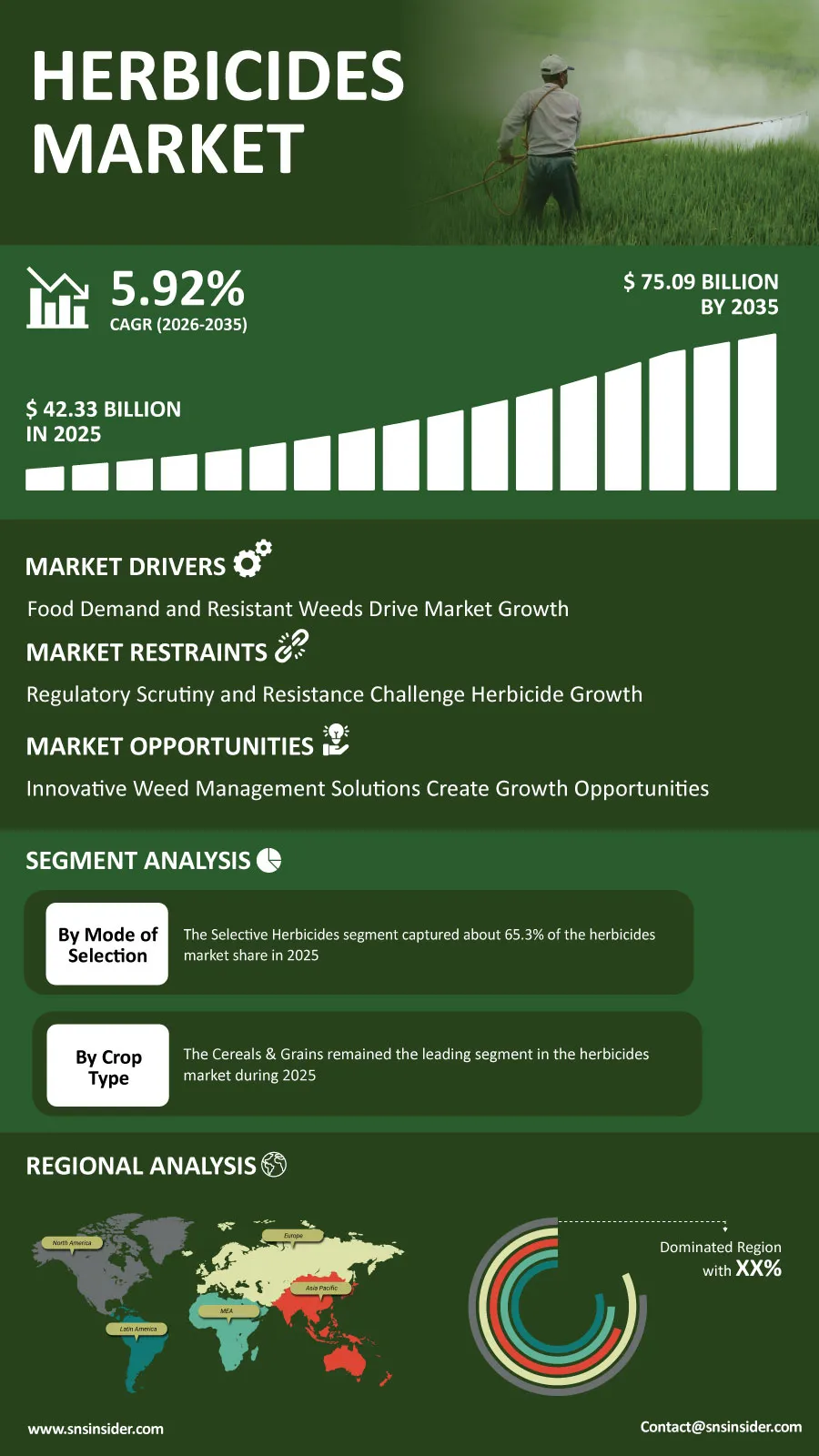
The Herbicides Market globally will witness steady growth owing to increasing use of innovative herbicide products by agricultural producers in order to enhance crop productivity and ensure food security. “According to a recent study by SNS Insider, the global Herbicides Market size valued at USD 42.33 Billion in 2025, is anticipated to grow to USD 75.09 Billion by 2035, registering a CAGR of 5.92% over the 2026–2035 forecast period.”
The increase in commercial agriculture, along with the increasing demand for maximizing yield from shrinking arable land, is contributing to increased use of herbicides in major agricultural zones. As shortage of labor becomes an important factor affecting agriculture, the farmers are becoming dependent on herbicide technology that helps in enhancing efficiency and minimizing costs of production. Along with these developments, the improvement in the area of crop protection is also helping farmers manage weeds efficiently.
To Get Detailed Insights on the Herbicides Market – Request a Sample Report
Precision Agriculture and Biological Innovation Create New Growth Opportunities
The adoption of agricultural technology can help revolutionize the process of herbicide application with the help of precision spray systems utilizing advanced artificial intelligence, intelligent sensors, and machine vision technology. Such technologies can allow for more effective detection of weeds as well as localization of spraying in order to save chemicals and increase efficiency.
There is another promising area of opportunity that will continue developing in the coming years. Namely, it relates to biological control of weeds. Various manufacturers are starting to invest in plant and microorganism-based herbicides that can be used along with other methods of protecting crops in order to promote sustainable farming.
Key Market Insights Reflect Evolving Agricultural Practices
Based on mode of selection, Selective Herbicides were responsible for about 65.3% of market revenue in 2025 since they have the capacity to destroy weeds without affecting the health of crops like cereals, oil seeds and other important field crops. Non-Selective Herbicides are estimated to grow at the fastest rate till 2035 with increasing conservation agriculture, no-tillage, and vegetation management in industries.
Based on type, Glyphosate contributed almost 29.5% of global revenue in 2025 because of its widespread use in large scale farming operations. On the other hand, Bio-herbicides are expected to show the fastest growth with the growing adoption of environmentally friendly weed control solutions among agriculture producers.
By mode of application, Foliar Spray held about 48.2% of market revenue in 2025 because of its efficacy and simplicity in operation. Soil Treatment is expected to exhibit the fastest growth rate during the forecast period as farmers enhance the use of pre-emergence weed control. Crop Type, Cereals & Grains held the largest market share of about 41.8%, whereas Fruits & Vegetables are estimated to grow at the fastest pace.
Advanced Weed Management Technologies Reshape Crop Protection
Innovation is still key to the development of the herbicides market since new active substances that can deal with resistant weeds will be developed. The main direction in scientific research is finding new mechanisms of action to increase weed control efficiency and help farmers avoid developing resistance.
New technologies in digital farming also assist in making wiser choices when it comes to using herbicides by means of satellite observation, analysis, and data gathering from the field. It helps in improving timing of application, resource optimization, reducing environmental pollution, and keeping high performance of the crops despite various weather conditions.
North America Led the Herbicides Market with the Largest Regional Share in 2025; Asia Pacific Set to Record the Fastest Growth Through 2035
North America captured the biggest regional market share in the Herbicides Market during 2025 due to significant corn, soybean, wheat, and cotton farming operations along with the use of herbicide-resistant crop systems. Ongoing investments in latest technologies for crop protection and weed management are further consolidating regional market leadership.
The Asia Pacific region is projected to witness rapid growth during 2035 due to increasing mechanization of agricultural practices, increase in the area of rice, wheat, and soybean farming, and growing support from governments towards agricultural advancement. This, in turn, would drive the demand for herbicides in countries such as China, India, Vietnam, Indonesia, and others.
Industry Participants Expand Research and Sustainable Product Portfolios
Innovations, regulatory compliance, and development of sustainable crop protection solutions are still at the core of competition in the global Herbicides Market. The major manufacturers in the industry persist in their efforts to invest in biological herbicides, application technologies, and next-generation actives capable of fighting resistant weed varieties while complying with toughening environmental regulations.
Key companies operating in the global Herbicides Market include Bayer AG, BASF SE, Syngenta AG (ChemChina), Corteva Agriscience, FMC Corporation, UPL Ltd., Adama Agricultural Solutions Ltd. (ChemChina), Nufarm Ltd., Sumitomo Chemical Co. Ltd., Arysta LifeScience (UPL), Nichino America Inc., American Vanguard Corporation, Albaugh LLC, Sipcam Oxon SpA, Sapec Agro SA, Helena Chemical Company, Drexel Chemical Company, Wilbur-Ellis Holdings Inc., Wynca Group (Hangzhou Wynca Chemical), and Rainbow Chemical Co. Ltd.
An SNS Insider analyst Himanshu Sharma commented, "The continued modernization of agriculture, rising adoption of precision farming technologies, and growing investment in biological crop protection are reshaping the global herbicides industry. Companies developing innovative weed management solutions that combine effectiveness, sustainability, and regulatory compliance will be well positioned to capture long-term growth opportunities as global agricultural productivity requirements continue to increase."
About the Author

Get in touch




