
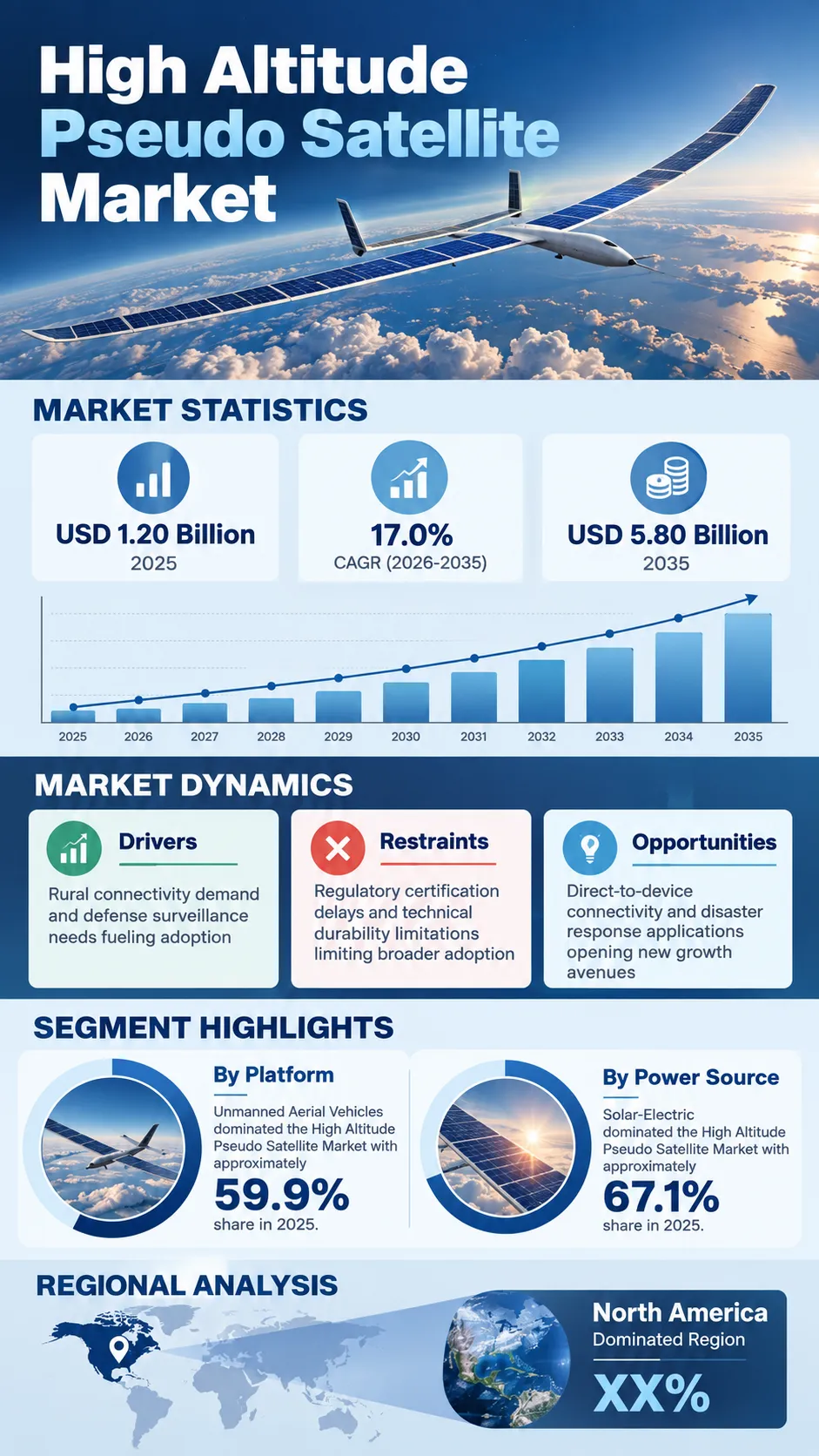
The global High Altitude Pseudo Satellite Market is set for rapid expansion as endurance milestones bring the technology closer to genuine commercial telecom and defense deployment. “According to a recent study by SNS Insider, the global High Altitude Pseudo Satellite Market size valued at USD 1.20 billion in 2025, is anticipated to grow to USD 5.80 billion by 2035, registering a CAGR of 17.0% over the 2026-2035 forecast period.”
There have been rapid changes within stratospheric platform and propulsion technology over time, due to which many developers aiming at improved endurance and commercial readiness can take advantage of this trend. This includes the need for more resilient solar-electric and hydrogen fuel cell systems that give telecom operators and government agencies confidence in platform reliability, across a wide range of applications from rural connectivity to disaster response. This applies in situations where high altitude pseudo satellites are used across communication, surveillance, environmental monitoring, and defense applications.
Developers are constantly working to improve platform endurance and regulatory readiness in order to meet various needs of telecom operators and government agencies worldwide.
To Get Detailed Insights on the High Altitude Pseudo Satellite Market – Request a Sample Report
Rural Connectivity and Defense Surveillance Ecosystems Create New Demand
The high altitude pseudo satellite market has evolved from early flight-test demonstrations into a broader mix of fixed-wing, airship, and hybrid propulsion platforms approaching genuine commercial readiness. The growing investment in direct-to-device payload technology, endurance testing, and multi-platform development has required the development of more efficient and reliable production systems.
New propulsion and payload approaches can improve endurance, reduce regulatory uncertainty, and expand the range of applications HAPS platforms can serve. This gives developers the possibility to be more effective when reaching telecom and government partners and strengthening claims around reliability and coverage economics.
HAPS developers, telecom operators, and government agencies are increasingly cooperating due to the growing interest in developing future solutions for cost-effective, persistent stratospheric coverage.
Key Market Findings Highlight High-Growth Segments
The unmanned aerial vehicles segment dominated all categories in the high altitude pseudo satellite market share with a market revenue share of approximately 59.9% in 2025 due to its proven solar-electric design and multi-month flight capability.
The fastest growing category is expected to be the airships segment, which will grow at a CAGR of approximately 25.5% through 2035. This will be possible owing to the platform's persistent station-keeping advantage for telecom coverage and environmental monitoring applications.
By end user, defense & government held the largest share of total market revenue at approximately 46.7% in 2025 due to decades of military interest in cost-effective surveillance capability. The commercial segment will see the fastest growth in revenue generation at a CAGR of approximately 25.5%.
Regional trends show North America leading with approximately 35.5% revenue share in 2025, while Asia Pacific is expected to register a fast growth trajectory driven by China's state-backed adoption and Japan's commercial telecom investment across the region.
Platform Endurance, Regulatory Certification, and Application Diversification Gain Importance
In this regard, developers have been looking at HAPS platforms that would make their endurance longer, their regulatory certification pathways clearer, and their applications more diverse.
Innovation in solar-electric and hydrogen fuel cell propulsion, direct-to-device payload technology, and multi-platform development has been making it possible for companies to come up with platforms that can meet increasingly demanding telecom and government expectations. In addition to that, increasing emphasis on disaster-response capability is also making it possible for companies to find solutions that support resilient emergency infrastructure.
Such trends are likely to become even more prominent in the future.
North America Leads Amid Deep Defense Demand and Developer Concentration
North America represented approximately 35.5% share of global market revenue in 2025 and was the largest regional market, owing to the United States' concentration of well-funded HAPS developers and deep defense-sector demand for persistent surveillance capability. In addition, Asia Pacific is expected to register a fast growth trajectory during the forecast period, propelled by China's rapid state-backed adoption and Japan's commercial telecom investment across the region's fast-growing economies.
On the other hand, Europe represented a meaningful share of global market revenue in 2025, aided by the United Kingdom's role as home to Airbus's Zephyr program and deep aerospace engineering expertise.
Leading Companies Drive Innovation and Competition
The environment continues to stay very dynamic since players continue innovating on stratospheric platform and propulsion technology as well as forming partnerships in order to enhance their position in the industry.
Some of the major companies that operate in the global high altitude pseudo satellite market are Airbus SE (Aalto HAPS / Zephyr), Sceye Inc., BAE Systems plc, AeroVironment, Inc., The Boeing Company, Northrop Grumman Corporation, Thales Group, Lockheed Martin Corporation, SoftBank Corp. (HAPSMobile), and Kea Aerospace Ltd.
An SNS Insider Analyst Sushant Kadam commented, “The steady progress toward multi-month flight endurance and direct-to-device commercialization is creating a genuine, if still capital-intensive, pathway to routine HAPS operations. Developers that successfully combine endurance testing, regulatory certification execution, telecom operator partnerships, and strong government backing will be best positioned to capitalize on emerging opportunities across communication, surveillance, environmental monitoring, and disaster response applications.”
About the Author

Get in touch




