
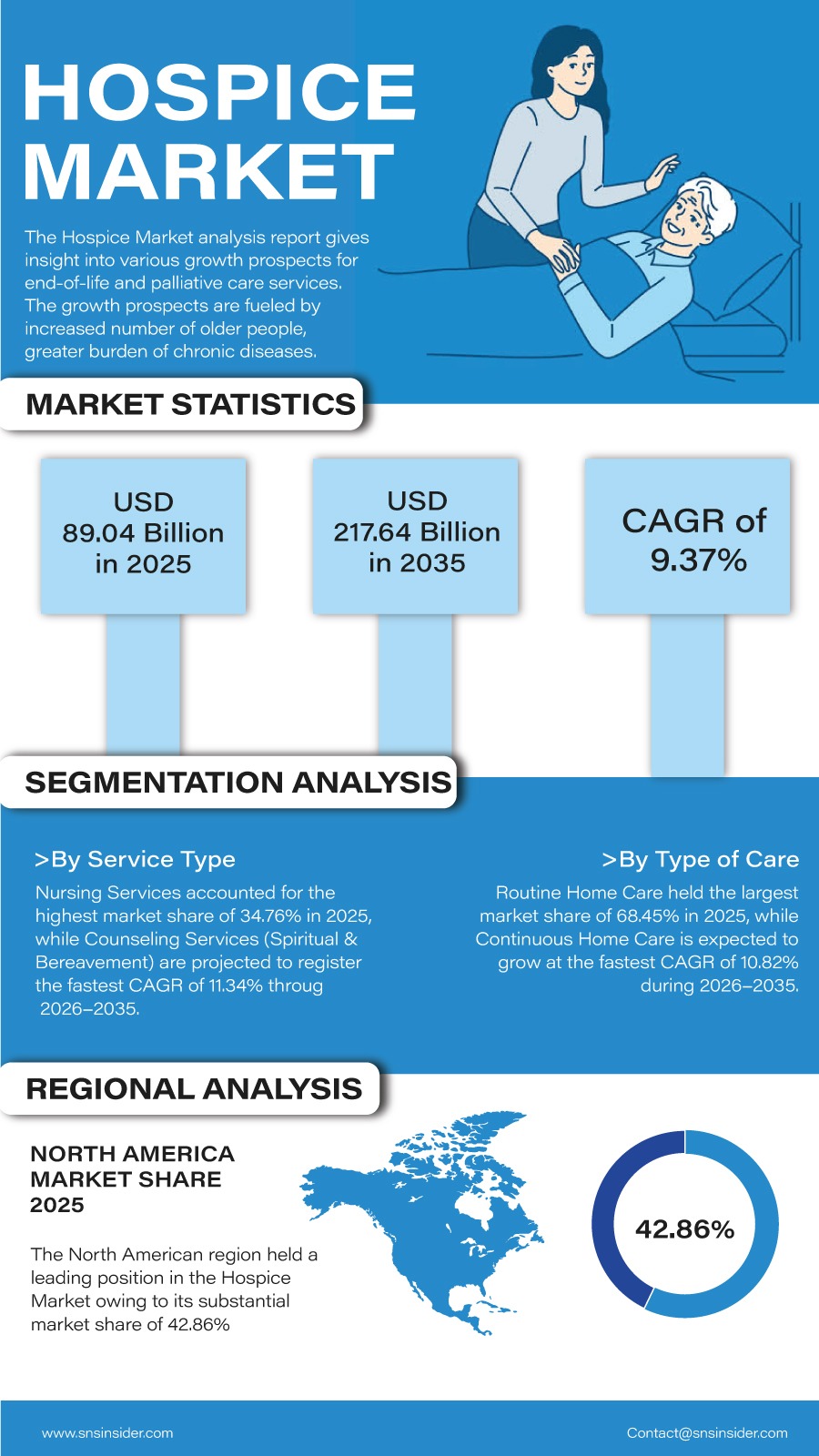
The global Hospice Market is projected to witness substantial growth over the coming decade as healthcare systems increasingly prioritize compassionate, patient-centered care for individuals living with life-limiting illnesses. “According to a recent study by SNS Insider, the global Hospice Market size valued at USD 89.04 billion in 2025, is anticipated to grow to USD 217.64 billion by 2035, registering a CAGR of 9.37% over the 2026–2035 forecast period.”
Healthcare providers are expanding hospice programmes across home, inpatient and community care settings in response to changing priorities, increased longevity and growing demand for supportive care services. Families and health care providers are becoming more aware of the value of integrated care models that emphasize comfort, dignity, symptom management and emotional support in the final stages of life.
Healthcare organizations also are investing in multidisciplinary care teams, digital health technologies and community-based service models to improve access to care while reducing unnecessary hospital utilization.
Patient-Centered Care Models Continue to Transform Hospice Services
Providers are using innovative ways to improve care coordination and enhance patient experiences, as the hospice care landscape is rapidly changing. Innovations in telehealth, remote patient monitoring and virtual visits are helping care teams stay connected to patients and carers, especially in home settings.
Technology-enabled care delivery is also helping providers to optimize clinical workflows, improve communication between healthcare professionals and deliver personalized support tailored to each individual patient’s needs. As healthcare systems transition to a value-based healthcare model, hospice services are emerging as an increasingly crucial component of holistic healthcare delivery.
An increasing collaboration between physicians, nurses, counsellors, therapists, and social care professionals further strengthens holistic care approaches that address medical and emotional needs.
Key Market Insights Highlight Emerging Growth Areas
Among care models, Routine Home Care accounted for 68.45% of global market revenue in 2025, reflecting the growing preference for receiving supportive care in familiar home environments.
Meanwhile, Continuous Home Care is projected to register the fastest growth through 2035, expanding at a CAGR of 10.82%, supported by increasing demand for higher-acuity care delivered outside traditional hospital settings.
By service type, Nursing Services represented 34.76% of total market revenue in 2025, underscoring the essential role of skilled nursing professionals in hospice care delivery. At the same time, Counseling Services, including spiritual and bereavement support, are expected to record the fastest growth at a CAGR of 11.34%, reflecting increasing recognition of comprehensive emotional and psychological care.
From a disease perspective, cancer-related hospice services accounted for 41.58% of market revenue in 2025, while neurological disorders are anticipated to witness the fastest growth, advancing at a CAGR of 10.97% through 2035, driven by increasing demand for long-term supportive care among patients with progressive neurological conditions.
Home-based care continues to strengthen its leadership across the industry. Home-Based Hospice Care captured 62.19% of market revenue in 2025 and is also expected to remain the fastest-growing care setting, expanding at a CAGR of 9.86% during the forecast period.
Digital Healthcare Expands Access to Hospice Services
The increasing use of digital healthcare platforms is enhancing the delivery of care by hospice providers to a wide range of patient populations. Today, clinicians can provide ongoing support through virtual visits, remote monitoring technologies and digital communication tools, while also enhancing convenience for patients and carers.
Healthcare organizations are also using technology to coordinate multidisciplinary care, streamline clinical documentation and improve communication between hospitals, primary care providers and hospice teams. These innovations are expected to become more and more important as the demand for community-based hospice services increases globally.
Regional Markets Continue to Present Significant Opportunities
In 2025, the global market revenue was dominated by North America with a share of 42.86% owing to the presence of well-developed hospice programs, attractive reimbursement schemes, and high awareness of palliative care services. The area features excellent healthcare infrastructure and broad provider networks focused on patient-centered care.
Asia Pacific is projected to emerge as the fastest growing regional market with a CAGR of 11.21% through 2035. Significant opportunities are emerging across the region due to increasing healthcare investment, ageing populations, better access to palliative care services, and a growing awareness of end-of-life care.
Leading Providers Continue to Strengthen Care Networks
The hospice market remains competitive as organizations build out service networks, strengthen home-based care capabilities, invest in digital health technologies and pursue strategic partnerships to improve patient access and care quality.
Key companies operating in the global hospice market include VITAS Healthcare Corporation, Kindred Healthcare, Amedisys, LHC Group, Compassus, AccentCare, Brookdale Senior Living, Enhabit, Hospice of the Valley, and Hospice of Michigan.
An SNS Insider analyst Parry Kardani commented, "The hospice market is evolving beyond traditional end-of-life services toward comprehensive, patient-centered care supported by multidisciplinary teams and digital health technologies. Organizations that continue investing in accessible, home-based, and technology-enabled care models will be well positioned to address growing global demand over the next decade."
An Infographic Representation of the Global Hospice Market
About the Author

Get in touch




