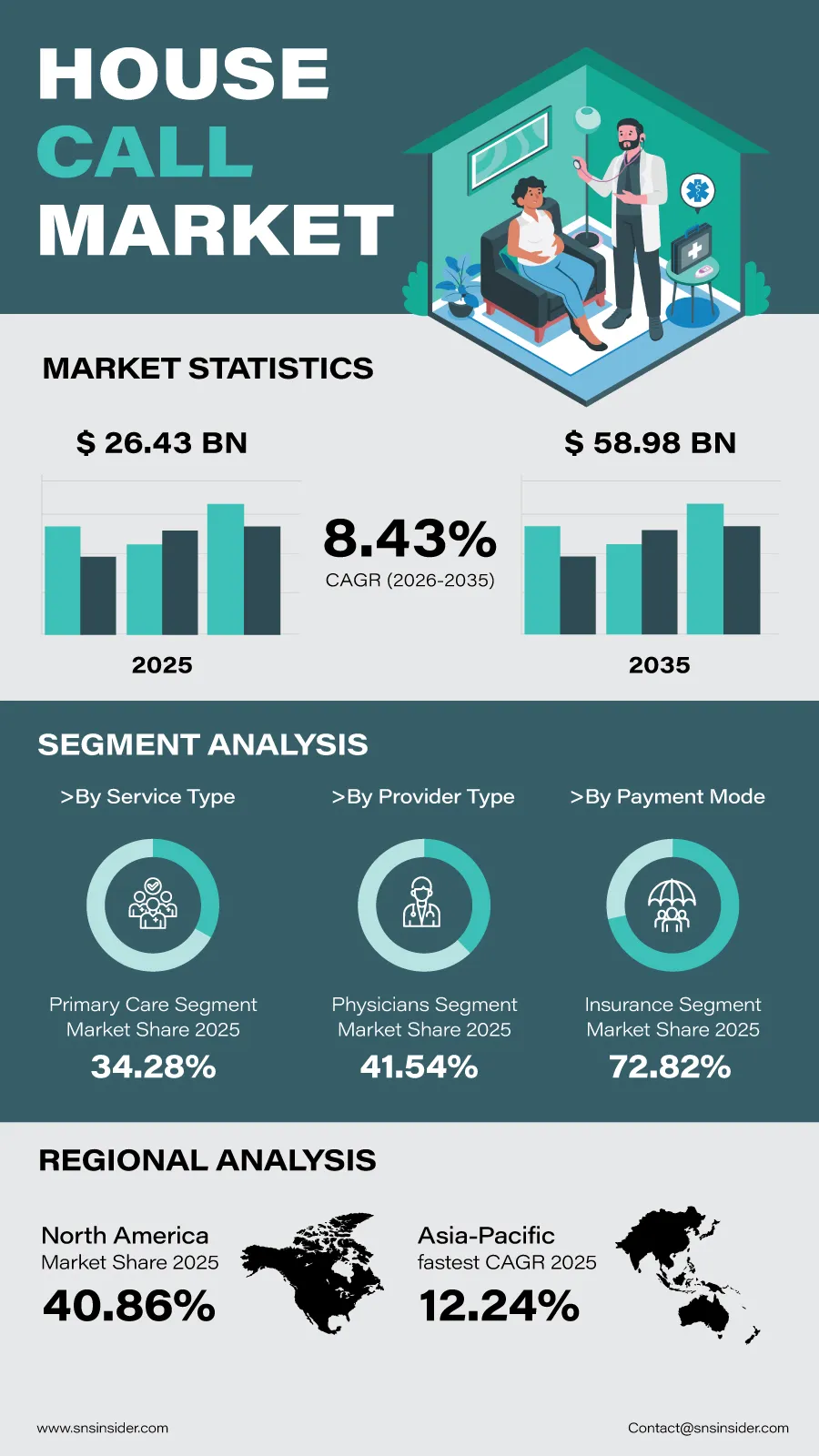
The global House Call Market is poised for significant expansion as healthcare providers increasingly shift toward patient-centric care models that extend clinical services beyond traditional hospitals and outpatient facilities. “According to a recent study by SNS Insider, the global House Call Market size valued at USD 26.43 billion in 2025, is anticipated to grow to USD 58.98 billion by 2035, registering a CAGR of 8.43% over the 2026–2035 forecast period.”
The rapid evolution of connected healthcare technologies, growing healthcare accessibility initiatives and changing patient expectations are transforming the way medical services are delivered around the world. Increasingly, healthcare organizations are investing in integrated care models that combine in-person home visits with digital health solutions, allowing for more convenience while increasing continuity of care.
As populations age and chronic health conditions become more common, the demand for healthcare services that are provided directly to patients’ homes is expected to increase across both developed and emerging economies.
Digital Innovation is Reshaping Home-Based Healthcare
Technology remains a key driver behind the provision of medical services outside the conventional clinical environment. Remote patient monitoring, AI technology, portable diagnosis, and scheduling applications have been increasingly used to enhance efficiency and patient experience.
The use of connected health systems has made it possible for doctors to effectively monitor patients, coordinate treatment with other specialists and manage diseases proactively. Such innovations are also contributing to cutting down unnecessary hospital admissions and increasing accessibility of healthcare services among patients with mobility challenges and chronic conditions.
Virtual consultations and physical appointments at medical facilities will continue to be one of the most significant trends in home-based medicine delivery.
Key Market Insights Highlight Emerging Opportunities
Among service categories, primary care accounted for 34.28% of global market revenue in 2025, reflecting strong patient demand for preventive services, routine health assessments, and long-term disease management delivered at home.
Meanwhile, telemedicine and hybrid house call services are projected to record the fastest growth through 2035, expanding at a CAGR of 9.45%, as healthcare providers increasingly combine digital consultations with in-home clinical care.
By provider type, physicians represented 41.54% of total market revenue in 2025, maintaining their leading role in delivering comprehensive medical services across home healthcare settings. However, nurse practitioners are expected to register the fastest growth, advancing at a CAGR of 11.64%, supported by expanding responsibilities within community-based healthcare delivery.
Payment models continue to evolve alongside healthcare transformation. Insurance-based reimbursement accounted for 72.82% of market revenue in 2025, while out-of-pocket healthcare services are expected to experience continued expansion throughout the forecast period, reflecting increasing consumer willingness to invest in personalized and on-demand medical care.
Among patient demographics, adults aged 19–64 accounted for 41.85% of global market revenue in 2025, whereas the geriatric population is projected to emerge as the fastest-growing segment, recording a CAGR of 16.02% through 2035 as demand for long-term home-based care continues to increase.
Personalized Care Models Gain Momentum
The healthcare systems throughout the world have started giving priority to patient-oriented care delivery models that can help increase convenience and adherence and provide improved healthcare outcomes. Delivery of health care at home is increasingly seen as a vital aspect of the management of chronic diseases, preventive care, post-acute recovery, and clinical practice.
Increased investment in portable healthcare technology, mobile diagnostics, and remote health technology is facilitating the provision of quality healthcare services by providers directly to patients and efficient healthcare resource use.
These developments are expected to strengthen the long-term adoption of home healthcare services across diverse patient populations.
Regional Markets Continue to Expand
North America contributed 40.86% of the total market revenue in 2025 owing to the availability of advanced healthcare facilities, high digital health penetration rate, better reimbursement policies, and increased consumer inclination towards home healthcare services.
Conversely, the Asia Pacific region is expected to witness strong growth during 2026-2035, driven by a CAGR of 12.24%. There are significant growth opportunities in the region due to increased investment in healthcare, urbanization, advanced infrastructure of digital healthcare, and increasing demand for geriatric and chronic illness management services.
Industry Participants Accelerate Innovation
Competition within the house call market continues to intensify as healthcare providers invest in technology-enabled care delivery, geographic expansion, and integrated healthcare solutions that combine virtual and in-person services.
Key companies operating in the global house call market include DispatchHealth, Heal, Teladoc Health, Doctor On Demand, Amwell, MDLIVE, Pager, Visiting Physicians Association, Housecall Providers, and Med2U Inc.
An SNS Insider analyst Parry Kardani commented, "Healthcare delivery is undergoing a fundamental transformation as patients increasingly seek accessible, personalized, and technology-enabled care outside traditional clinical settings. Continued innovation in digital health, remote monitoring, and hybrid care models is expected to create significant opportunities for providers and healthcare technology companies over the coming decade."
An Infographic Representation of the Global House Call Market
About the Author

Get in touch