
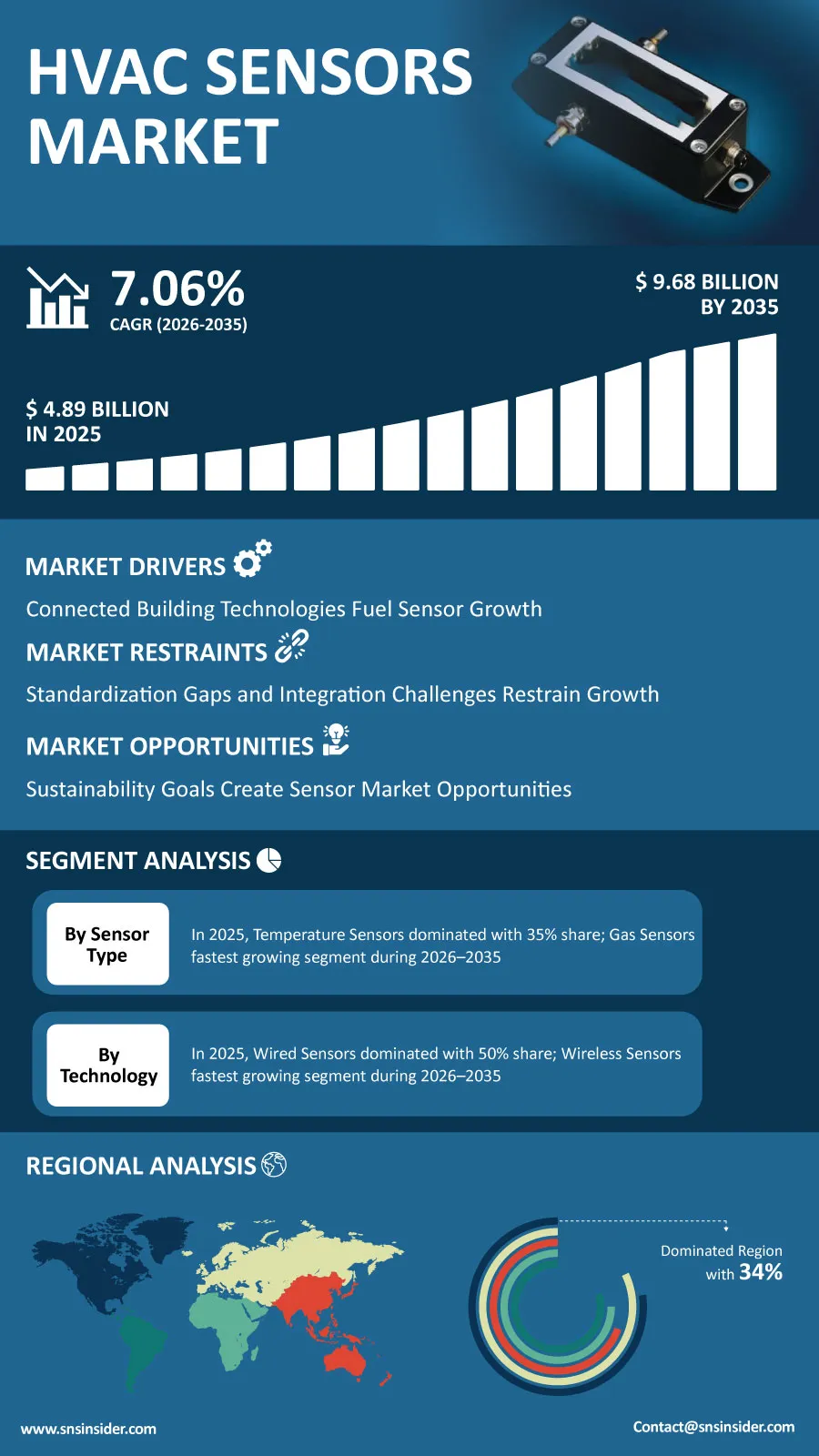
The global HVAC Sensors Market is witnessing steady expansion as building owners, facility operators, and industrial users increasingly prioritize energy optimization, indoor air quality, and intelligent climate control. According to a recent study by SNS Insider, the global HVAC Sensors Market size valued at USD 4.89 billion in 2025, is anticipated to grow to USD 9.68 billion by 2035, registering a CAGR of 7.06% over the 2026–2035 forecast period.
Increasing adoption of connected buildings has brought about an increasing need for sensors that are able to provide precise data regarding temperatures, humidity levels, pressures, airflows, and air quality. The desire to reduce energy usage and increase occupant comfort levels has made sensors for HVAC an increasingly essential part of today’s building automation systems.
In addition to this, the market is gaining due to increased construction activities, renovation projects of buildings, and growing awareness about indoor environmental conditions. The combination of the HVAC sensors with IoT platforms and building management system has taken the functionality of the sensors beyond simple measuring devices to automatic control devices and energy management devices.
To Get Detailed Insights on the HVAC Sensors Market – Request a Sample Report
Smart Building Investments Continue to Create New Growth Opportunities
The changeover to energy efficient buildings around the globe is resulting in investments made in the form of intelligent HVAC infrastructure. There are efforts being made to integrate connected sensors that help detect ways in which HVAC operations can be improved.
There is also growing need for sensing technologies due to sustainability concerns and green building movements. Environmental information allows better management of the systems, improves energy efficiency goals, and maintains a healthier environment inside the buildings.
Wireless connectivity is creating additional opportunities by simplifying installation in retrofit projects and enabling flexible deployment across buildings where conventional wired infrastructure may be difficult or expensive to install.
Key Market Insights Highlight Shifting Demand Patterns
By sensor type, temperature sensors segment accounted for 35% of global market revenue in 2025, supported by their essential role in maintaining desired indoor climate conditions across residential, commercial, and industrial HVAC systems. Gas sensors are projected to be the fastest-growing segment through 2035 as building operators place greater emphasis on indoor air quality and the detection of potentially harmful gases.
Based on application, commercial HVAC systems segment generated 42% of market revenue in 2025, driven by extensive deployment across offices, healthcare facilities, retail properties, and hospitality infrastructure. Industrial HVAC systems are expected to record the fastest growth as manufacturing facilities, warehouses, and production environments increasingly modernize climate-control infrastructure.
By technology, wired sensors segment dominated with 50% market share in 2025, reflecting their established presence in large-scale installations and legacy building systems. Wireless sensors are projected to be the fastest-growing technology category as smart buildings and retrofit projects increasingly demand flexible, scalable, and cost-effective monitoring solutions.
In terms of end user, Building Management Systems segment held 55% of market revenue in 2025 as HVAC sensors remain central to automated monitoring and control. Energy management companies are projected to experience the fastest growth as businesses seek specialized solutions for reducing energy costs and meeting sustainability objectives.
By functionality, monitoring sensors segment dominated with a 48% revenue share in 2025 due to their widespread use in basic environmental and equipment monitoring. Smart and multi-function sensors are forecast to grow at the fastest pace as integrated devices combine sensing, control, and analytical capabilities for connected building applications.
Indoor Air Quality and Energy Efficiency Remain Key Priorities
With the trend towards healthy living indoors, there is increased pressure for the development of sensors that measure air quality parameters together with normal HVAC data. Building operators are increasingly investing in advanced sensors that will be able to detect changes in the environment and better control the building’s ventilation.
However, with high energy costs being a concern for most organizations, there is an increasing pressure on companies to use sensors that allow advanced control of their HVAC system. This would lead to savings in terms of energy consumption.
North America Holds 34% Market Share in 2025 as Asia Pacific Emerges as the Fastest-Growing Region
North America held around 34% of the global market revenue by 2025 due to the high adoption rate of smart buildings, increased efficiency, and the modernization of commercial infrastructure in the region. The high demand for HVAC systems connectivity and indoor air quality monitoring is helping to drive the market forward.
The Asia-Pacific region is expected to grow at the highest CAGR, attributed to urbanization, industrialization, new constructions, and investments in smart infrastructures. Countries like China, India, and Japan have contributed to the growth of the market in the region.
As smart building projects expand across emerging economies, demand for wireless, IoT-enabled, and multi-functional HVAC sensors is expected to accelerate.
Industry Participants Focus on Connected Sensor Innovation
The competitive landscape remains dynamic as manufacturers develop increasingly intelligent sensor platforms designed to integrate with building automation, IoT, and energy management ecosystems. Companies are focusing on wireless connectivity, multifunctional sensing, improved accuracy, and interoperability to address the evolving needs of modern buildings.
Key companies operating in the global HVAC Sensors Market include Honeywell International Inc., Siemens AG, Johnson Controls International, Schneider Electric SE, ABB Ltd., Robert Bosch GmbH, Danfoss Group, Omron Corporation, Azbil Corporation, Sensata Technologies Holding N.V., General Electric Company (GE), E+E Elektronik GmbH, Panasonic Corporation, Delta Electronics, Inc., STMicroelectronics N.V., Texas Instruments Inc., ROHM Semiconductor, Infineon Technologies AG, Allied Electronics & Automation, and Siemens Building Technologies (Siemens Smart Infrastructure Division).
An SNS Insider analyst Sushant Kadam commented, “The shift toward intelligent buildings, tighter energy-efficiency requirements, and greater attention to indoor air quality is creating sustained demand for advanced HVAC sensing technologies. Companies that deliver connected, interoperable, and multifunctional solutions will be well positioned to benefit as building operators accelerate investments in automation and energy optimization.”
About the Author

Get in touch




