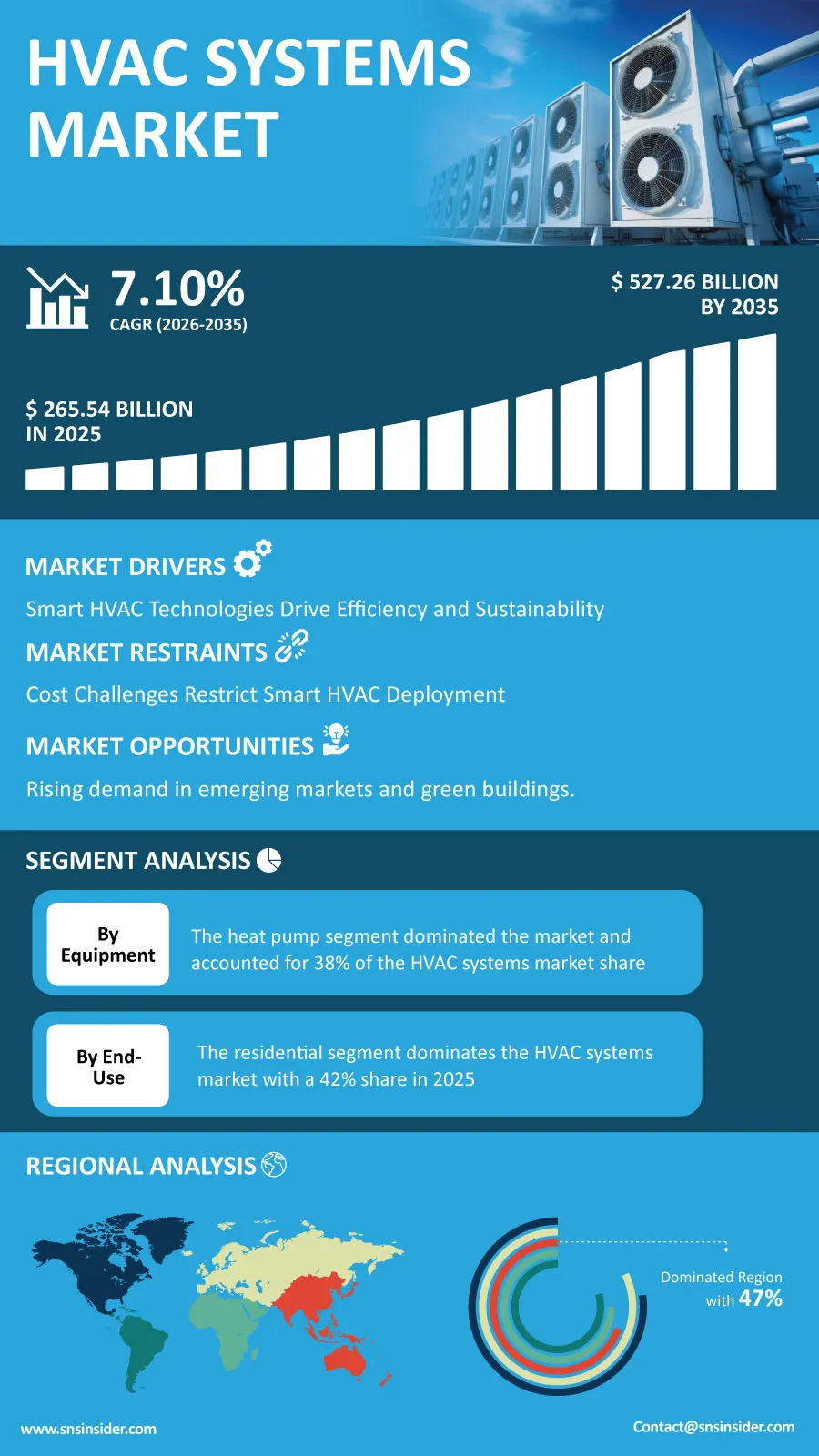
The global HVAC Systems Market is experiencing sustained growth as governments, businesses, and homeowners increase their investments in energy-efficient climate control systems. “According to a recent study by SNS Insider, the global HVAC Systems Market size valued at USD 265.54 billion in 2025, is anticipated to grow to USD 527.26 billion by 2035, registering a CAGR of 7.10% over the 2026–2035 forecast period.”
Increased urbanization, expanded commercial sectors and stringent environmental regulations are leading to the innovative market demand of modernHVAC systems globally. Facilitating HVAC Infrastructure Modernization (Indoor Comfort and Operating Efficiency) To a higher extent, organizations are focused on indoor comfort, operating efficiency, and reduced energy usage translating into widespread upgrading of HVAC systems across residential, industrial as well as commercial establishments.
Manufacturers are also launching intelligent solutions that integrate automation with connected sensors along with digital monitoring features to elevate system performance while keeping operational costs in check. With sustainability goals at the heart of most construction and facility management strategies, demand for next-gen HVAC technology is building across developed and emerging economies.
To Get Detailed Insights on the HVAC Systems Market – Request a Sample Report
Smart Building Investments and Energy Efficiency Drive Long-Term Market Expansion
Your ContentThe changeover to intelligent buildings is opening new avenues for HVAC producers globally. Application owners are deploying more connected climate control systems than ever before.
At the same time, governments are pushing for widespread adoption of greener technologies through more stringent building efficiency standards and carbon reduction initiatives. In particular, these policy measures are accelerating the replacement of aging heating and cooling equipment with cutting-edge systems that will provide better energy efficiency while reducing emissions.
Increased investments in commercial complexes, healthcare facilities, educational institutions as well as data centers and manufacturing plants are also fueling demand for advanced HVAC solutions which provide steady state indoor environmental control against highly variable operating conditions.
Key Market Insights Reflect Changing Customer Requirements
On the basis of end use, in 2025, Residential segment had accounted for 42% revenue share of global market due to increasing home construction & renovation activity along with growing consumer inclination towards energy efficient climate control systems. By 2035, the Industrial segment is projected to be the fastest growing in that manufacturing facilities are continuing to invest in precision temperature and air quality maintenance.
Based on equipment, the Heat Pumps segment accounted for more than 38% of revenue share in 2025 owing to increasing demand for efficient heating & cooling technologies for residential and commercial applications. As global awareness of indoor air quality continues to increase, Air purifiers are expected to witness the highest growth over the forecast period.
Increasing awareness of the environment, growing need to optimize energy costs and advancements in HVAC technology are influencing organizations to invest in integrated systems that can deliver against both sustainability goals and operational performance.
Intelligent Climate Control Technologies Reshape Industry Innovation
You are trained to recognize these things — digital transformation identified as a defining influence on the HVAC industry. Going forward, AI, IoT connectivity and cloud-based analytics tools are providing a new kind of predictive maintenance platform that allow facility managers to track performance in real time and reduce unplanned downtime.
Manufacturers are also focused on inverter technologies, eco-friendly refrigerants and high-efficiency compressors that improve system reliability while minimizing electricity use. These innovations enable building operators to achieve a tightrope walk between occupant comfort and ever-tightening energy efficiency requirements.
Integration of HVAC equipment into larger smart building ecosystems is likely to continue as a technology trend, since many organizations are seeking centralized management of lighting, security, ventilation and energy consumption.
Asia Pacific Accounted for 47% Market Share in 2025; Latin America Forecast to Expand at the Fastest Pace by 2035
Asia Pacific generated 47% of global HVAC systems market revenue in 2025 on account of rapid urbanization, industrial development and large-scale residential & commercial construction activity. China remains the largest regional demand driver as infrastructure continues to develop, with many emerging economies such as India and other influential players now investing in sustainable building technologies.
The research report also offers focused regional upsides exclusive to Latin America that make it the fastest-growing regional market through 2035 due to increasing urban development growing middle-class housing demand and recognition of energy-efficient climate control solutions. The Move Towards Infrastructure Modernization and Increased Construction Activity are Expected to Create Significant Opportunities for HVAC Equipment Suppliers Across the Region
By maintaining North America as a leading market for investment in smart buildings, energy efficiency retrofits, and sophisticated commercial infrastructure. The more stringent environmental laws in Europe also contribute to further dissemination of low-emission heating and cooling technologies
Industry Participants Focus on Sustainable Innovation and Digital HVAC Solutions
Competition in the HVAC systems industry is becoming more intense as companies focus on innovation and the use of environmentally friendly technology. Companies are investing in research and development as well as increasing their production capacity to cater to the rising need for intelligent climate control systems.
Key companies operating in the global HVAC Systems Market include Samsung, Fujitsu, Johnson Controls, Rheem Manufacturing Company, Daikin Industries Ltd., Lennox International Inc., LG Electronics, Mitsubishi Electric Corporation, Haier Group, Carrier Corporation, Havells India Ltd., Trane, Hitachi Ltd., Bosch Thermotechnology, Honeywell International Inc., Ingersoll Rand, Johnson & Johnson, United Technologies, Daikin Applied, and Nortek Global HVAC.
An SNS Insider analyst Santosh Bhul commented, “The growing convergence of energy efficiency, digital building management, and sustainability initiatives is transforming the global HVAC industry. Companies investing in intelligent climate control technologies, connected infrastructure, and environmentally advanced HVAC solutions are expected to strengthen their competitive position as demand for high-performance building systems continues to expand worldwide.”
About the Author

Get in touch