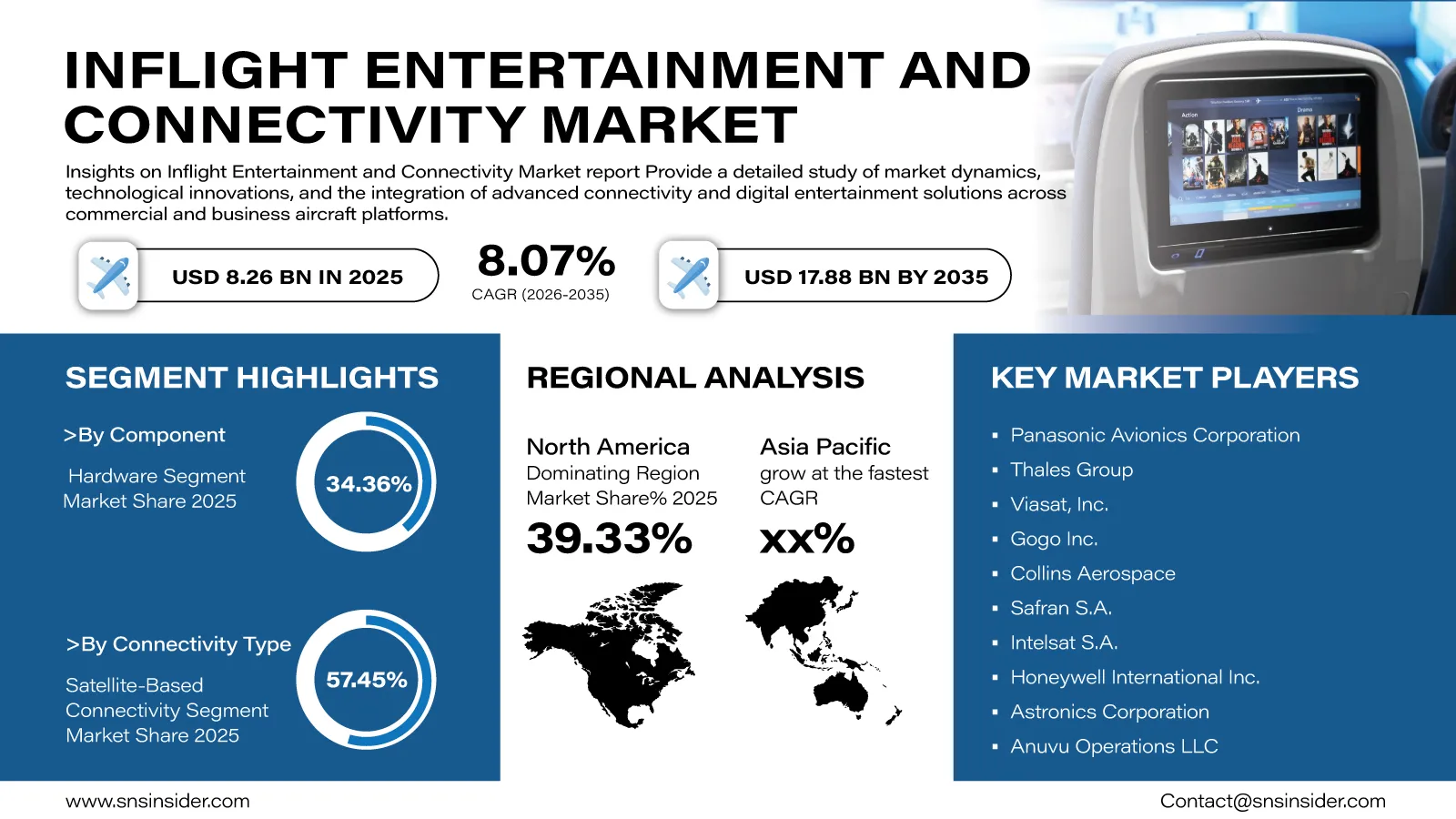
The global Inflight Entertainment and Connectivity Market is projected to register consistent growth in the coming decade owing to increased spending by airlines on cabin electronics technology and passenger engagement systems and advanced inflight connectivity solutions. “According to a recent study by SNS Insider, the global Inflight Entertainment and Connectivity Market size valued at USD 8.26 billion in 2025, is anticipated to grow to USD 17.88 billion by 2035, registering a CAGR of 8.07% over the 2026–2035 forecast period.”
The aviation sector is currently witnessing an immense wave of digital change because of the increasing realization by airlines that connectivity and personalized entertainment are now vital elements of the modern passenger experience. There is increased expectation of having seamless internet services, streaming media, and constant communication which is making airlines embrace digital change in their cabin facilities.
To Get Detailed Insights on the Inflight Entertainment and Connectivity Market – Request a Free Sample Report
On the other hand, aerospace firms, satellite communication firms, and airlines are working together to develop sophisticated digital ecosystems that will be able to facilitate high-speed data transmission. This trend keeps reinforcing the significance of IFEC as an important investment area within the global commercial aviation industry.
Airline Digital Transformation Creates New Growth Opportunities
The passenger expectations have changed over the last decade with passengers demanding similar connectivity during their flight as they get at home. This changing scenario is motivating the airlines to upgrade their cabins with integrated entertainment platforms and broadband connections.
The adoption of the next-generation satellites and the cloud content delivery system and the wireless entertainment platform is allowing the airlines to offer better digital experience to the passengers. Additionally, the adoption of bring-your-own-device is helping airlines lower their equipment weight along with making the content accessible to multiple devices of the passengers.
Fleet modernization programs and retrofit programs continue to present opportunities for IFEC solution providers as they upgrade their fleets without the need for redesigning their cabin interiors.
Key Market Insights Reflect Evolving Passenger Preferences
In the case of component segments, hardware accounted for the highest share of the total revenue in 2025, contributing 34.36% of the worldwide revenue as airlines made investments in servers, antennas, networking systems, and cabin display system components.
It is predicted that the services segment will grow at the fastest pace during the forecast period, registering a CAGR of 8.96% due to rising demands for high-speed broadband internet access from the commercial flights.
On the basis of connectivity technology, satellite connectivity accounted for 57.45% of the overall market revenue in 2025 because of its capacity to deliver reliable coverage on long-haul international flight networks. The hybrid connectivity segment is expected to grow at the highest pace with a CAGR of 10.91%.
The narrow-body aircraft formed the leading aircraft category by generating revenues of 40.85% owing to increased fleet size in the domestic and regional airline segments. In contrast, the business jets will witness the highest rate of growth as there are ongoing investments aimed at improving passenger connectivity.
In terms of offerings, internet connectivity accounted for 36.24% of total market revenue, whereas the greatest rate of growth will be seen in the area of onboard e-commerce and retailing.
An Infographic Representation of the Global Inflight Entertainment and Connectivity Market
Connected Cabins Become Central to Passenger Experience Strategies
The airlines are now distinguishing their brands by making use of digital passenger engagement rather than the traditional in-flight amenities. The entertainment library, instant messaging, cloud computing, and digital travel services are emerging as competitive advantages for full-service and regional airlines.
The development of artificial intelligence is influencing IFEC systems by providing the capacity for recommendation of content, targeted advertisements, multilingual user interfaces, and personal shopping experiences of passengers.
Moreover, advancements in satellite bandwidth, multi-orbit networks, and low latency internet connectivity have made it possible for the airlines to provide consistent internet access across domestic and international routes.
Regional Markets Continue Driving Industry Momentum
North America contributed 39.33% to the total market share in 2025 on the back of its well-developed aviation infrastructure, airline digitization projects, and use of high-bandwidth satellite communication systems. Continued cooperation between the airlines and technology vendors would ensure that this region maintains its dominance in the future.
The Asia-Pacific region was anticipated to be the fastest-growing region with a CAGR of 9.12% from 2025 to 2035. The increasing passenger traffic, expanding fleets of aircrafts, and the demand for travel among the middle classes have encouraged airlines across the region to deploy advanced cabin connectivity solutions.
Investments in connected aircrafts would remain a key focus area for airlines in emerging aviation markets as they look to improve customer experience and develop new revenue streams.
Industry Leaders Accelerate Innovation Across Connected Aviation
The global market for Inflight Entertainment and Connectivity is still very competitive due to continued innovations in communication infrastructure, cloud entertainment system, satellite networks and smart cabin management system by technology vendors. Vendors are giving importance to scalability, cyber security, broadband connectivity, and integration between aircraft and passenger devices in order to cater to emerging needs of airlines.
Key companies operating in the global Inflight Entertainment and Connectivity Market include Panasonic Avionics Corporation, Thales Group, Viasat, Inc., Gogo Inc., Collins Aerospace, Safran S.A., Intelsat S.A., Honeywell International Inc., Astronics Corporation, Anuvu Operations LLC, Lufthansa Systems GmbH, Global Eagle Entertainment Inc., Iridium Communications Inc., EchoStar Corporation, SITAONAIR, Burrana Pty Ltd., Bluebox Aviation Systems Ltd., Kontron AG, ThinKom Solutions, Inc., ST Engineering iDirect, and Aerodyne Group.
An SNS Insider analyst Santosh Bhul commented, "The future of commercial aviation will increasingly depend on digitally connected cabin environments that deliver seamless communication, personalized entertainment, and enhanced passenger engagement. Airlines investing in advanced IFEC platforms today are positioning themselves to improve customer loyalty while unlocking new operational and commercial opportunities throughout the coming decade."
About the Author

Get in touch