
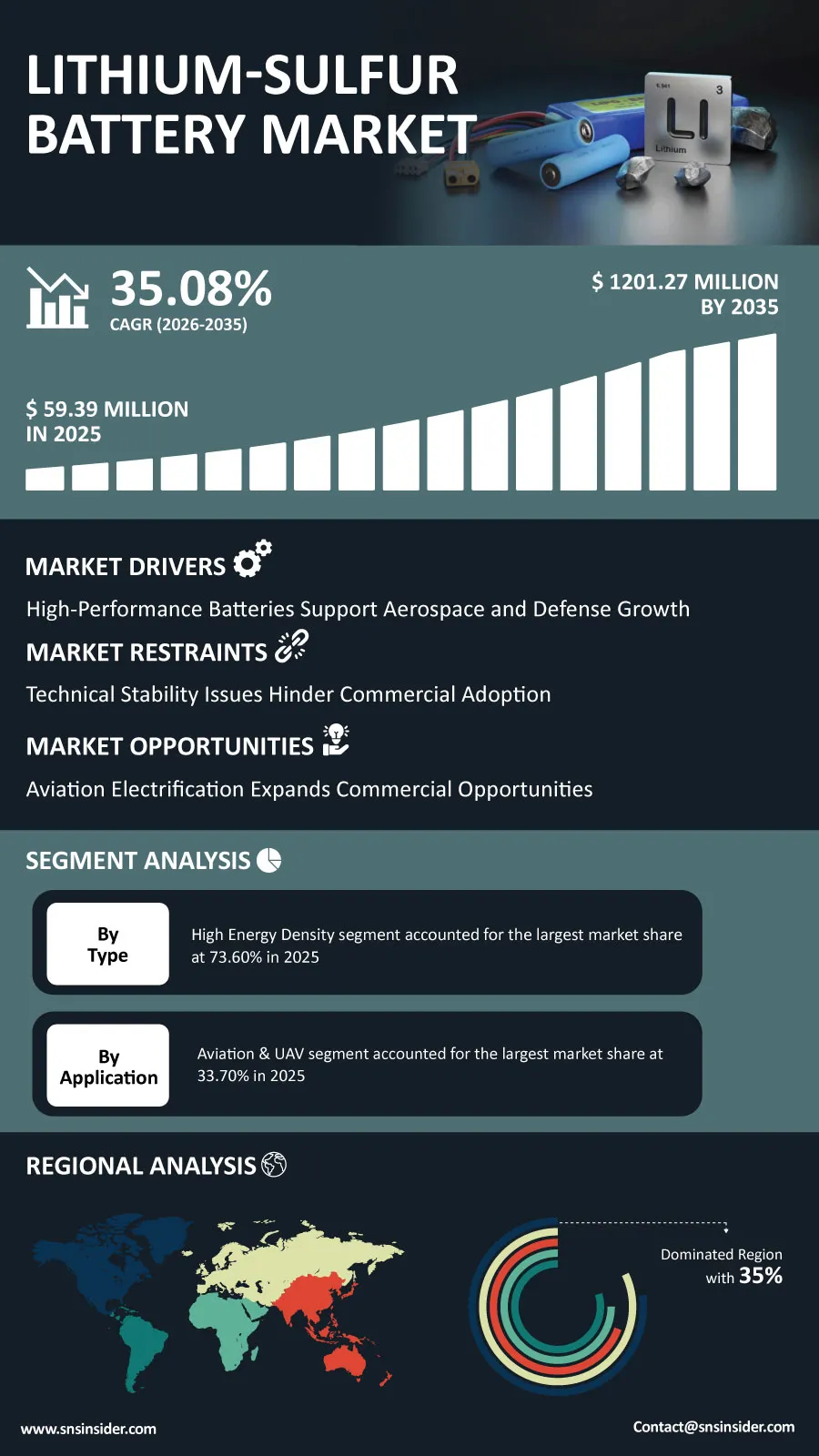
The global Lithium Sulfur Battery Market is entering a high-growth phase as battery developers and technology companies pursue energy storage solutions capable of delivering greater energy capacity with lower weight. According to a recent study by SNS Insider, the global Lithium Sulfur Battery Market size valued at USD 59.39 million in 2025, is anticipated to grow to USD 1201.27 million by 2035, registering a CAGR of 35.08% over the 2026–2035 forecast period.
Increased interest in low-weight power sources is driving scientific work and commercial development in a variety of industries, including aerospace, military, UAVs, and innovative means of electric transportation. Sulfur can serve as an inexpensive material for the cathode, which gives lithium-sulfur batteries an additional cost advantage compared to other battery technologies relying mostly on expensive metal components.
Researchers are shifting their focus from scientific studies to pilot-level production and technology applications. Progress in electrode engineering, electrolytes composition, and lithium metal shielding is assisting in solving technical challenges that limited widespread use of lithium-sulfur batteries in the past.
To Get Detailed Insights on the Lithium Sulfur Battery Market – Request a Sample Report
Advanced Battery Development Opens New Commercial Opportunities
In connection with the global trend towards electrification, there is an emerging need for batteries capable of providing increased energy density while decreasing the overall system’s weight. The issue becomes especially relevant for aircraft, drones, and military vehicles, among others, where battery weight influences the distance traveled and payload size.
At the same time, there is a growing number of companies willing to invest in the scaling up of production and commercialization efforts in the field. With the advances in the technology of manufacture, lithium-sulfur batteries might be applied in other industries, especially if there are some improvements concerning their life cycle performance and reliability.
The expanding electric aviation ecosystem represents another important opportunity. Lightweight batteries could help support longer flight durations and greater payload capacity for electric aircraft and advanced air mobility platforms.
Key Market Insights Highlight Shifting Demand Patterns
By type, high energy density batteries segment accounted for 73.60% of global market revenue in 2025, reflecting strong demand from performance-sensitive applications where minimizing battery weight is essential. Meanwhile, low energy density batteries are projected to be the fastest-growing segment, registering a CAGR of 37.80% through 2035 as advances in manufacturing enable applications in compact electronics, sensors, and medical devices.
Based on capacity, the above 1000 mAh segment held the dominant position in the market in 2025, supported by demand from aerospace systems, electric mobility, and high-power unmanned platforms. The below 500 mAh segment is expected to record the fastest growth at a CAGR of 37.38% as compact, lightweight battery solutions gain traction in portable electronics, miniature sensors, and specialized equipment.
In terms of application, aviation and UAVs segment dominated with a 33.70% revenue share in 2025. The segment is also expected to maintain the strongest growth trajectory through 2035 as operators seek greater flight endurance without adding significant battery weight.
By end use, aerospace segment led with 31.60% of market revenue in 2025 and remain the fastest-growing end-use category through the forecast period. Automotive and energy storage applications represent additional long-term opportunities as developers work to improve cycle life and operating stability.
Energy Density and Weight Reduction Remain Central to Adoption
The capacity to hold a considerable amount of energy without considerably adding mass to the system continues to be the most appealing factor about the lithium-sulfur batteries. This benefit becomes especially important for endurance drones, airplanes, military systems, and other mobility devices because each additional kilogram counts.
On the other hand, scientists continue their research efforts to find a solution to the problem of the polysulfide shuttle. Improvements in cathode technology, protective coatings, electrolyte composition, and solid-state methods will likely prove crucial in solving the problem.
North America Accounts for 37% Market Share in 2025 Amid Rising Investments in Next-Generation Batteries
North America is likely to continue as the biggest market region due to high funding for research, requirements from the defense industry, development capability of batteries, and increased investments in the sector. In 2025, the U.S. was responsible for 37% of worldwide market revenues and remains a significant center of lithium-sulfur innovations.
The fastest growth over the next decade will be recorded in Asia Pacific due to the well-developed infrastructure for battery production, growing electric vehicles industry, and government funding of studies on future energy sources. China, Japan, and South Korea will increase investments in advanced batteries along with promoting electric aircraft and unmanned vehicles.
Industry Participants Focus on Commercialization and Battery Innovation
The competitive landscape is evolving rapidly as battery developers, automotive companies, aerospace organizations, and research institutions pursue breakthroughs in energy density, cycle life, safety, and scalable manufacturing. Companies are increasingly prioritizing pilot-scale production, strategic partnerships, and application-specific testing to accelerate the transition from experimental cells to commercial products.
Key companies operating in the global Lithium Sulfur Battery Market include Sion Power Corporation, OXIS Energy, Lyten, Inc., PolyPlus Battery Company, NexTech Batteries, Gelion Technologies PLC, LG Energy Solution, Samsung SDI Co., Ltd., Panasonic Energy Co., Ltd., Amprius Technologies, CATL (Contemporary Amperex Technology), BYD Co., Ltd., Giner, Inc., Zeta Energy LLC, and Li-S Energy Limited.
An SNS Insider analyst Sushant Kadam commented, “The exceptional energy-to-weight potential of lithium-sulfur chemistry is creating strong interest across aerospace, defense, UAV, and emerging electric mobility markets. Continued progress in cycle stability, lithium-metal protection, and scalable manufacturing will be critical in determining how quickly the technology moves from specialized deployments toward broader commercial adoption.”
About the Author

Get in touch




