
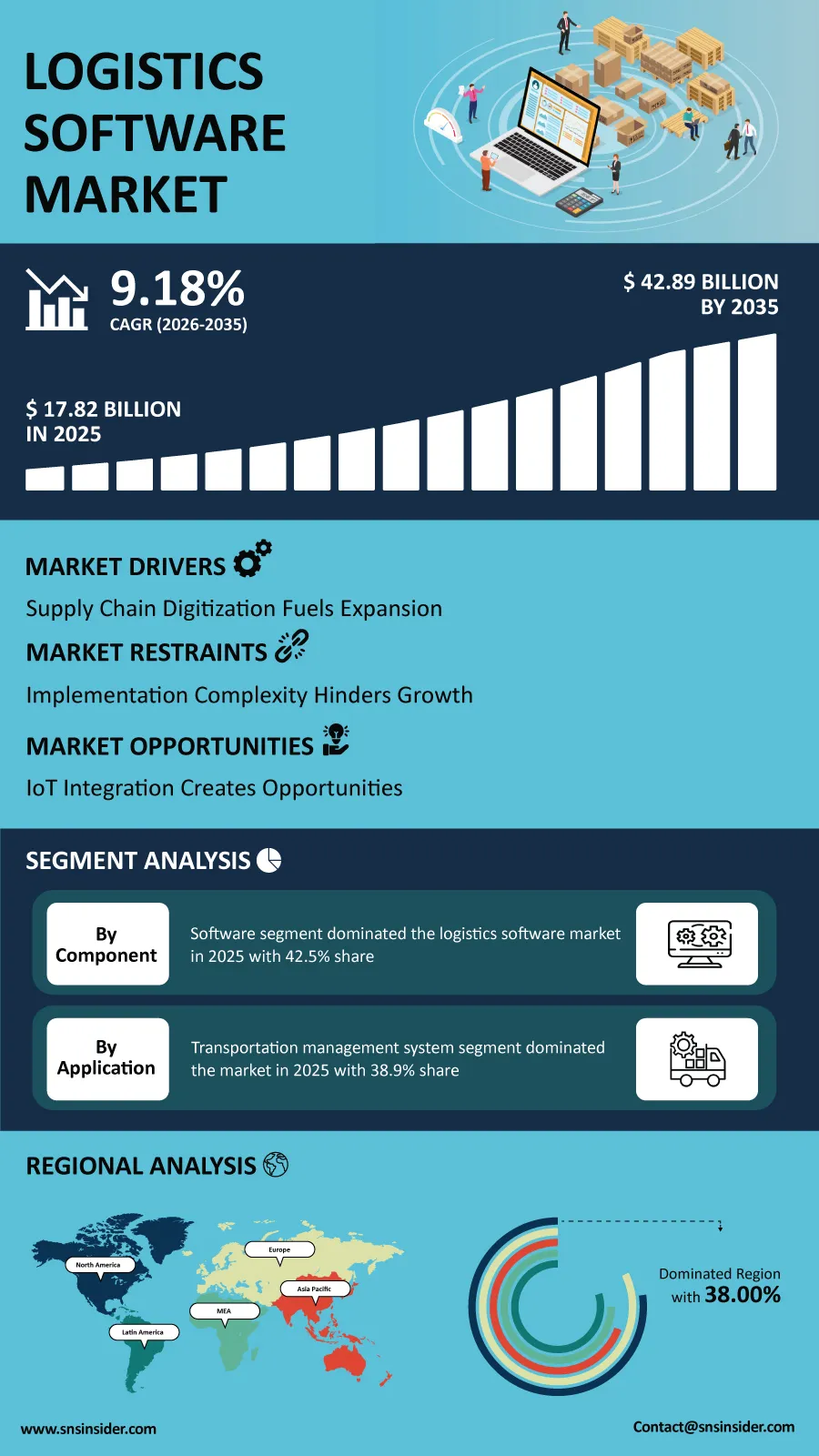
The global Logistics Software Market is anticipated to register remarkable growth owing to rapid digitization in logistics-related businesses such as transportation, warehousing, and supply chains. “According to a recent study by SNS Insider, the global Logistics Software Market size valued at USD 17.82 billion in 2025, is anticipated to grow to USD 42.89 billion by 2035, registering a CAGR of 9.18% over the 2026–2035 forecast period.”
The fast pace of development in international business and increasing consumer demands for speedy deliveries drive companies to integrate modern logistics processes with the help of advanced software systems. Companies are using digital technologies to gain better visibility of shipments, automate their processes, and optimize their transportation networks while remaining efficient.
More widespread use of such tools as cloud computing, artificial intelligence, machine learning, and Internet of Things (IoT) are also influencing the field of logistics management. Companies are using predictive analytics, automated routing, inventory intelligence, and fleet tracking to cut down on expenses and improve accuracy of deliveries.
To Get Detailed Insights on the Logistics Software Market – Request a Sample Report
Digital Supply Chain Transformation Creates Long-Term Growth Opportunities
Across retail, manufacturing, healthcare and third-party logistics companies are investing in best-of-breed advanced logistics software for end-to-end supply chain visibility. The trend of buying online and shipping globally continues to drive a consistent demand for seamless transportation, warehouse and inventory management platforms with the ability to accommodate ever-evolving logistics ecosystems.
Cloud Native logistics platforms are empowering companies to scale their operations efficiently and get better multi location supply chain flexibility. Companies are also deploying AI-driven decision support systems that optimize commodity circulation, predict how demand will change from one period to another and maximize resource utilization in logistics networks.
Business sustainability is another growth area for software vendors, with new solutions designed around carbon measurement and management, green media and fuel efficiency optimization, intelligent route planning, as well the eco-friendly transportation market. With sustainability goals taking a front seat at enterprises, software-driven logistics optimization must be incorporated as an operational efficiency lever.
Key Market Insights Highlight Shifting Demand Patterns
Depending on the component type, the industry is anticipated to account for 42.5% of global revenue share in 2025 primarily because software stimulates transportation planning & optimization, warehousing, inventory control and order management amid contemporary supply chains. Based on type of organization the services segment will see high adoption in coming years to 2035, due as the organizations across various industry verticals need implementation and consulting and integration services along with required training for advanced logistics platform also managed support service.
On the basis of deployment mode, cloud-based solutions account for 47.3% of overall market revenues by 2025 owing to enhanced scalability, lower infrastructure expenditure, rapid solution deployment and real-time accessibility across distributed operations. Hybrid deployment, on the other hand, is projected to register a healthy CAGR due to increasing tendency for enterprises to balance cloud versatility with on-premises security and compliance regulations in the forecast years.
As per application, in 2025, transportation management systems (TMS) accounted for 38.9% market share on the basis of rising demand for route optimization, shipment visibility & tracking, freight planning and control costs. Fleet management systems can register the highest growth through to 2035 as logistics providers continues to adopt smart vehicle tracking, predictive maintenance, fuel optimisation and driver behaviour solutions.
End user-wise, the retail and e-commerce segment is expected to capture 36.7% of market revenue share in 2025, aided by burgeoning online shopping activity and increasingly sophisticated fulfillment operations. The healthcare segment is projected to grow at a high pace owing to the growing adoption of digital logistics platform by medical supply chains for better inventory accuracy, regulatory compliance and distribution of temperature sensitive products.
Intelligent Logistics Technologies Accelerate Industry Transformation
By this point, logistics software is an archetype of fast-evolving technology since providers are rapidly integrating artificial intelligence, predictive analytics, IoT-connectivity and automation into supply chain management platforms. These technologies help organizations in enhancing shipment visibility, automating manual processes, maximizing warehouse operations and making data-driven logistics decisions in real-time.
Even manufacturers and logistics service providers have started to deploy digital twins, AI-powered forecasting models and cloud-based collaboration platforms to bolster supply chain resilience while more effectively responding to dynamic changes in customer demand and global trade. These innovations are enabling enterprises minimize risks in their logistics operations while empowering them to provide faster and seamless services.
North America Held 38% of the Logistics Software Market Share in 2025; Asia Pacific Projected to Register the Fastest CAGR Through 2035
Due to a mature logistics infrastructure, high penetration of enterprise software, growth in the e-commerce ecosystem and few key logistics technology providers being based in North America, this region is expected to account for 38% of global total market revenues by 2025. Continues to drive regional growth through freight digitalization and intelligent transportation management solutions investment in the US US
Asia Pacific is estimated to be the fastest growing regional Market in the next decade till 2035. China, India and Southeast Asia are seeing some of the most significant investments in digital logistics infrastructure spurred by rapid industrialization, rising manufacturing activity, explosive growth in e-commerce and accelerated cloud adoption.
Europe continues to be a key growth driver for the market, as companies improve supply chain visibility, freight optimization and sustainability initiatives due to changing legislative requirements. At the same time, increasing trade volumes throughout the Middle East, Africa and Latin America are providing further opportunities for logistics software implementation as organizations update transportation and warehouse operations.
Industry Participants Focus on Innovation and Intelligent Supply Chain Solutions
The competitive environment continues to be dynamic as leading software vendors invest in cloud-enabled logistics platforms, artificial-intelligence (AI)-enabled transportation management systems, predictive analytics, warehouse automation and end-to-end supply chain visibility solutions. Companies use continual R&D, corporate partnerships and expansion of their platforms to constantly fulfil the rising needs of diverse industries for intelligent, scalable and data-driven logistics solutions across the globe.
Key companies operating in the global Logistics Software Market include SAP SE, Oracle Corporation, Manhattan Associates, BluJay Solutions, Descartes Systems Group, WiseTech Global, Blue Yonder Group, Samsara Inc., Ramco Systems, PTV Group, 4flow, Alpega TMS, Magaya Supply Chain, LogiNext Mile, HighJump (Körber), Infor, 3GTMS, Kinaxis Inc., Epicor Software Corporation, and JDA Software (Blue Yonder).
An SNS Insider analyst Sakshi Kale commented, "The accelerating digital transformation of global supply chains, combined with rapid advancements in artificial intelligence, cloud computing, and real-time analytics, is reshaping logistics operations across industries. Organizations investing in intelligent logistics software platforms that enhance visibility, automation, and operational efficiency will be well positioned to capitalize on the next phase of global supply chain modernization."
About the Author

Get in touch




